

Breast implant replacement at a glance
- Duration1 hour to 2.5 hours
- AnaesthesiaGeneral
- Hospital stayDay surgery or one night
- Time off work7 to 15 days
- Final shape3 months
- Price€3,000 to €10,000
Breast implant replacement replaces implants that are causing a problem (rupture, capsular contracture, rotation, rippling, poor position) or whose volume the patient wishes to change. It is not automatic after 10 years. The capsule surrounding the old implant is usually removed, and the pocket can be corrected. The operation lasts 1 hour to 2.5 hours under general anaesthesia, as day surgery or with a one-night stay at Clinique Oxford in Cannes.
Price: €3,000 to €10,000, implants included, on a written quote after a consultation (€100).
Do breast implants need to be replaced after 10 years?
No. A silicone gel implant lasts 12 to 15 years on average, but it does not expire on a fixed date. As long as it is intact and you are happy with the result, a clinical check-up and imaging every two years are enough.
Replacement is decided for a reason: a rupture, capsular contracture, a deformity, or your wish to change size. Only PIP implants must be removed as a precaution; the ANSM (French medicines safety agency) does not recommend it for macrotextured implants that cause no symptoms.
When should breast implants be replaced?
Your situation
An implant is not replaced on a fixed date: its average lifespan is 12 to 15 years. A clinical check-up and imaging every two years are enough as long as it is intact and you are happy with the result.
This diagram summarises the most common situations; it does not replace a consultation.
| Reason | Signs | What is done | Find out more |
|---|---|---|---|
| Rupture | Often none; sometimes a change in the breast, a lump, pain | Both implants replaced, capsule removed | Further down this page |
| Capsular contracture, grades III and IV | Hard, misshapen breast, sometimes painful | Total capsulectomy, antibiotic irrigation, new implants, change of pocket if needed | Capsular contracture |
| BIA-ALCL or late seroma | Breast that swells years after the implants were placed | Removal of the implants and total capsulectomy, on both sides | Lymphoma and implants |
| Rotation | Anatomical implant that turns: the fullness of the breast moves to the side or to the top | Replacement with a round implant | Rotation |
| Rippling, visible implant | Visible folds, especially in the cleavage | More cohesive gel, change of pocket, fat transfer or dermal matrix | Rippling |
| Double bubble, implant too low | Double fold under the breast | Reconstruction of the fold, change of pocket, dermal matrix | Double bubble |
| Changing size | Wish for a larger or smaller volume | New implants; a breast lift if the volume is reduced a great deal | Choosing implant size |
| PIP implants | No sign needed | Preventive removal, new implants if you wish | Further down this page |
If you no longer want implants, they can also be removed without being replaced: see breast implant removal.
How can you tell if a breast implant has ruptured?
A rupture often goes unnoticed: it is found on routine surveillance imaging. It can also show as a change in the shape of the breast, a lump or pain.
Intact implant: the shell is smooth and the cohesive silicone gel stays inside. The body forms a thin membrane around it, the capsule.
| Signs | None |
|---|---|
| Imaging | Check-up every two years |
| Driving | Monitoring |
- 1Capsule around the implant
- 2Silicone gel and implant shell
- 3Gel outside the capsule
Gel bleed
Before any rupture, the intact shell can slowly let through tiny amounts of gel, which settle in the capsule. This bleed is slight with today’s cohesive gels and does not on its own justify replacement.
Intracapsular rupture
The implant shell is split, but the gel stays contained within the capsule. With a cohesive silicone gel, this is the most common form; the breast often keeps its appearance.
Extracapsular rupture
The gel has passed through the capsule and can migrate into the breast, sometimes as far as the lymph nodes in the armpit. Replacement is then more urgent, and the gel is removed with the capsule.
Saline-filled implants
The saline leaks out and the body absorbs it: the breast deflates within a few days, which makes the rupture obvious.
The reference examination is ultrasound, supplemented by an MRI if there is any doubt. If there is a rupture, both implants are replaced, even if only one has ruptured.
Implant replacement for capsular contracture
At grades III and IV, the breast is hard and misshapen. The operation involves complete removal of the capsule (total capsulectomy), thorough irrigation of the pocket with an antibiotic solution, new implants and, if needed, a change of pocket, for example from in front of the muscle to dual plane. These steps reduce the risk of recurrence. Everything about capsular contracture.
Lymphoma (BIA-ALCL) and late seroma
A breast that swells several years after the implants were placed needs a prompt consultation: an ultrasound and aspiration of the fluid look for BIA-ALCL. At an early stage, the treatment is removal of the implants and complete removal of the capsule, on both sides. No new implant is placed at the same time; new implants or fat transfer are discussed once the condition has been cured. Everything about lymphoma and implants.
PIP implants
Preventive removal of PIP implants is recommended, even without a rupture. New implants can be placed if you wish.
Rotation, rippling and double bubble
- Rotation: an anatomical implant that has turned often turns again. The definitive treatment is to replace it with a round implant, which can turn without distorting the breast. Everything about rotation.
- Rippling: implants with a more cohesive gel, smooth or microtextured, or moving them behind the muscle, reduce visible folds. Fat transfer or an acellular dermal matrix can thicken the tissues. Everything about rippling.
- Double bubble: the fold is rebuilt at the right height by suturing the capsule (capsulorrhaphy), a capsule flap or a dermal matrix, with a change of pocket if needed. Everything about double bubble.
Changing size
Replacement allows you to move to a larger or smaller volume. For a markedly smaller volume, the skin stretched by the old implant may require a breast lift at the same time. For a larger volume, the measurements of the breast set the limit: an implant wider than the breast shows and thins the tissues. Choosing the size of your implants.
What can be corrected at the same time?
| Additional procedure | When? |
|---|---|
| Change of pocket (from in front of the muscle to dual plane) | Capsular contracture, rippling, visible implant |
| Breast lift | Sagging breasts, areolas too low |
| Breast fat transfer | Thin tissues, cleavage to fill, implant edges to conceal |
| Acellular dermal matrix | Very thin tissues, rippling, fold to rebuild |
| Correction of an asymmetry | Implants of different volume or profile |
Which new implant?
Dr Médard de Chardon places round implants in cohesive silicone gel, smooth or microtextured. Anatomical implants are replaced with round implants, and macrotextured implants with surfaces authorised in France. You leave with the implant card for your new implants.
Why is implant replacement more demanding than a first augmentation?
- The tissues have been altered by the old implant: stretched skin, thinned gland, thickened or calcified capsule.
- The pocket often has to be repaired or moved, not simply reused.
- The cause of the problem must be treated, otherwise it recurs: capsular contracture, rotation or a double bubble are not corrected by changing the implant alone.
Dr Médard de Chardon’s experience in secondary implant surgery
- MD thesis on breast augmentation with implants (Nice Faculty of Medicine, 2008): less than 1% capsular contracture and 6.2% rotation of macrotextured anatomical implants in this series.
- More than 1,500 implants replaced; management of complications and revisions: capsular contracture, double bubble, rotation, rippling, PIP implants.
- Qualified plastic surgeon in plastic, reconstructive and aesthetic surgery; practising in Cannes since 2011.
- Member of SOFCEP, ISAPS and the Rhinoplasty Society of Europe.
How does implant replacement work?
- First consultation€100 at the practice, 101 rue d’Antibes in Cannes: history of your implants (date, brand, volume, position, approach), examination, photos, trial sizers. Bring your implant card and your latest scans. A first consultation by video call is possible if you live far away.
- ImagingUltrasound and mammogram, MRI if a rupture is suspected.
- Second consultationChoice of the new implant, the pocket and any additional procedures; detailed written quote.
- Cooling-off periodAt least 15 days, required by law, between receiving the quote and the operation.
- PreparationAnaesthetic consultation, stopping smoking and aspirin.
- OperationAt Clinique Oxford in Cannes, 1 hour to 2.5 hours under general anaesthesia, usually through the scar from the first operation. The capsule removed is analysed in the laboratory; a drain is placed after a capsulectomy.
- Follow-upCheck-ups at 6 days, 3 weeks, 3 months, 6 months and 1 year, then every two years with imaging.
What is the recovery like after implant replacement?
Recovery is similar to that after a first augmentation, a little longer when a capsulectomy or a change of pocket has been carried out.
- Day 0: operation, home the same evening or the next day.
- 6 days: first check-up.
- 7 days: back to driving.
- 7 to 15 days: back to work.
- 4 weeks: non-wired bra, lower-body exercise.
- 6 weeks: upper-body exercise.
- 3 months: final shape, check-up.
- 12 months: final scars, check-up.
Where will you be?
14 days after the procedure
What are the risks of implant replacement?
In addition to the risks of any surgery (haematoma, infection, anaesthesia), replacement carries the same risks as a first augmentation, plus two specific risks:
- recurrence of the problem treated (capsular contracture, double bubble, rotation), all the rarer when its cause has been corrected;
- seroma: fluid around the new implant, particularly after a capsulectomy, hence the drain.
The risks of a first augmentation (capsular contracture, rippling, double bubble, Mondor’s disease, milk discharge, BIA-ALCL) are described on the breast augmentation page.
Choosing a qualified, experienced and reputable surgeon reduces these risks.
Before and after photos
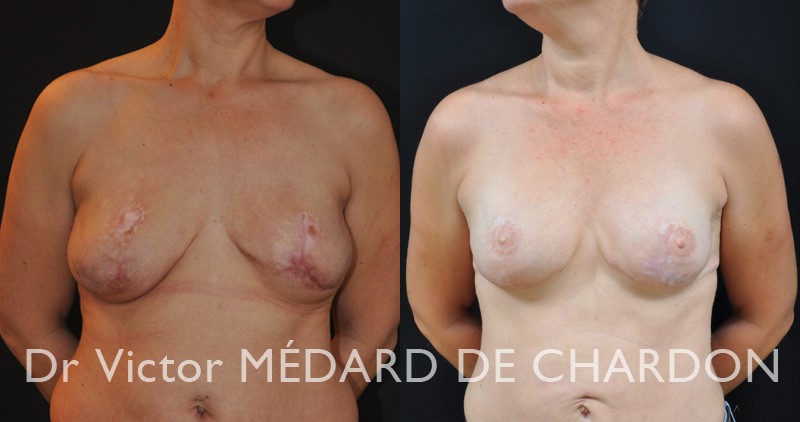
Breast reconstruction after cancer
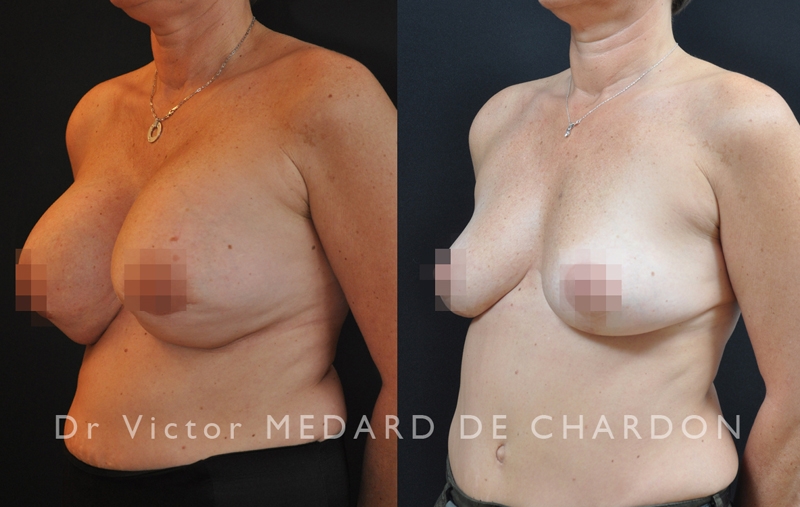
Secondary breast implants
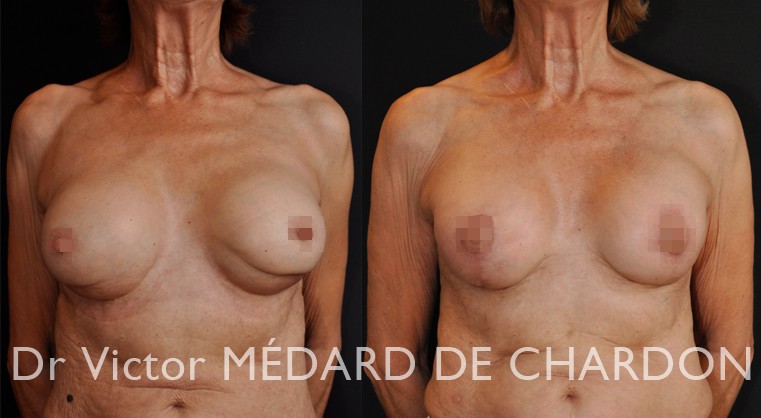
Secondary breast implants
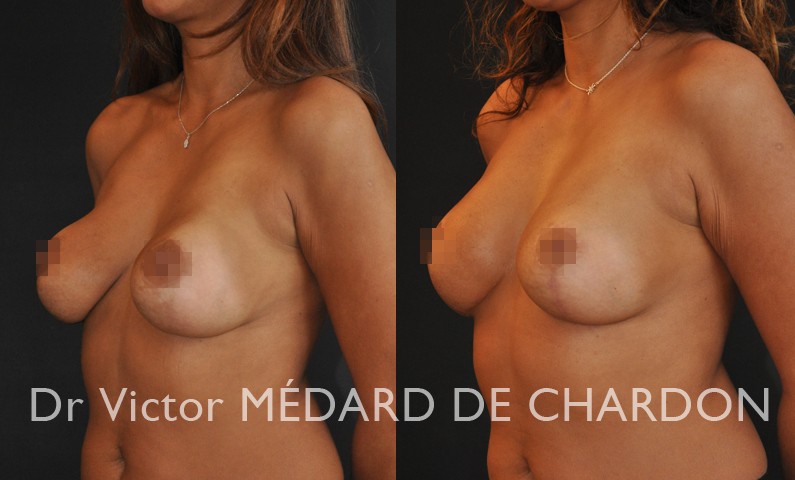
Breast lift
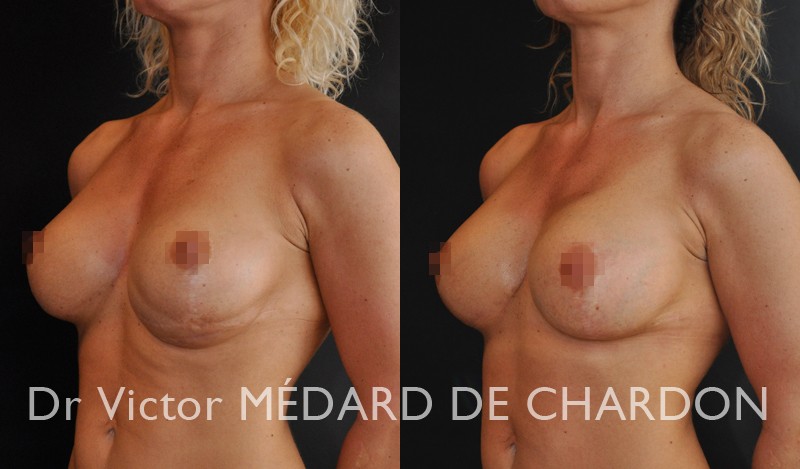
Secondary breast implants
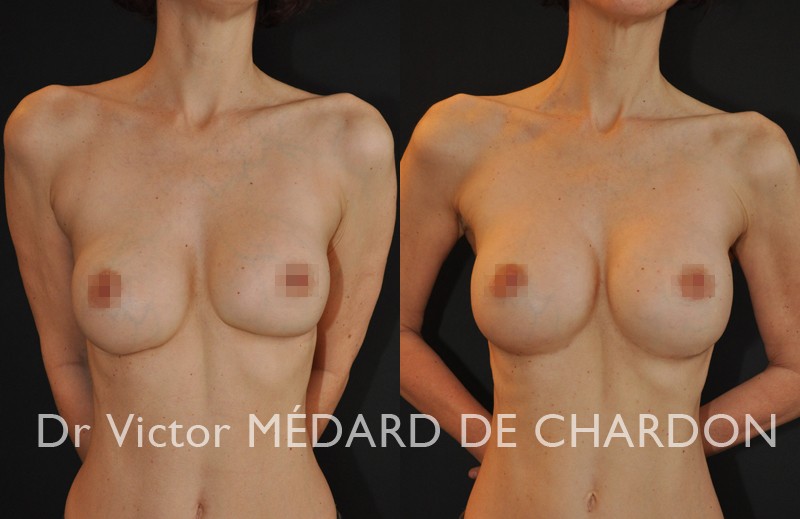
Secondary breast implants
See all before and after photos of breast implants
How much does breast implant replacement cost in Cannes?
€3,000 to €10,000
Implants included. The exact price is shown on the detailed written quote given after the consultation (€100, free for a patient already followed at the practice). Cover by Assurance Maladie (French national health insurance) is possible only if the original implant operation was itself covered (for example a reconstruction after cancer), in the case of BIA-ALCL, or for PIP implants; in these last two cases, only the removal is covered, not the new implant. A rupture or capsular contracture after a cosmetic augmentation does not qualify for cover. Dr Médard de Chardon practises in Sector 2 (fees above the national health insurance rate), not OPTAM-registered. Book on Doctolib or call +33 (0)4 93 68 86 68.
Frequently asked questions about breast implant replacement
Do breast implants need to be replaced every 10 years?
No. A silicone gel implant lasts 12 to 15 years on average; as long as it is intact and you are happy with the result, a clinical check-up and imaging every two years are enough.
How long does a breast implant last?
On average 12 to 15 years for a silicone gel implant. This is not an expiry date: some last much longer, others rupture sooner.
How can I tell if my breast implant has ruptured?
Most often a rupture gives no sign and is found on the routine surveillance ultrasound, supplemented by an MRI if needed. A change in the breast, a lump or pain should prompt a consultation.
Is a ruptured implant dangerous?
A rupture is not a life-threatening emergency, but it justifies replacement. The cohesive gel usually stays contained within the capsule; if it escapes, it can migrate into the breast or towards the armpit.
Can you change size when implants are replaced?
Yes, to a larger or smaller volume. A large reduction in volume may require a breast lift at the same time.
Can implants be replaced through the same scar?
Usually yes, through the scar from the first operation. An en bloc capsulectomy or a correction of the fold may require a scar under the breast.
Is breast implant replacement reimbursed?
No, unless the original implant operation was covered. In the case of BIA-ALCL or PIP implants, the removal is covered, but not the new implant.
How much does breast implant replacement cost in Cannes?
€3,000 to €10,000, implants included. The exact price is shown on the detailed written quote given at the consultation (€100).
References
- Médard de Chardon V. MD thesis on breast augmentation with implants. Nice Faculty of Medicine, 2008.
- ANSM. Decision of 2 April 2019: withdrawal from the market of macrotextured breast implants and polyurethane-coated implants; preventive explantation not recommended.