Rhinoplasty at a glance
- Duration1.5 to 3 hours
- AnaesthesiaGeneral
- Hospital stayDay surgery or 1 night
- Social downtime≈ 10 days
- Final resultAt 1 year
- Price€6,000 to €10,000
Rhinoplasty changes the shape of the nose (hump, tip, length, width) and can improve breathing at the same time. It is suitable for adults and for teenagers from the age of 16. The operation takes 1.5 to 3 hours, most often under general anaesthesia, as day surgery or with one night’s stay at Clinique Oxford in Cannes. A nasal splint is worn for 7 to 10 days, with no nasal packing in more than 95% of cases. Social downtime is about 10 days; the final result can be assessed at 1 year, and it is long-lasting.
Price: €6,000 to €10,000, on a written quote after a consultation (€100).
Why is rhinoplasty such a demanding operation?
The nose is at the centre of the face: a difference of 1 to 2 millimetres at the tip or along the bridge shows from the front as well as in profile.
- Form and function are linkedEvery step on the bone or cartilage also affects breathing (septum, nasal valves). A refined nose that breathes less well is a failure.
- The structures are very smallCartilages of just a few millimetres, under skin whose thickness hides or reveals every detail.
- The result evolves over a yearHealing and the gradual resolution of swelling change the nose for months: the final result has to be anticipated in the operating theatre.
- Every nose is differentThick or thin skin, ethnic nose, injured nose: the surgical plan is built for each patient.
- Revision is more difficultIn a nose that has already been operated on, cartilage is missing or scarred and the skin has contracted: cartilage grafts are often needed.
Rhinoplasty therefore calls for specific training, precise knowledge of the anatomy of the nose and regular practice.
Dr Médard de Chardon’s experience in primary and revision rhinoplasty
- Member of the Rhinoplasty Society of Europe (RSE)
- Dallas Rhinoplasty Symposium, Rhinoplasty Video Symposium (Paris), Bergamo Open Rhinoplasty Course
- University diploma (DU) in facial plastic surgery (Lyon)
- Former anatomy prosector and former Chef de Clinique (university hospital senior registrar), Nice Faculty of Medicine
Primary, revision, functional or non-surgical rhinoplasty: what are the differences?
| Primary | Revision | Functional | Non-surgical | |
|---|---|---|---|---|
| Aim | Change the shape of the nose (hump, tip, width, length) and breathing if needed | Correct the cosmetic or breathing result of a previous rhinoplasty | Improve breathing (deviated septum, turbinates, nasal valves) | Correct a small imperfection (slight hump, dip, asymmetry) without surgery |
| Technique | Ultrasonic, preservation, closed or open approach | Open approach, structural technique, cartilage grafts | Septoplasty, turbinoplasty, treatment of the valves | Hyaluronic acid injection |
| Scar | None visible (closed approach) or a small scar under the columella (open approach) | Small scar under the columella, plus that of the cartilage harvest if any | None visible | None |
| Duration | 1.5 to 3 hours | 1 to 4 hours (touch-up: 15 to 45 min) | 15 min to 1 hour | 15 min |
| Anaesthesia | General in most cases | General in most cases | General | Anaesthetic cream |
| Hospital stay | Day surgery or 1 night | Day surgery or 1 night | Day surgery | None |
| Social downtime | About 10 days | About 10 days | About 10 days | None (slight swelling for 48 hours) |
| Final result | At 1 year | At 1 year | At 1 year | Immediate |
| How long the result lasts | Long-lasting; the nose then ages with the face | Long-lasting | Long-lasting | 8 to 12 months |
| Cover | No | Possible if there is a functional cause | Assurance Maladie (French national health insurance) and mutuelle (top-up health insurance), with prior approval | No |
| When | From age 16 | At least 6 months, ideally 1 year | At any age | — |
| Price | €6,000 to €10,000 | €6,000 to €10,000 | €500 to €5,000 | From €350 |
Which techniques does Dr Médard de Chardon use?
Removing the hump, lifting the tip
Before: hump on the bridge of the nose and drooping tip.
Hidden incisions
With the closed approach, all the incisions are inside the nostrils: no scar is visible. The open approach adds a small incision under the columella, which becomes very discreet; it is useful for complex tips and revisions.
Ultrasonic rhinoplasty
The nasal bones are shaped and repositioned with an ultrasonic instrument (piezosurgery), without hammer or chisel. The neighbouring soft tissues are spared: more precise movements, less bruising and swelling.
Preservation rhinoplasty
Dissection close to the cartilage, hump lowered rather than removed (“pushdown”), tip reshaped with sutures: the bridge of the nose keeps a natural appearance and its strength.
Profileplasty
The harmony of the profile also depends on the chin and the forehead: rhinoplasty can be combined with a genioplasty.
Ethnic rhinoplasty
It respects the particular features of the skin, cartilage and projection of noses of African, Asian or Mediterranean origin, without erasing the identity of the face.
Nasal packing has become exceptional
Less than 5% of operations at the practice. Dissolvable internal sutures replace it: the patient breathes through the nose on waking, sleeps better and eats normally from the evening.
Revision rhinoplasty: operating again on a nose that has already been operated on
This is the most demanding operation in nose surgery: the cartilages have been reduced or moved, internal scars have formed and the skin has contracted. It is most often performed through the open approach, with a structural technique and cartilage grafts (septum, ear or rib).
- Breathing causes: weakened valves, septum still deviated, enlarged turbinates, perforation.
- Cosmetic causes: pollybeak, inverted V, open roof, residual hump, drooping or asymmetrical tip.
- Timing: at least 6 months, ideally 1 year; a limited touch-up (15 to 45 min) is possible from 6 months.
Functional rhinoplasty: breathing better
Deviated septum, enlarged turbinates or valves that close when you breathe in: septoplasty straightens the septum and turbinoplasty reduces the turbinates, on their own or with a cosmetic rhinoplasty (rhinoseptoplasty). The functional part can be covered with prior approval (from Assurance Maladie).
Who is it for, and from what age?
Rhinoplasty is for women and men who are bothered by the shape of their nose (hump, tip too wide or drooping, long, deviated or asymmetrical nose) or by difficulty breathing. It is possible from the age of 16, once the nose has finished growing; a minor is seen with the consent of both parents. Smoking must be stopped for 6 weeks before and after the operation.
Surgery or injection?
Non-surgical rhinoplasty corrects a small hump, a dip or a slight asymmetry in 15 minutes by hyaluronic acid injection, with no social downtime; the result lasts 8 to 12 months. It does not make a nose smaller and does not replace surgical rhinoplasty.
What happens during a rhinoplasty with Dr Médard de Chardon?
- First consultation€100 at the practice, 101 rue d’Antibes, Cannes: your expectations, examination of the nose (framework, skin, breathing) and photographs. A preliminary video consultation is possible if you live far away.
- Second consultationThe plan is refined on photographs. Detailed written quote (surgeon’s and anaesthetist’s fees, clinic charges), SOFCPRE (French Society of Plastic, Reconstructive and Aesthetic Surgery) information sheet and consent form; sinus CT scan if needed.
- Cooling-off periodAt least 15 days, required by law, between receiving the quote and the operation.
- PreparationAnaesthetic consultation, blood tests, stopping aspirin, anti-inflammatories and certain supplements 15 days before.
- OperationAt Clinique Oxford in Cannes, 1.5 to 3 hours. Discharge a few hours later or the next day; someone must accompany you home and stay with you the first night.
- Follow-upThe nasal splint is removed between day 7 and day 10, then check-ups at 1 month, 3 months, 6 months and 1 year. The practice remains reachable throughout your recovery.
What is the recovery like?
Pain is moderate and relieved by simple painkillers; rest with your head raised for the first few days.
Where will you be?
14 days after the procedure
What are the risks?
Complications are rare but they do exist. Choosing a qualified, experienced and reputable surgeon reduces these risks, and can even eliminate some of them.
Haematoma
May need to be drained.
Infection
Rare, treated with antibiotics.
Changes in sensation
Temporary, at the tip of the nose or the upper lip.
Residual imperfection
Slight asymmetry or irregularity of the bridge, which may justify a touch-up, less extensive than the initial operation.
Anaesthesia
Risks assessed at the anaesthetic consultation.
Smoking
It increases the risk of poor healing: stop for 6 weeks before and after.
Before and after photos
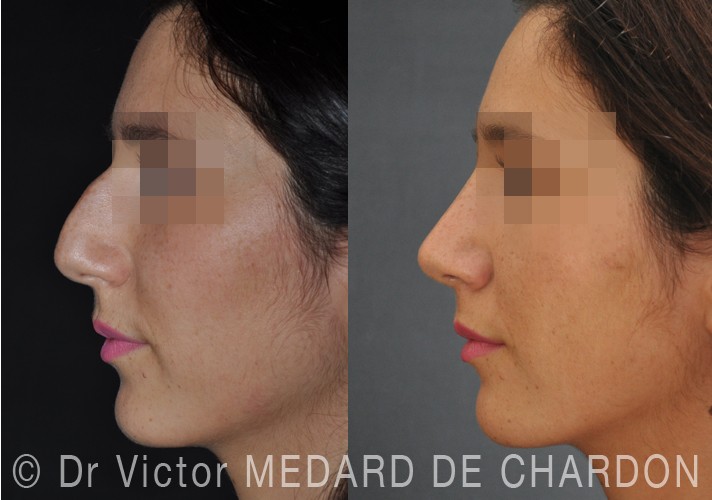
Structural rhinoplasty
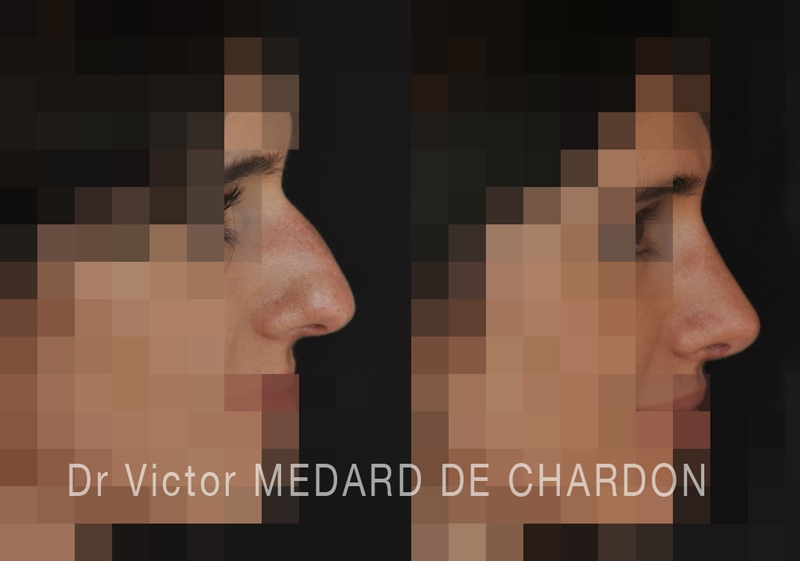
Primary rhinoplasty
Humped (kyphotic) nose with an osteocartilaginous hump and a drooping, prominent tip, on thick skin. Result at 6 months of a primary structural powered rhinosculpture
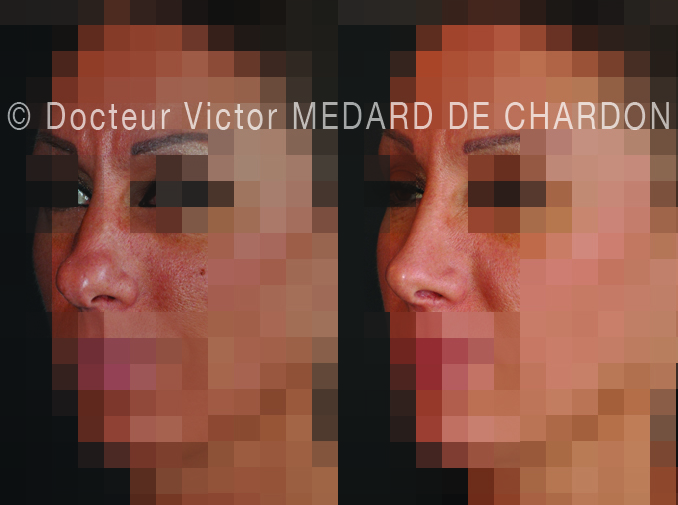
Rhinoplasty for a bulbous, boxy tip
Cosmetic nose surgery for a wide, bifid tip. The tip is lifted and refined.
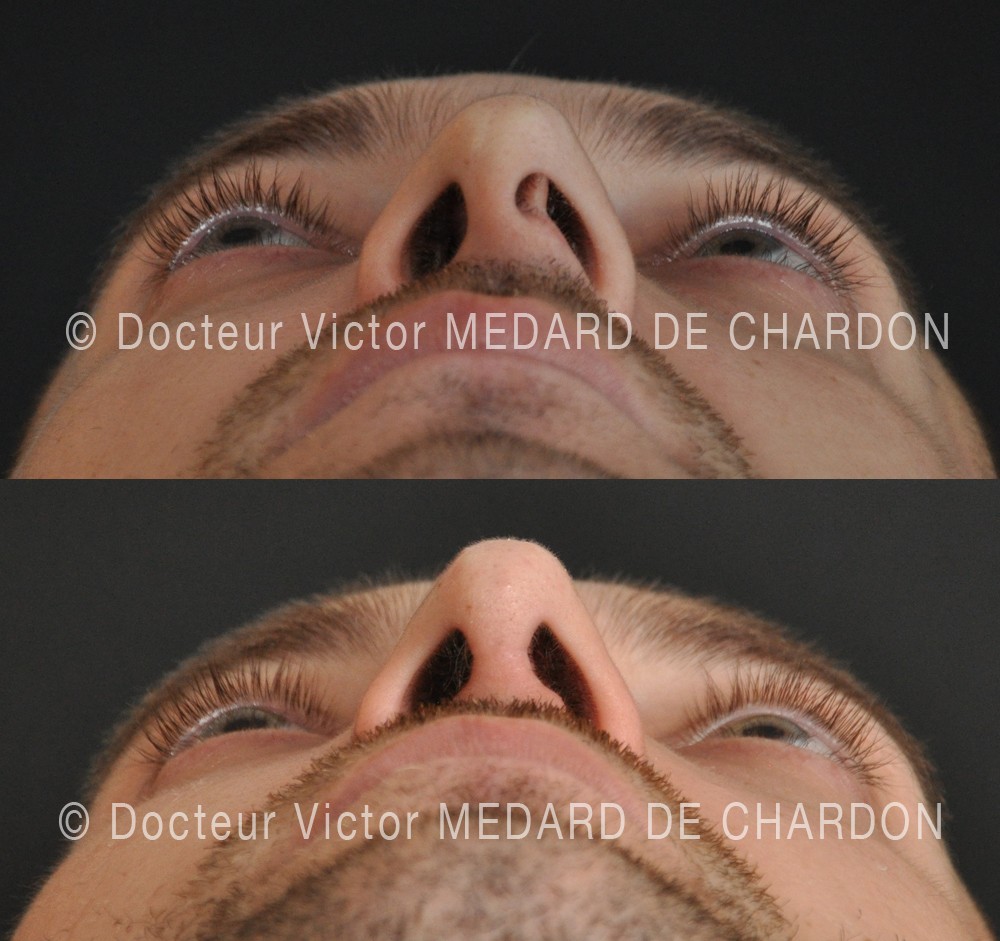
Septoplasty
Deviated nasal septum treated by septoplasty.
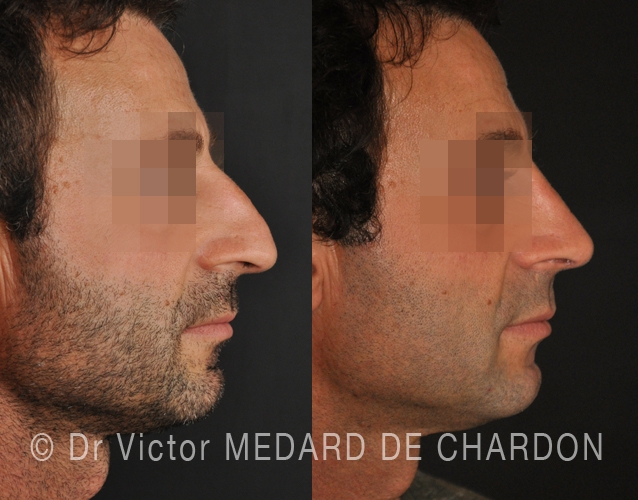
Structural rhinoplasty in a man
Cosmetic nose surgery (rhinoplasty) in a man to correct an over-projected, humped (kyphotic) nose
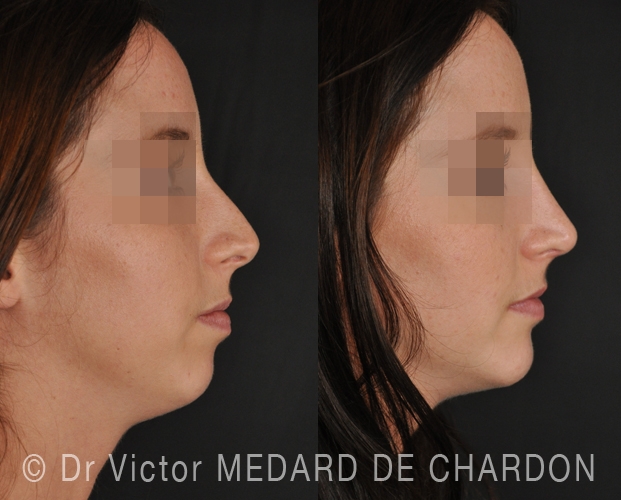
Surgical profileplasty
Cosmetic surgery of the profile by rhinoplasty (nose surgery) and genioplasty (chin surgery), with submental liposuction to define the neck
See all before and after photos of rhinoplasty
How much does a rhinoplasty cost, and is it reimbursed?
€6,000 to €10,000
On a written quote after the consultation (€100, free for a patient already followed at the practice), depending on the complexity of the nose and any additional procedures. The functional part, and the after-effects of injury or malformation, can be covered with prior approval (from Assurance Maladie). Sector 2 (fees above the national health insurance rate), not OPTAM-registered. Functional rhinoplasty on its own: €500 to €5,000; non-surgical rhinoplasty from €350.
Frequently asked questions about rhinoplasty
Why is rhinoplasty said to be one of the most difficult operations?
The nose combines a function, breathing, with a visible shape at the centre of the face, where every millimetre counts. The result evolves over a year as it heals and has to be anticipated during the operation. This is why it requires specific training and practice.
How do I choose a surgeon for a rhinoplasty?
Check that the surgeon is qualified in plastic, reconstructive and aesthetic surgery and performs rhinoplasty regularly, both primary and revision. Ask to see before and after photos and take the time for two consultations. Dr Médard de Chardon is a member of the Rhinoplasty Society of Europe.
From what age can you have a rhinoplasty?
From 16, once the nose has finished growing; a minor is seen with the consent of both parents.
What is preservation rhinoplasty?
It is a technique that keeps the natural structures of the nose instead of removing and then rebuilding them. The hump is lowered rather than cut away, and the tip is reshaped with sutures. The bridge of the nose keeps a natural appearance and its strength.
What is the advantage of ultrasonic rhinoplasty?
The bones are shaped by ultrasound, without hammer or chisel, which allows more precise movements. The neighbouring soft tissues are spared, which reduces bruising and swelling. See the comparison: ultrasonic or traditional rhinoplasty.
How should I prepare for a rhinoplasty?
Smoking is stopped 6 weeks before and 6 weeks after the operation. Aspirin, anti-inflammatories and certain food supplements (omega-3, vitamin E, ginger, ginkgo) are stopped at least 15 days before, in agreement with your GP. For day surgery, someone must accompany you on the journey home and stay with you the first night.
Is nasal packing needed after a rhinoplasty?
No, in more than 95% of cases at Dr Médard de Chardon’s practice. Dissolvable internal sutures replace packing: the patient breathes through the nose on waking. A nasal splint is worn for 7 to 10 days.
What should I do in the first few days after a rhinoplasty?
Limit your activities, sleep with your head raised (two pillows) and apply cold to the cheeks and around the eyes; avoid aspirin and anti-inflammatories. Bruising disappears in 7 to 10 days and can be covered with make-up from day 3 or 4.
What precautions should I take after a rhinoplasty?
No glasses for 1 month if the nasal bones have been altered, no forceful nose-blowing for 1 month, SPF 50 sunscreen and no direct sun exposure for 2 to 3 months. Gentle exercise resumes from 15 days, swimming after 6 weeks, contact sports and all sports at 3 months; a long-haul flight should be postponed by 2 weeks if possible.
When is the result of a rhinoplasty final?
The result is visible when the splint is removed, clear at 2 months and final at 1 year, once the swelling of the tip has gone. It is long-lasting; the nose then ages with the rest of the face.
Can a nose that has already been operated on be operated on again?
Yes, this is revision (secondary) rhinoplasty, possible at least 6 months after the first operation, ideally 1 year. It often uses cartilage grafts to rebuild the framework. Dr Médard de Chardon also operates on noses previously operated on by other surgeons.
What is the price of a rhinoplasty in Cannes, and is it reimbursed?
The price ranges from €6,000 to €10,000; it is set on a written quote after a €100 consultation. Cosmetic rhinoplasty is not reimbursed; the functional part can be covered by the Assurance Maladie and the mutuelle, with prior approval.