
Revision rhinoplasty at a glance
- TimingAt least 6 months, ideally 1 year
- Duration1 to 4 hours
- AnaesthesiaGeneral in most cases
- Nasal splint7 to 10 days
- Social downtimeAbout 10 days
- Price€6,000 to €10,000
Revision rhinoplasty (secondary rhinoplasty, R2) is a second operation on the nose. It corrects an unsatisfactory cosmetic or functional result of a first rhinoplasty, including one performed by another surgeon. It is carried out at least 6 months after the first operation, ideally 1 year after, and often uses cartilage grafts. The operation takes 1 to 4 hours, most often under general anaesthesia, as day surgery or with one night’s stay at Clinique Oxford in Cannes. Social downtime is about 10 days and the final result can be assessed at 1 year.
Price: €6,000 to €10,000, on a written quote after a consultation (€100).
Touch-up or revision rhinoplasty: what is the difference?
A touch-up corrects a minor flaw; it is a short operation of 15 to 45 minutes. A revision rhinoplasty is a genuine second rhinoplasty. Some touch-ups can be done without surgery, by non-surgical rhinoplasty (hyaluronic acid injection).
| Surgical touch-up | Revision rhinoplasty | Non-surgical rhinoplasty | |
|---|---|---|---|
| Aim | Correct a minor flaw | Rework the nose as a whole | Fill a small dip, a slight asymmetry |
| Duration | 15 to 45 min | 1 to 4 hours | 15 min |
| Time after the first rhinoplasty | At least 6 months | At least 6 months, ideally 1 year | From 1 month |
| Anaesthesia | Local or general | General in most cases | Anaesthetic cream |
| Social downtime | 0 to 10 days | About 10 days | None (slight swelling for 48 hours) |
| Result | Final at 1 year | Final at 1 year | Immediate, lasts 8 to 12 months |
| Price | €0 (touch-up of your own rhinoplasty, within the year) to €500 | €6,000 to €10,000 | From €350 |
How long after the first rhinoplasty?
A revision rhinoplasty cannot be performed less than 6 months after the first operation; the ideal interval is one year, to allow the swelling to go down and the tissues to heal. A touch-up can be considered from 6 months.
Why operate again on a nose that has already been operated on?
Breathing difficulty after the first rhinoplasty. Reducing the nose too much can narrow the airway. The difficulty may come from:
- internal nasal valve syndrome (narrowing of the upper part of the airway);
- external nasal valve syndrome: the sides of the nose (alae) collapse when you breathe in;
- a persistent deviated septum: the nose is permanently blocked;
- a turbinate that has remained too large: the nose is blocked alternately on each side;
- a perforation of the septum.
Cosmetic imperfections (not an exhaustive list):
- pollybeak deformity (a raised area just above the tip, seen in profile), due to cartilage or to the skin;
- inverted V deformity (a visible mark between the bone and the cartilage on the bridge of the nose);
- irregularities of the bridge of the nose;
- open roof (bridge of the nose too wide or flattened after a hump has been removed);
- residual hump;
- tip too wide, asymmetrical or too small;
- tip lacking support, with a loss of projection of the nose.
The most common flaws
Pollybeak: a raised area above the tip, due to excess cartilage or scar tissue; the tip looks less projected.
Nose in profile; dotted line: the target profile.
Why is revision rhinoplasty more demanding?
This is the most demanding operation in nose surgery: the cartilages have been reduced or moved, internal scars have formed and the skin has contracted. The framework of the nose often has to be rebuilt with cartilage grafts.
How is a revision rhinoplasty prepared?
- Operation reportsThe operation reports from the previous procedures are obtained and, if possible, photos from before the first rhinoplasty.
- ConsultationA cosmetic and functional analysis of the nose is carried out at the consultation (€100).
- Plan and quoteA photographic plan of the new nose is drawn up at a second consultation, with the detailed written quote. A statutory 15-day cooling-off period applies before any cosmetic surgery.
- AnaesthesiaAn anaesthetic consultation takes place before the operation.
How is the operation carried out?
The incision is most often made under the tip, across the columella, then continued inside the nose (external or open rhinoplasty), which allows the cartilages to be examined in detail. The bones are reshaped with ultrasound (piezosurgery) and the cartilage framework is rebuilt to restore the anatomy and stability of the nose (structural rhinoplasty).
Depending on the flaws to be corrected, the surgeon may:
- remove excess cartilage;
- graft cartilage taken from the ear or a rib to support the tip (columellar strut), reshape it (tip graft), support or fill the sides of the nose (alae), or build up the bridge and root of the nose (diced cartilage wrapped in fascia, or DCF);
- widen the airway in the case of internal valve syndrome (spreader grafts or spreader flaps);
- reshape the tip with cartilage sutures.
If needed, the profile is balanced at the same time (profileplasty) by a genioplasty, a chin implant or reshaping of the forehead.
Cartilage grafts
The cartilage is taken from the ear (concha) or a rib, then shaped and fixed onto the framework of the nose.
- 1Spreader grafts: widen the internal valve and straighten the bridge
- 2Columellar strut: supports the tip
- 3Tip graft: reshapes the tip
- 4Diced cartilage (DCF): builds up the bridge and root of the nose
Before and after photos
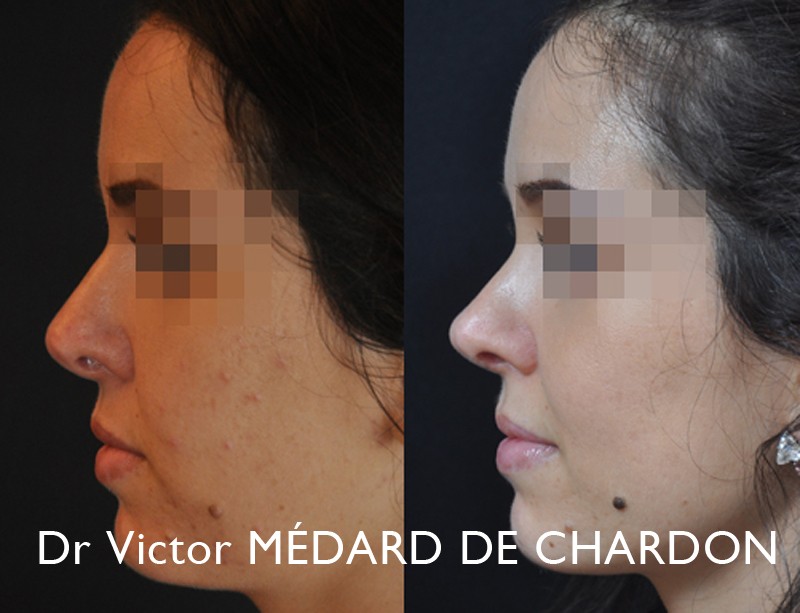
Revision rhinoplasty
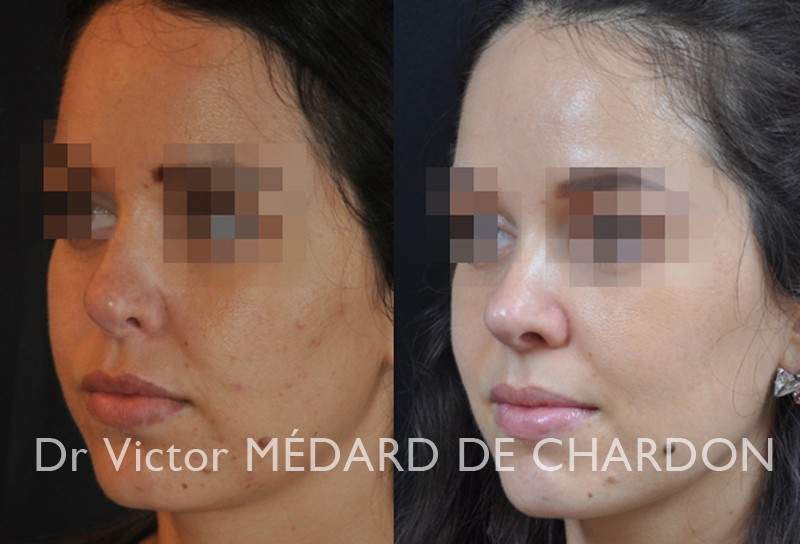
Revision rhinoplasty
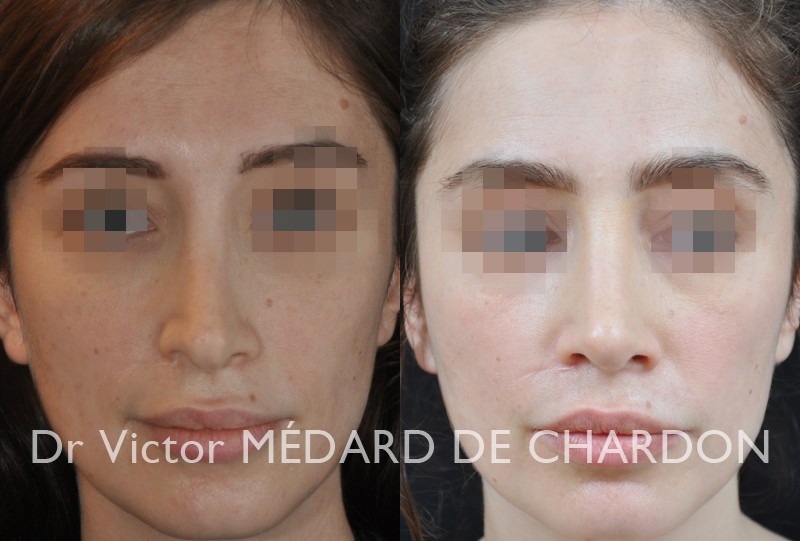
Revision rhinoplasty
See the before and after photos of rhinoplasty
What is the recovery like?
- Nasal splint: 7 to 10 days. No nasal packing in more than 95% of cases.
- Social downtime: about 10 days; return to work between 1 and 2 weeks.
- Precautions: no forceful nose-blowing for 1 month, no glasses for 1 month if the bones have been altered, no direct sun for 2 to 3 months.
- Sport: gentle activity after 15 days, contact and strenuous sports after 3 months.
- Result: visible when the splint is removed, clear at 2 months, final at 1 year, once the swelling of the tip has gone.
Where will you be?
14 days after the procedure
What are the risks?
They are those of any rhinoplasty, with a few particularities:
- swelling, particularly of the tip, which takes longer to go down than after a first rhinoplasty;
- small residual irregularities or asymmetries;
- persistent breathing difficulty;
- scar and pain at the cartilage donor site (behind the ear or on the chest);
- infection or displacement of a graft;
- need for a further touch-up.
Choosing a qualified, experienced and reputable surgeon reduces these risks, and can even eliminate some of them.
Is it covered by health insurance?
€6,000 to €10,000
A purely cosmetic revision rhinoplasty is not reimbursed. Its functional part (breathing difficulty, septum, turbinates, nasal valves) can be covered by French national health insurance (Assurance Maladie) and top-up insurance (mutuelle), with prior approval. Dr Médard de Chardon practises in Sector 2 (fees above the national health insurance rate), not OPTAM-registered.
Book an appointment: +33 (0)4 93 68 86 68 or Doctolib.
Dr Médard de Chardon’s experience
- A large part of his practice is devoted to nose surgery, including revision of noses operated on by other surgeons.
- Member of the Rhinoplasty Society of Europe (RSE), the European professional society dedicated to rhinoplasty.
- Further training in rhinoplasty: Dallas Rhinoplasty Symposium (United States), Rhinoplasty Video Symposium (Paris), Bergamo Open Rhinoplasty Course (Italy).
- In practice in Cannes since 2011; more than 1,300 rhinoplasties performed.
Frequently asked questions about revision rhinoplasty
When can a rhinoplasty be redone?
At least 6 months after the first operation, ideally 1 year after, to allow the swelling to go down and the tissues to heal. A touch-up can be considered from 6 months.
Touch-up or revision rhinoplasty: what is the difference?
A touch-up corrects a minor flaw in 15 to 45 minutes; it can sometimes be done by hyaluronic acid injection. A revision rhinoplasty is a genuine second rhinoplasty, lasting 1 to 4 hours.
Can a nose operated on by another surgeon be revised?
Yes. The operation reports from the previous procedures then need to be obtained and, if possible, photos from before the first rhinoplasty.
Why are cartilage grafts often needed for a revision rhinoplasty?
The first operation has often reduced or moved the cartilages of the nose. To rebuild its framework and support the tip, the surgeon uses cartilage taken from the ear or a rib.
What is a pollybeak and how is it treated?
It is excess volume just above the tip of the nose (the supratip), which gives a bird’s-beak appearance in profile, either permanently or only when smiling. It most often comes from a septal edge left too high, tip cartilages that are too large, a tip that droops for lack of support, thick skin that does not retract well, or a hump that was over-resected. Treatment depends on the cause: lowering the septum, reducing the tip cartilages, a columellar strut to lift the tip, corticosteroid injections followed by careful defatting for thick skin, or filling the over-resected area with hyaluronic acid, fascia-wrapped cartilage (DCF), an acellular dermal matrix (ADM) graft or fat grafting (lipofilling).
Can you breathe better after a revision rhinoplasty?
Yes, breathing difficulty that appears after a first rhinoplasty is one of the reasons for revision: nasal valves, septum, turbinates. This functional part can be covered by the Assurance Maladie, with prior approval.
What is the recovery like after a revision rhinoplasty?
A nasal splint is worn for 7 to 10 days, with no nasal packing in more than 95% of cases. Social downtime is about 10 days and you must not blow your nose hard for 1 month. The final result can be assessed at 1 year.
Can an injection be enough instead of a revision rhinoplasty?
Sometimes, for a small dip or a slight asymmetry: non-surgical rhinoplasty corrects these flaws in 15 minutes, from €350, with a result that lasts 8 to 12 months. It does not replace a revision rhinoplasty.
How much does a revision rhinoplasty cost?
The price is set on a written quote after the consultation (€100); it depends on the complexity of the nose and the grafts needed, and ranges from €6,000 to €10,000.