

Breast lift at a glance
- Duration1.5 to 3 hours
- AnaesthesiaGeneral
- Hospital stayDay surgery or one night
- Time off work7 to 15 days
- Final result1 year
- Price€4,000 to €7,500
Mastopexy, or breast lift, raises sagging breasts (breast ptosis) and gives them back a round, projected shape. It removes excess skin and reshapes the gland, keeping the volume, or combining it with implants if the breasts have emptied, or with a reduction if they are too large. The procedure takes 1.5 to 3 hours under general anaesthesia, as day surgery or with one night at the Clinique Oxford in Cannes. Time off work is 7 to 15 days; the shape settles in 2 to 3 months and the final result is reached at 1 year.
Price: €4,000 to €7,500 (€6,000 to €8,500 with implants or fat transfer), on a written quote after a consultation (€100).
What is breast ptosis?
Breast ptosis is the descent of the mammary gland combined with stretching of the skin: the breasts sag and have often “emptied” in their upper part. It can be present from the outset (constitutional ptosis, tuberous breasts, large breasts), but most often occurs after pregnancy and breastfeeding, after major weight loss, or with age and the menopause. Find out more: why do breasts sag?
What degree of ptosis, and what treatment?
| Degree of ptosis | Position of the nipple | Usual treatment | Scars |
|---|---|---|---|
| Minor ptosis | Level with the fold under the breast | Periareolar mastopexy, or implants alone if volume is lacking | Around the areola (no lift scar with implants alone) |
| Moderate ptosis | Below the fold, pointing downwards | Mastopexy | Around the areola + vertical |
| Major ptosis | Well below the fold, pointing downwards | Mastopexy | Inverted T: around the areola, vertical and in the fold |
| Pseudoptosis | Well positioned, above the fold; it is volume that is lacking | Augmentation with implants or fat transfer | Those of the augmentation |
Tuberous breasts, whose lower part has developed little, need a specific approach.
Mastopexy in diagrams
Where is the nipple in relation to the fold?
Side cross-section of the breast. The dotted line marks the fold under the breast, the blue-green dot the nipple: the further it drops below the fold, the greater the ptosis and the longer the scars.
Around the areola
For minor ptosis: a scar around the areola.
There are no stitches to remove; the scars are final at 1 year.
Raising and reshaping
Before: major ptosis, nipple well below the fold.
Diagram of the principle: the shape settles in 2 to 3 months and the result is final at 1 year.
Mastopexy alone, with implants, with fat transfer or with reduction: which should you choose?
The choice depends on volume: it is kept, increased (with implants or fat transfer) or reduced.
| Mastopexy alone | Mastopexy + implants | Mastopexy + fat transfer | Reduction with lift | |
|---|---|---|---|---|
| Suitable for | Sagging breasts of satisfactory volume | Sagging, emptied breasts with insufficient volume | Sagging breasts, empty cleavage, moderate gain in volume wanted without an implant | Sagging breasts that are too large (hypertrophy) |
| Volume | Kept and reshaped | Increased | Slightly increased, with your own fat | Reduced |
| Scars | Depending on the degree of ptosis | Depending on the degree of ptosis | Depending on the degree of ptosis, + tiny openings where fat is harvested | Around the areola + vertical, often in a T |
| Duration | 1.5 to 3 hours | 1.5 to 3 hours | 2 to 3 hours | 2 to 3 hours |
| Time off work | 7 to 15 days | 7 to 15 days | 7 to 15 days | 7 to 15 days |
| Covered by Assurance Maladie | No | No | No | Possible if at least 300 g are removed per breast |
| Price | €4,000 to €7,500 | €6,000 to €8,500 | €6,000 to €8,500 | €3,000 to €5,000 if covered by Assurance Maladie |
What does a breast lift correct?
Mastopexy works on both the skin envelope and the gland. The gland is reshaped and the excess skin removed, which makes it possible to:
- raise the breasts and the areola;
- reduce their width and increase their projection;
- fill the cleavage;
- reduce the diameter of the areolas if they are stretched;
- correct an asymmetry between the two breasts.
What scars after a mastopexy?
The length of the scars depends on the degree of ptosis: around the areola for minor ptosis, around the areola and vertical for moderate ptosis, and an inverted T (“anchor” scar) for major ptosis. There are no stitches to remove. The scars are final at 1 year; on darker skin, healing is usually of very good quality, but keloid scars may develop.
Why is mastopexy a demanding procedure?
- The shape must hold over time: the gland is reshaped, not just the skin tightened.
- Both breasts must be symmetrical in volume, height and areola position.
- The areola must keep a good blood supply, especially when an implant is added.
- The scars must be as short as possible for the degree of ptosis.
Dr Médard de Chardon’s experience in breast surgery
- Qualified plastic surgeon in plastic, reconstructive and aesthetic surgery, former Chef de Clinique (university hospital senior registrar), Nice Faculty of Medicine; practising in Cannes since 2011.
- MD thesis on aesthetic breast augmentation; more than 3,000 breast implants placed.
- More than 1,500 mastopexies and breast reductions performed.
- Member of SOFCEP (French Society of Aesthetic Plastic Surgery), SOFCPRE (French Society of Plastic, Reconstructive and Aesthetic Surgery) and ISAPS (International Society of Aesthetic Plastic Surgery).
Who is it for, and when?
Mastopexy is for adult women bothered by sagging breasts, most often after one or more pregnancies, breastfeeding or weight loss. It is best considered once your weight is stable and you have finished having children, because a new pregnancy or a significant change in weight can make the breasts sag again. Smoking increases the risk of healing complications: you must stop at least one month before and one month after surgery.
How does a mastopexy work?
- First consultation€100 at the practice, 101 rue d’Antibes in Cannes: your expectations, examination and measurement of the breasts, degree of ptosis, photographs.
- Second consultationChoice of technique, scars and, if needed, implants; detailed written quote and the SOFCPRE information sheet; a mammogram and/or ultrasound is prescribed.
- Cooling-off periodAt least 15 days, required by law, between receiving the quote and the surgery.
- PreparationPre-anaesthetic consultation; stopping smoking and aspirin.
- SurgeryAt the Clinique Oxford in Cannes, 1.5 to 3 hours under general anaesthesia, as day surgery or with one night. No stitches to remove.
- Follow-upBy Dr Médard de Chardon’s team until the final result, at 1 year.
What is the recovery like?
- Pain: little or no pain.
- Bra: medical support bra for 4 weeks, then a bra without underwire for 4 weeks.
- Sleep: no sleeping on your side for 7 days.
- Driving: no driving for 7 days.
- Time off work: 7 to 15 days.
- Sport: resumed after 4 weeks.
- Volume: swelling (oedema) persists for about 2 months, so the breasts look larger just after the operation.
- Shape: just after the lift, the breasts are deliberately full at the top and slightly flat at the bottom; they find their shape in 2 to 3 months.
- Scars: final at 1 year.
- Sensation: altered sensation in the nipples, areolas or breast skin may occur; it recovers within 2 years.
Where will you be?
14 days after the procedure
What are the risks and complications?
Like any surgery, mastopexy carries risks, which are rare and explained at the consultation:
- haematoma or infection;
- delayed healing, particularly where the T-shaped scars meet and in smokers;
- compromised blood supply to the areola, which is exceptional;
- thick scars (hypertrophic or keloid);
- residual asymmetry;
- altered sensation, usually temporary;
- partial recurrence of the ptosis over time, more frequent when the skin has little elasticity (stretch marks, constitutionally weak skin).
Choosing a qualified, experienced and reputable surgeon reduces these risks, and can even eliminate some of them.
Is the result permanent?
The result is final at 1 year and long-lasting. The breasts nevertheless continue to age naturally: age, a pregnancy or a significant change in weight can cause partial sagging again.
Before and after photos
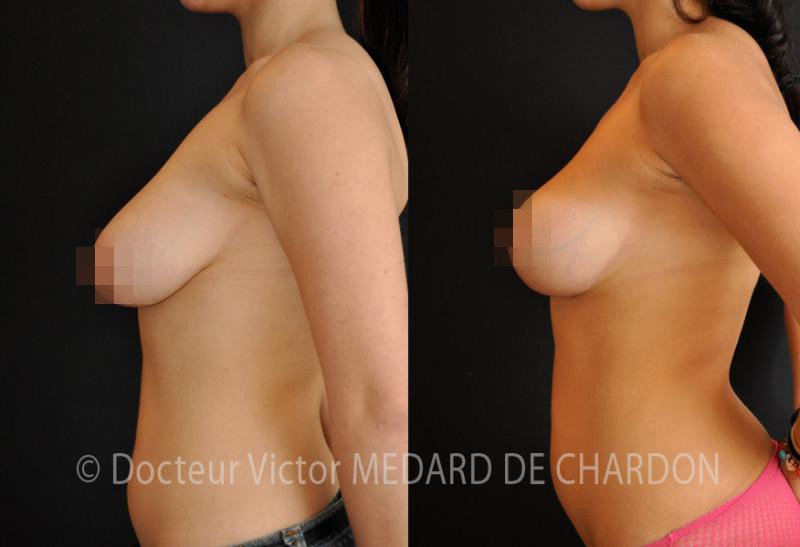
Constitutional breast ptosis
Mastopexy without volume reduction
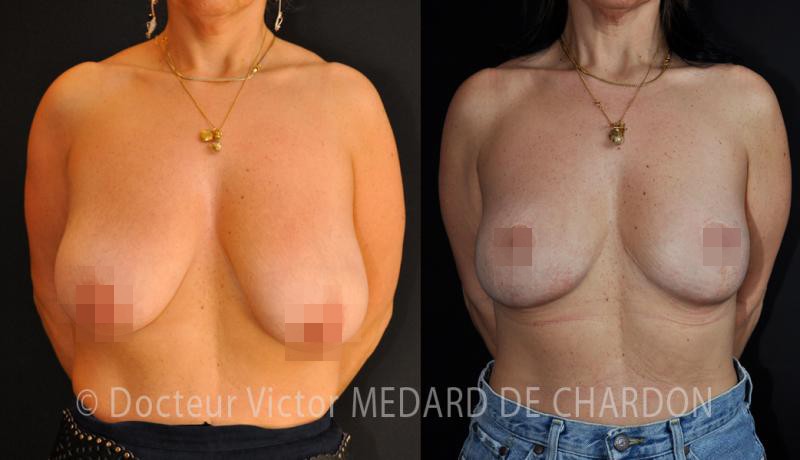
Breast ptosis and asymmetry
Mastopexy (breast lift) with correction of breast asymmetry
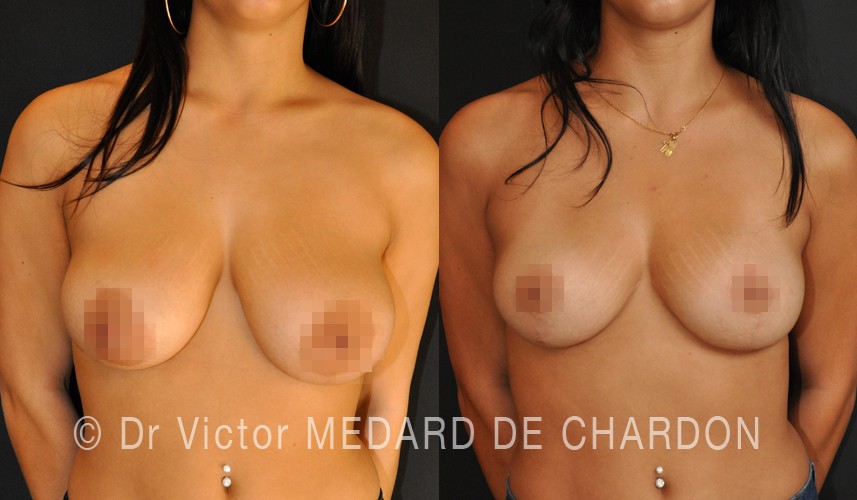
Breast reshaping to correct ptosis
Mastopexy and reshaping of the breast to correct ptosis. The scars are T-shaped and discreet. The areolas were also reduced in size during the same operation.
See all breast lift before and after photos
How much does a mastopexy cost in Cannes?
€4,000 to €7,500
€6,000 to €8,500 when combined with implants or fat transfer. The price is set on a written quote after the consultation (€100, free for a patient already followed at the practice) and includes the surgeon’s and anaesthetist’s fees and the clinic costs, as well as the implants if they are used. Cosmetic mastopexy is not reimbursed by French national health insurance (Assurance Maladie); a breast reduction may be covered if at least 300 g are removed per breast. Book on Doctolib or call +33 (0)4 93 68 86 68.
Frequently asked questions about mastopexy
What is the difference between mastopexy and a breast lift?
There is none: mastopexy is the medical term, breast lift the everyday term. It is also called correction of breast ptosis. All three refer to the procedure that raises sagging breasts.
Can breasts be lifted without a scar?
Only in cases of minor ptosis with insufficient volume: breast implants alone can then correct the sagging, without a lift scar. As soon as the nipple is below the fold, the excess skin has to be removed, which leaves scars whose length depends on the degree of ptosis.
Can mastopexy be combined with implants?
Yes, when the breasts are sagging and have emptied. The mastopexy raises and reshapes the breast, and the implant fills the upper breast and the cleavage. Both are done during the same operation.
Can mastopexy be combined with fat transfer?
Yes, when the breasts are sagging and the cleavage is empty, but an implant is not wanted. The fat is harvested by liposuction, purified and then reinjected into the upper breast during the mastopexy. The gain in volume is moderate: about 60% of the reinjected fat is permanently retained.
How long does the result of a breast lift last?
The result is final at 1 year and long-lasting. The breasts continue to age: age, a pregnancy or a significant change in weight can make them sag again in part.
Can you breastfeed after a mastopexy?
Breastfeeding usually remains possible, because the gland is reshaped without being removed and the areola stays connected to the gland.
Should you wait until you have finished having children before a breast lift?
It is preferable: a pregnancy and breastfeeding after a mastopexy can change the volume, make the breasts sag partially and then require a touch-up. The operation is ideally done when your weight is stable.
When can you return to sport after a breast lift?
After 4 weeks. The medical support bra is worn for 4 weeks, then a bra without underwire for a further 4 weeks.
What does a mastopexy cost in Cannes?
The price of a mastopexy ranges from €4,000 to €7,500, and from €6,000 to €8,500 when combined with implants or fat transfer. It is set on a written quote after the consultation (€100). Cosmetic mastopexy is not reimbursed by Assurance Maladie.