

The facelift at a glance
- Techniques4 types of lift
- Duration1 to 4 hours
- Hospital stayDay surgery or 1 night
- Social downtime7 to 21 days
- How long the result lasts4 to 12 years
- Price€3,000 to €15,000
A facelift repositions sagging tissues (muscle, fat and skin) to rejuvenate the face without changing its features. There are four types of lift, depending on the area to be treated: the face and neck lift (cervicofacial: jawline and neck), the midface lift (cheeks and tear troughs), the temporal lift (tail of the eyebrow) and the brow lift (forehead and eyebrows). The operation takes 1 to 4 hours at Clinique Oxford in Cannes, as day surgery or with one night’s stay. Social downtime is 7 to 21 days depending on the lift. The result of a face and neck lift lasts 4 to 12 years, depending on the quality of the tissues.
Price: €3,000 to €15,000 depending on the type of lift and any additional procedures, on a written quote after a consultation (€100).
Which lift for which area of the face?
Ageing does not affect every area of the face at the same rate. The choice of lift depends on the area that has sagged; several lifts are often combined in the same operation for a harmonious result.
| Face and neck lift | Midface lift | Temporal lift | Brow lift | |
|---|---|---|---|---|
| Areas treated | Jawline, jowls, neck, neck–chin angle | Cheeks, dark circles, tear trough, lower eyelid, nasolabial fold | Tail of the eyebrow, crow’s feet, sagging temple | Drooping eyebrows, forehead lines, frown lines |
| Scar | In the hair and around the ear (sometimes under the chin) | Under the lashes of the lower eyelid | 3 to 4 cm, in the hair | In the hair: 3 to 5 incisions of 1 cm (endoscopic) or one continuous incision (coronal) |
| Duration | 2 to 4 hours | 2 hours | 1 hour | 1 hour |
| Anaesthesia | General or local with sedation | General | General or local with sedation | General or local with sedation |
| Hospital stay | Usually one night, day surgery possible | Day surgery or 1 night | Day surgery | Day surgery or 1 night |
| Social downtime | 15 to 21 days | 15 to 21 days | 7 days | 15 days |
| Final result | At 2 months | At 6 months | At 2 months | At 6 months |
| How long the result lasts | 4 to 12 years depending on tissue quality | 8 to 12 years | 1 to 4 years; maintained with botulinum toxin | 4 to 12 years |
| Price | €5,000 to €15,000 depending on additional procedures | €5,000 to €10,000 | €3,000 to €5,000 | €5,000 to €10,000 |
The face and neck lift: jawline and neck
This is the standard procedure for facial rejuvenation when the jawline sags and the neck becomes lax. Dr Médard de Chardon performs it using the deep plane facelift technique: the muscle layer (the SMAS) is re-tightened at a deep level, then the skin is redraped without tension. The result is natural, because the skin is not pulled, and long-lasting, because it relies on the muscle layer. When the cheek has also descended, the procedure is extended to the midface (high SMAS technique) or completed at a second stage by a midface lift. When the neck is very lax or shows platysmal bands, a short incision in the crease under the chin completes the procedure. Excess fat can be treated by liposuction; conversely, a gaunt face benefits from micro-injection of fat.
The midface lift: cheeks and tear troughs
Also called a centrofacial lift or malar lift, it raises the cheek by vertical suspension, improves the tear trough and the nasolabial fold, and treats excess skin or bags of the lower eyelid through an incision under the lashes; the stitches are removed on day 6. It is often combined with a temporal lift and, if the outer corner of the eye is lax, with a canthopexy. It does not treat the jowls or the neck, which call for a face and neck lift.
The temporal lift: the eyes
The temporal lift raises the outer part of the eyebrow, softens crow’s feet and opens up the eyes. Rarely performed on its own, it most often complements a blepharoplasty, or a brow, midface or face and neck lift. The 3 to 4 cm scar is hidden in the hair and the suture is intradermal: no stitches are visible.
The brow lift: forehead and eyebrows
The brow lift raises drooping eyebrows and softens forehead lines and frown lines. It is performed endoscopically (3 to 5 incisions of 1 cm, with no skin removed) or by the coronal approach (one continuous incision in the hair, with removal of excess skin). It can also correct a short forehead in young adults. When the indication is limited, botulinum toxin injections may be enough.
The facelifts in diagrams
Four areas, hidden scars
On the left of the face, the areas treated; on the right, where the scars lie. Tap a lift to show it on its own.
Repositioning without pulling the skin
Before: lax eyebrow, cheek, jawline and neck. The arrows show the direction in which the deep tissues are re-tightened (deep plane).
Schematic diagram: the features stay the same; only the lax tissues are repositioned.
Dr Médard de Chardon’s experience in facelift surgery
Dr Victor Médard de Chardon devotes a large part of his practice to facial rejuvenation by facelift and eyelid surgery.
- More than 1,000 facelifts performed; in practice in Cannes since 2011.
- Deep plane facelift technique for the face and neck lift.
- University diploma (DU) in plastic surgery of the face (Lyon).
- Former anatomy prosector and former Chef de Clinique (university hospital senior registrar), Nice Faculty of Medicine.
At what age should you have a facelift?
A facelift can be considered as soon as signs of sagging appear, usually from the age of 45. The ideal age for a first face and neck lift is between 45 and 55: the tissues are still of good quality, which favours a natural and long-lasting result.
Surgical facelift or non-surgical mini facelift with injections?
In the early stages of ageing, when the skin and tissues have sagged only a little, hyaluronic acid injections, possibly combined with botulinum toxin, fill wrinkles and restore volume: this is the non-surgical mini facelift (filler lift). Its effect is temporary and it does not replace a facelift once the jawline or neck has sagged. The consultation will determine which of the two approaches suits your face.
How does a facelift take place?
- Pre-operative consultation€100 at the practice, 101 rue d’Antibes, Cannes: analysis of the face, choice of the lift or lifts, information on the risks and a detailed written quote.
- Cooling-off periodA minimum of 15 days, required by law, between receiving the quote and the operation.
- Anaesthetic consultationWith an anaesthetist; stopping smoking.
- OperationAt Clinique Oxford in Cannes, under general anaesthesia or local anaesthesia with sedation, lasting 1 to 4 hours depending on the procedure.
- Follow-upPost-operative consultations with Dr Médard de Chardon and his team.
What is the recovery like?
A facelift causes little pain: patients mainly describe a feeling of discomfort or tightness behind the ears and in the neck. Timeline given for a face and neck lift:
| When | What happens |
|---|---|
| Day of surgery | Usually one night at the clinic; dressing |
| Day 2 | Dressing removed, first shampoo |
| A few days to 3 weeks | Swelling going down; bruising for 7 to 21 days |
| Day 7 | Driving possible |
| Day 15 | Back to social life; gentle exercise |
| Days 15 to 21 | Back to work |
| 1 month | Normal sport; hair colouring |
| 2nd month | Final result; sun protection for the scars during the first few months |
After a temporal lift alone, social life resumes after 7 days; after a midface lift, bruising lasts up to 21 days and the final result is reached at 6 months.
Where will you be?
14 days after the procedure
What are the risks?
Like any surgery, a facelift carries risks, which are rare when the operation is performed by a qualified plastic surgeon in an approved facility:
- haematoma;
- temporary changes in sensation in the cheeks and ears;
- injury to a branch of the facial nerve, exceptional and usually temporary;
- localised hair loss along the scars;
- delayed healing, made more likely by smoking;
- risks related to anaesthesia, assessed at the anaesthetic consultation.
Choosing a qualified, experienced and reputable surgeon reduces these risks, and can even eliminate some of them. They are explained in detail at the consultation.
Prolonging and maintaining the result
A facelift can be combined with other techniques to harmonise or maintain the rejuvenation:
- botulinum toxin injections for forehead lines, frown lines (glabella) and crow’s feet;
- hyaluronic acid injections or micro-injections of fat for dark circles, folds and cheek volume;
- blepharoplasty for the eyelids;
- chemical peel, mesotherapy or CO2 laser for skin quality.
Before and after photos
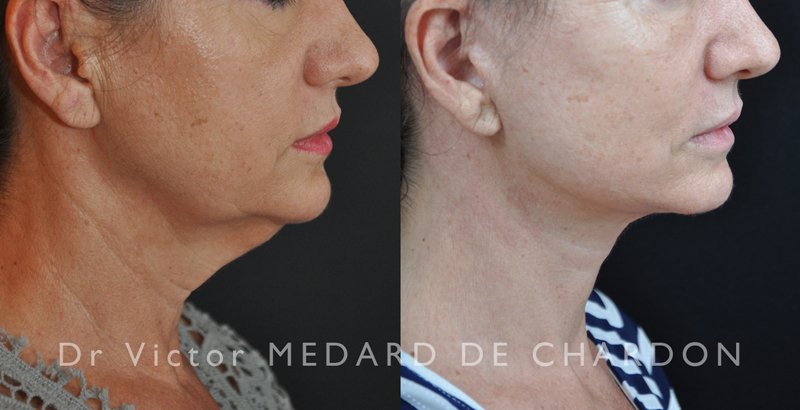
Facelift: jawline and neck
Right profile, before and after
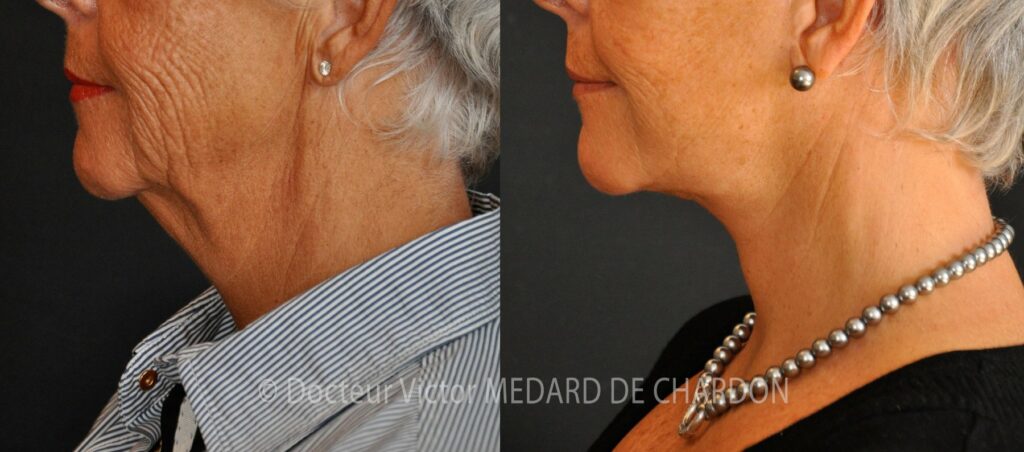
Facelift: neck and jawline
Left profile, before and after
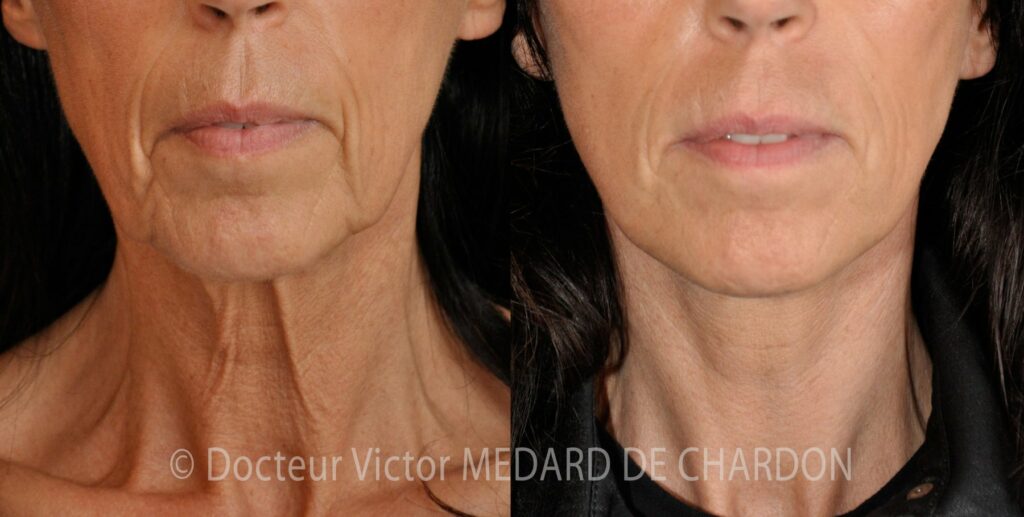
Facelift: lower face and neck
Front view, before and after
See all before and after photos of facelifts
How much does a facelift cost, and is it reimbursed?
€3,000 to €15,000
The price ranges from €3,000 to €15,000 depending on the type of lift, any additional procedures and the length of the hospital stay. It is set on a written quote after the consultation (€100, free for a patient already followed at the practice) and includes the surgeon’s and anaesthetist’s fees and the clinic’s charges. A cosmetic facelift is not reimbursed by the Assurance Maladie or by mutuelles (top-up health insurance). Dr Médard de Chardon practises in Sector 2 (fees above the national health insurance rate), not OPTAM-registered.
Book an appointment: +33 (0)4 93 68 86 68 or Doctolib.
Frequently asked questions about the facelift
Does a facelift change your facial expression?
No. A facelift puts the anatomical structures back in the position they occupied a few years earlier, without changing your features. With the deep plane technique, the tension is placed on the muscle and not on the skin, which avoids a “pulled” look.
What is a deep plane facelift?
It is a face and neck lift technique that re-tightens the deep tissues of the face (the SMAS) rather than the skin. The skin is then redraped without tension. The result is more natural and longer-lasting than a facelift that pulls only on the skin.
How long does the result of a facelift last?
Depending on the quality of the tissues, the result lasts 4 to 12 years after a face and neck lift or a brow lift, and 8 to 12 years after a midface lift. A temporal lift lasts 1 to 4 years and is maintained with botulinum toxin. The face then continues to age, but from a younger starting point.
Are facelift scars visible?
They are hidden in the hair and around the ear for the face and neck lift, under the lashes for the midface lift, and in the hair for the temporal and brow lifts. They fade gradually over the months following the operation.
Is a facelift painful?
It causes little pain. Patients mainly describe a feeling of tightness behind the ears and in the neck during the first few days.
When can I go back to work after a facelift?
Allow 15 to 21 days after a face and neck lift and about 15 days after a temporal lift. Bruising can last up to 3 weeks.
Can a facelift be done without surgery?
In the early stages of ageing, a non-surgical mini facelift with hyaluronic acid and botulinum toxin injections may be enough. Once the jawline and neck have sagged, only a surgical facelift repositions the tissues for the long term.
Why combine fat injections with a facelift?
Facial ageing combines sagging of the tissues, loss of volume and ageing of the skin surface; a facelift treats only the sagging. Fat grafting (lipostructure), performed during the same operation, restores volume with your own fat. It complements the facelift without replacing it: on a sagging face, large amounts of fat without a facelift give a “puffy” look.
How much does a facelift cost in Cannes?
The price depends on the type of lift, any additional procedures and the length of the hospital stay. It is set on a written quote after the pre-operative consultation (€100) and ranges from €3,000 to €15,000. A cosmetic facelift is not reimbursed by the Assurance Maladie or by mutuelles.
Where is a facelift performed?
Consultations take place at the practice, 101 rue d’Antibes, Cannes; operations are performed at Clinique Oxford in Cannes. Book on Doctolib or on +33 (0)4 93 68 86 68.