

Calf implants at a glance
- Duration1 hour
- AnaesthesiaGeneral or spinal anaesthesia
- Hospital stayDay surgery or 1 night
- Time off work15 days
- Result3 months (scar: 12 months)
- Price€5,000 to €7,500
Calf implants increase the volume of calves that are too thin, most often because the muscles are underdeveloped. Cohesive silicone gel implants are placed beneath the fascia (aponeurosis) of the calf muscles, through a 3 cm scar hidden in the hollow behind the knee. The operation takes 1 hour at Clinique Oxford in Cannes, under general or spinal anaesthesia, as day surgery or with one night in hospital. Time off work of 15 days; result for shape and volume at 3 months, for the scar at 12 months. Fat transfer (lipofilling) and Hyacorp injection are alternatives.
Price: €5,000 to €7,500, on a written quote after consultation (€100).
Implants, fat transfer or Hyacorp: how can the calves be enlarged?
| Calf implants | Calf fat transfer | Hyacorp injection | |
|---|---|---|---|
| Product | Cohesive silicone gel implants | The patient’s own fat, harvested by liposuction | Highly cross-linked hyaluronic acid |
| Suitable for | Thin calves | Thin calves, with fat available to harvest | Thin calves, including in very slim people |
| Duration | 1 hour | 2 hours | 30 minutes |
| Pain | Moderate, 7 to 15 days | In the liposuction areas, 7 to 15 days; not in the calves | Very little or none |
| Compression | Compression socks 4 weeks, stockings 15 days | Garment 4 weeks | 0 to 2 weeks |
| Time off work | 15 days | 3 to 15 days | From the next day to a few days |
| Sport | 6 weeks | 4 weeks | 3 weeks |
| Longevity of the result | 12 to 15 years | 50 to 70% of the fat takes; a second session is sometimes needed at 6 months | Absorbed over 12 to 18 months, maintenance injection every year |
Why are some calves too thin?
The cause is most often constitutional: the calf muscles (gastrocnemius and soleus) are underdeveloped. Even with regular, intensive exercise, they may remain underdeveloped. The cause is sometimes an illness or a neurological or muscular injury, for example the after-effects of polio.
Calf implants
The scar is placed in the hollow behind the knee (popliteal fossa) and measures 3 cm. A pocket is created beneath the fascia of the gastrocnemius muscles; the implants are made of cohesive silicone gel.
A composite augmentation is sometimes carried out: fat transfer complements the implants to refine their contours, improve the symmetry of the result or harmonise the shape of the ankles.
Before: thin calves, because the muscles are underdeveloped.
- 1Thin calf: underdeveloped muscles
- 2Cohesive silicone gel implant, beneath the fascia (aponeurosis) of the muscle
- 33 cm scar in the hollow behind the knee
Calf fat transfer
The patient’s own fat, harvested by liposuction during the same operation, is reinjected into the calves. It is a graft: 50 to 70% of the fat takes, and a second session 6 months later may be needed. The operation takes 2 hours. Moderate pain in the liposuction areas for 7 to 15 days, not in the calves; compression garment for 4 weeks; work after 3 to 15 days, sport after 4 weeks; final result at 3 months.
Hyacorp injection
Hyacorp is a highly cross-linked, absorbable hyaluronic acid. The injection takes 30 minutes, with very little or no pain; compression for 0 to 2 weeks; work from the next day or after a few days; sport after 3 weeks. The volume is gradually absorbed over 12 to 18 months: a maintenance injection, of a smaller volume, is needed about once a year.
Advantage: it remains possible in very slim people, with no fat to harvest. Drawback: unlike fat transfer, it is absorbable.
Dr Médard de Chardon’s experience
- Qualified plastic surgeon in plastic, reconstructive and aesthetic surgery, former Chef de Clinique (university hospital senior registrar), Nice Faculty of Medicine; in practice in Cannes since 2011; member of SOFCEP (French Society of Aesthetic Plastic Surgery), SOFCPRE (French Society of Plastic, Reconstructive and Aesthetic Surgery) and ISAPS (International Society of Aesthetic Plastic Surgery).
- Implants and body fat transfer: buttock fat transfer, Hyacorp injections.
Before and after photos
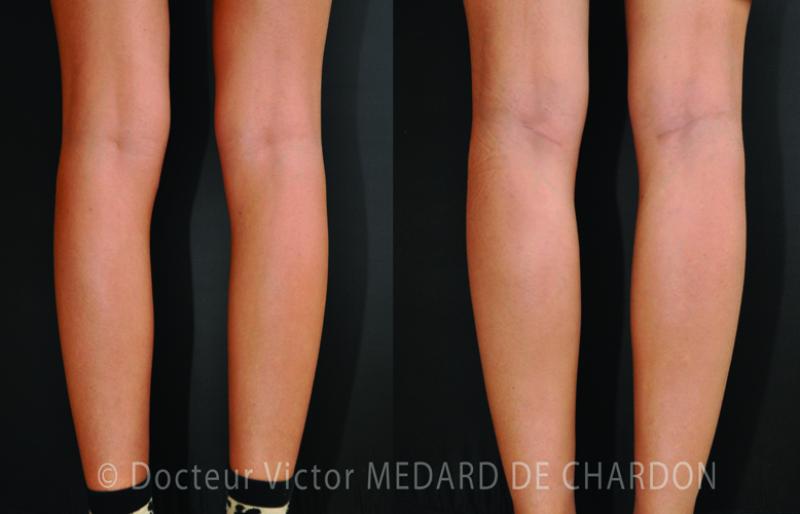
Thin calves
Calf implants
See the before and after photos of calf implants
How is the operation carried out?
- ConsultationAt the practice, 101 rue d’Antibes, Cannes (€100): examination of the calves, choice of technique, written quote. Statutory 15-day cooling-off period.
- Anaesthetic consultationWith an anaesthetist (anaesthesia and intensive care physician).
- OperationAt Clinique Oxford in Cannes, under general or spinal anaesthesia, lasting 1 hour, as day surgery or with one night in hospital.
- Technique3 cm scar in the hollow behind the knee; pocket created beneath the fascia of the gastrocnemius muscles; cohesive silicone gel implants. No stitches to remove.
What is the recovery like?
- Moderate pain: 7 to 15 days.
- Result visible immediately, slightly overcorrected by the swelling.
- Compression socks: 4 weeks; compression stockings: 15 days.
- Work: 15 days.
- Sport: 6 weeks.
- No stitches to remove.
- Final result for shape and volume: 3 months; for the scar: 12 months.
Where will you be?
14 days after the procedure
What are the risks?
Like any surgery, calf augmentation with implants carries risks, which are explained in detail at the consultation:
- haematoma or collection of fluid (seroma);
- infection;
- displacement of the implant or asymmetry;
- widened scar in the hollow behind the knee;
- changes in sensation.
Choosing a qualified, experienced and reputable surgeon reduces these risks, and can even eliminate some of them.
How much does calf augmentation cost?
€5,000 to €7,500
The price is set out in a written quote after the consultation (€100). It ranges from €5,000 to €7,500. Calf augmentation can exceptionally be covered by insurance when the lack of volume is the result of an illness or of a neurological or muscular injury; otherwise, it is classed as cosmetic surgery.
Book an appointment: +33 (0)4 93 68 86 68 or Doctolib.
Frequently asked questions about calf augmentation
Where is the scar from calf augmentation?
In the hollow behind the knee: it measures 3 cm. Its appearance is final at 12 months.
Which implants are used to enlarge the calves?
Cohesive silicone gel implants, placed beneath the fascia of the calf muscles.
Can fat transfer be combined with calf implants?
Yes. In composite augmentation, fat transfer complements the implants to refine their contours, improve symmetry or harmonise the shape of the ankles.
Can the calves be enlarged if I am very slim?
Injection of Hyacorp, a highly cross-linked hyaluronic acid, remains possible even with no fat to harvest. It is absorbable and needs to be repeated about once a year.
When can I return to work and sport after calf implants?
Work after 15 days, sport after 6 weeks.
Do I need to wear compression after calf implants?
Yes: compression socks for 4 weeks and compression stockings for 15 days.
How much does calf augmentation cost?
The price is set out in a written quote after the consultation (€100) and ranges from €5,000 to €7,500.