

Tuberous breasts at a glance
- Duration2 to 3 hours
- AnaesthesiaGeneral
- Hospital stayDay surgery or one night
- Time off work7 to 15 days
- Final result1 year
- Covered by Assurance MaladiePossible
- Price€6,000 to €8,500
Tuberous breasts are a malformation of breast development that becomes apparent at puberty: a narrow breast base, a fold under the breast that is too high, a wide, puffy areola, and frequent asymmetry. Correction releases the gland, reduces the areola and adds the missing volume with implants or fat transfer, with a lift if needed. The procedure takes 2 to 3 hours under general anaesthesia, as day surgery or with one night at the Clinique Oxford in Cannes. Time off work is 7 to 15 days and the final result is reached at 1 year. Once the medical adviser (médecin-conseil) has given approval, French national health insurance (Assurance Maladie) can cover the procedure.
Price: additional fees of €2,500 to €5,000 if covered; €6,000 to €8,500 as cosmetic surgery; on a written quote after a consultation (€100).
What is a tuberous breast?
A tuberous breast, sometimes called a tubular breast, is a congenital anomaly of breast development. It is not visible at birth: it is the growth of the breast at puberty that reveals the malformation, with the breast taking on a narrow, elongated shape rather than a rounded one. It is a common but often little-known malformation, recognised as such by Assurance Maladie.
When not all the anomalies are present (for example a narrow base without a puffy areola), the breasts are described as “tuberoid”: these mild forms are corrected according to the same principles.
Why do breasts develop in a tube shape?
The most widely accepted explanation is a fibrous ring at the base of the breast that restricts the growth of the gland. Constrained at the sides and below, the gland can only grow forwards, through the areola: this is the areolar herniation typical of tuberous breasts. No clear family inheritance has been demonstrated, and no lifestyle factor is involved.
In side cross-section
Tuberous breast: narrow base, puffy areola, fold too high; dotted line: the outline of a normal breast.
- 1Fibrous ring: narrow base
- 2Wide, puffy areola (herniation)
- 3Fold under the breast too high
- 4Short lower pole
How do you recognise tuberous breasts?
The diagnosis is clinical. The anomalies are present in varying proportions, and it is analysing them that guides the surgery:
- Narrow breast base: a constant sign; the volume is concentrated in the centre and lower part, and the inner cleavage is hollow.
- Wide, puffy areola: the gland herniates through the areola, which can exceed 5 cm in diameter.
- Fold under the breast too high: the breast seems to be “attached too high” on the chest.
- Insufficient lower pole: the part between the areola and the fold lacks volume and roundness.
- Asymmetry: almost always present, in shape, volume (sometimes one or two sizes), height of the folds or size of the areolas.
What are the three types of tuberous breasts?
The Grolleau classification, the most widely used, distinguishes three types according to which parts of the breast lack volume:
| Type | Deficient part | Appearance | Usual correction |
|---|---|---|---|
| I | Lower inner quadrant | Cleavage hollowed at the bottom and inner side; the least marked form | Fat transfer, sometimes on its own |
| II | Both lower quadrants | High fold, areola pointing downwards | Release of the gland, lowering of the fold, volume (implant or fat transfer), areola reduction |
| III | All four quadrants | Small, narrow, tube-shaped breast, very puffy areola | Combination of all the techniques, most often with an implant |
Front view
Type II: both lower quadrants lack volume; the fold is high and the areola points downwards.
Right breast seen from the front. Hatched: the volume missing compared with a normal breast (dotted line).
How are tuberous breasts corrected?
This is tailor-made surgery, combining several techniques according to the type, the asymmetry and the patient’s wishes. The aims: make the breasts symmetrical, lower and redefine the fold, round out the lower pole, reduce the areola and give the desired volume.
| Technique | Purpose | Scar |
|---|---|---|
| Release of the gland | Lift the ring restricting the breast, unfold the lower pole | No additional scar (through the areola) |
| Areola reduction | Correct the herniation and the diameter of the areola (target of about 4 cm) | Around the areola |
| Breast implants | Add the missing volume | Around the areola or in the fold |
| Breast fat transfer | Fill the cleavage, soften the contours, moderate volume | A few millimetres |
| Breast lift | Raise a sagging breast | Areola, vertical or T-shaped depending on the case |
| Making the other breast match | Balance an asymmetry (reduction, lift, augmentation or fat transfer) | Depending on the technique |
The correction in cross-section
After: gland released by radial incisions, fold lowered, areola reduced; dotted line: the breast before surgery.
The volume is completed if needed with an implant or fat transfer.
Releasing the gland
First step: the gland is incised on its deep surface along radial lines, to release the ring restricting it. The breast can then unfold and occupy its normal position; the fold is lowered and redefined.
Reducing the areola
The excess skin around the areola is removed as a ring, then closed around an areola of about 4 cm in diameter. The herniation is corrected; the circular scar gradually fades.
Adding volume: implants or fat transfer
When volume is lacking, a silicone gel implant is placed, in front of or behind the muscle depending on your build. Fat transfer (fat taken from the abdomen, hips or thighs) may be enough in mild forms, or can complement an implant to soften the contours.
Everything about breast augmentation with implants Everything about breast fat transfer
Lifting or making the breasts symmetrical
If the breast sags, a lift is added (scar around the areola, vertical or T-shaped). If only one breast is affected, the other can be reduced, lifted, augmented or filled with fat transfer to obtain two breasts as similar as possible.
Everything about breast lift Everything about breast reduction
Before and after photos
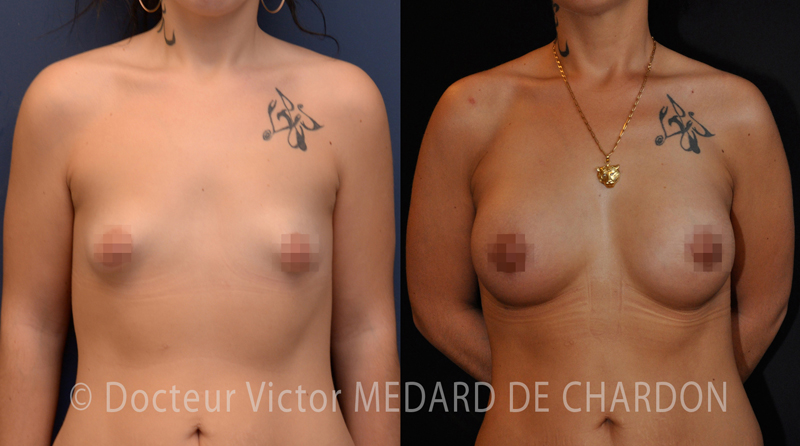
Tuberous breasts
Breast augmentation with breast implants and breast fat transfer
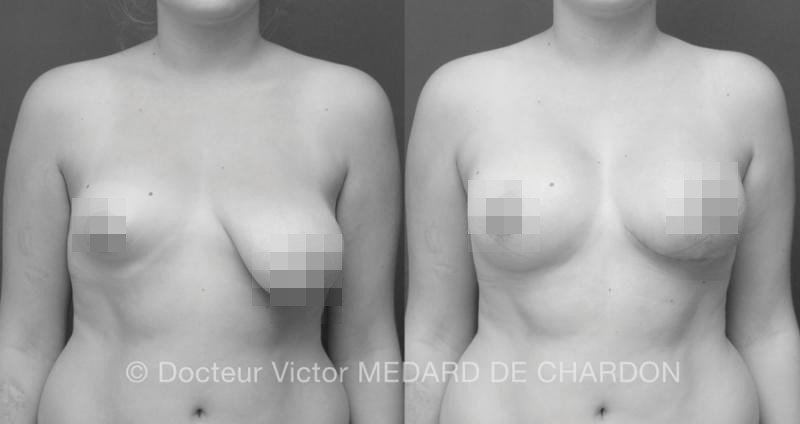
Right mastopexy with a periareolar scar and a large-volume breast implant, and left mastopexy with T-shaped scars and a small-volume breast implant
Tuberous breasts with left breast ptosis and right breast hypoplasia, causing major breast asymmetry
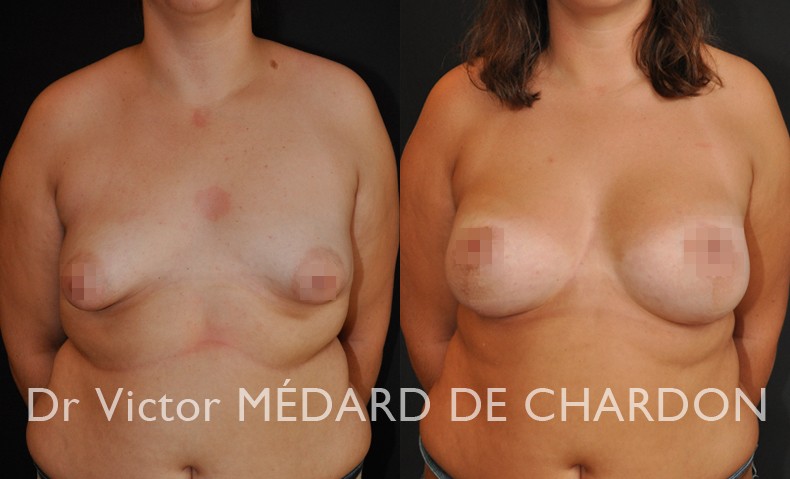
Primary breast implants
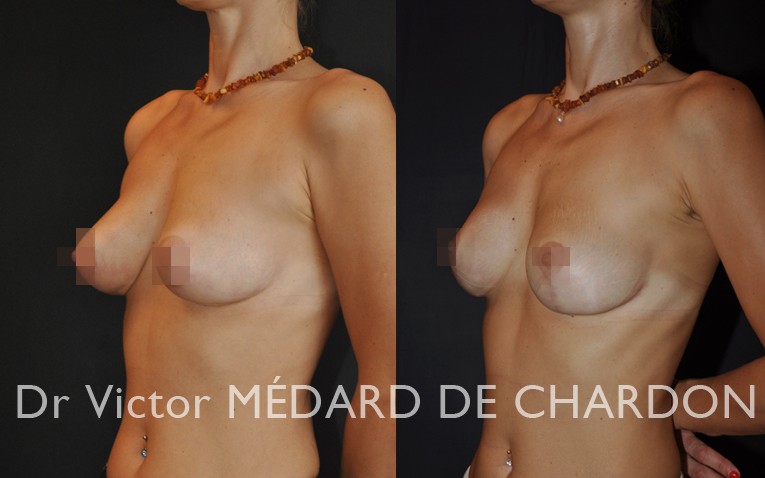
Breast reduction
- Tuberous breasts: breast augmentation with implants and fat transfer.
- Tuberous breasts with left ptosis and right hypoplasia (major asymmetry): periareolar mastopexy and a large-volume implant on the right, T-shaped mastopexy and a small-volume implant on the left.
- Tuberous breasts: mastopexy and breast implants.
- Tuberous breasts with ptosis: breast lift.
Dr Médard de Chardon’s experience in breast surgery
- Qualified plastic surgeon in plastic, reconstructive and aesthetic surgery, former Chef de Clinique (university hospital senior registrar), Nice Faculty of Medicine; practising in Cannes since 2011.
- More than 500 tuberous breast corrections performed.
- More than 1,500 mastopexies and breast reductions and more than 3,000 breast implants placed; MD thesis on breast augmentation.
- Member of SOFCEP (French Society of Aesthetic Plastic Surgery), SOFCPRE (French Society of Plastic, Reconstructive and Aesthetic Surgery) and ISAPS (International Society of Aesthetic Plastic Surgery).
Who is it for, and at what age?
The procedure is for women bothered by the shape, volume or asymmetry of tuberous breasts. It is generally considered from the age of 18, once breast development is complete; it can be discussed earlier if the psychological impact is significant, after a thorough assessment and with parental consent.
The impact is often real from adolescence: discomfort in intimate situations, avoiding the beach or sport, a poor body image. This is a medically recognised malformation, not simple dissatisfaction with appearance.
How does treatment with Dr Médard de Chardon work?
- ConsultationAt the practice, 101 rue d’Antibes in Cannes (€100): measurements of each breast (base, areolas, fold height, herniation, asymmetry, skin quality), medical photographs, discussion of your wishes (volume, implants or not, future pregnancy and breastfeeding); detailed written quote and information sheet.
- Request for prior approvalDr Médard de Chardon sends it to your Assurance Maladie office with the photographs; the medical adviser may call you in for an examination and decides on cover.
- Cooling-off periodIf the procedure is not covered (cosmetic surgery), at least 15 days between receiving the quote and the surgery.
- SurgeryAt the Clinique Oxford in Cannes: 2 to 3 hours under general anaesthesia, as day surgery or with one night in hospital. The markings are drawn with you standing, on the morning of surgery.
- Follow-upBy Dr Médard de Chardon’s team until the final result.
What is the recovery like?
- Pain: moderate, relieved by painkillers.
- Support bra: day and night for 4 to 6 weeks.
- Time off work: 7 to 15 days depending on your job and the extent of the procedure.
- Driving: from day 7 to day 10, provided there is no pain.
- Sport: gentle (walking, exercise bike) after 3 weeks; intensive sport and carrying heavy loads after 2 months.
- Sun: protect the scars for 1 year.
- Shape: the swelling and firmness of the breast disappear in 3 to 6 months; the result is final at 1 year.
Where will you be?
14 days after the procedure
What result can you expect?
Natural-looking breasts, better projected and more symmetrical, with proportionate areolas and the fold back in its proper place. No surgery gives perfect symmetry: the aim is a clear and lasting improvement. A small touch-up, most often additional fat transfer, is sometimes useful.
What are the risks?
- risks of any surgery: haematoma, infection, delayed healing, phlebitis;
- scars visible at first, which fade over 12 to 18 months; a thick scar (hypertrophic or keloid) is possible in those prone to it;
- altered sensation in the areola and nipple, usually temporary;
- possible effect on breastfeeding;
- with implants: capsular contracture, rupture, palpable folds, anaplastic large cell lymphoma (BIA-ALCL, exceptional);
- residual asymmetry, sometimes corrected by a touch-up.
Choosing a qualified, experienced and reputable surgeon reduces these risks, and can even eliminate some of them.
What does it cost, and is it reimbursed?
If covered: additional fees€2,500 to €5,000As cosmetic surgery€6,000 to €8,500
Correction of tuberous breasts is reconstructive surgery for a recognised malformation. Once the medical adviser has given approval, the procedure, anaesthesia and hospital stay are covered at Assurance Maladie rates; the additional fees, €2,500 to €5,000 on a written quote, may be partly reimbursed by your top-up health insurance (mutuelle). If cover is refused, the procedure is classed as cosmetic surgery: €6,000 to €8,500 depending on the techniques, on a written quote after the consultation (€100).
Book an appointment: +33 (0)4 93 68 86 68 or Doctolib.
Frequently asked questions about tuberous breasts
Is tuberous breast correction reimbursed?
Yes, once the Assurance Maladie medical adviser has approved a request for prior approval: it is a recognised malformation. The additional fees, €2,500 to €5,000 on a written quote, may be partly reimbursed by your mutuelle.
Are implants always needed to correct tuberous breasts?
No. Implants are only useful if the volume to be added exceeds what fat transfer can provide. In mild forms, releasing the gland, fat transfer and areola reduction are often enough.
At what age can tuberous breasts be operated on?
Generally from the age of 18, once breast development is complete. Earlier surgery can be discussed if the psychological impact is significant, with parental consent.
Will I be able to breastfeed after tuberous breast surgery?
Breastfeeding remains possible in most cases, though it cannot be guaranteed. If a pregnancy is planned soon, some patients prefer to wait until they have completed their family.
Do tuberous breasts get worse over time?
No: the malformation appears at puberty and then stabilises. Pregnancies, changes in weight and age can, however, change the appearance of the breasts.
Are the scars from tuberous breast surgery visible?
They are placed around the areola and, if a lift is added, vertically below the areola or in the fold. They fade over 12 to 18 months and usually become barely visible.
When can I return to work and sport after tuberous breast surgery?
Work after 7 to 15 days depending on your job, gentle sport after 3 weeks and intensive sport after 2 months.
Can only one breast be tuberous?
Yes. It is often asymmetrical, sometimes limited to one breast. The more normal breast can then be reduced, lifted or augmented to balance the result.
What does tuberous breast surgery cost?
If the procedure is covered, only the additional fees remain payable: €2,500 to €5,000, on a written quote. As cosmetic surgery, the price is €6,000 to €8,500 depending on the techniques, on a written quote after the consultation (€100).