

Breast implant removal at a glance
- Duration1 hour to 2.5 hours
- AnaesthesiaGeneral
- Hospital stayDay surgery or one night
- Time off work7 to 15 days
- Final shape3 to 6 months
- Price€3,000 to €10,000
Breast implant removal, or explantation, means taking out the implants without replacing them, usually together with the membrane that surrounds them (capsulectomy). It is for women who no longer want implants, or whose implants are causing a problem: capsular contracture, rupture, discomfort. The operation lasts 1 hour to 2.5 hours under general anaesthesia, as day surgery or with a one-night stay at Clinique Oxford in Cannes. Time off work is 7 to 15 days; the final shape is reached in 3 to 6 months.
Price: €3,000 to €10,000 depending on the procedure (removal alone or combined with a breast lift or fat transfer), on a written quote after a consultation (€100).
Why remove breast implants?
Removal is done for a medical reason or as a personal choice. In both cases, the decision is made in consultation, after an examination and recent imaging.
Medical reasons
- Capsular contracture, grade III or IV: hard, misshapen, sometimes painful breast. See capsular contracture after breast augmentation.
- Rupture of the implant, found on ultrasound or MRI.
- Breast implant-associated anaplastic large cell lymphoma (BIA-ALCL) or unexplained late seroma around the implant.
- Malposition: implant that has dropped, moved towards the armpit, double bubble.
- Implants withdrawn from the market: for PIP implants, preventive removal has been recommended since 2011, even without a rupture; for macrotextured or polyurethane implants, banned in France since 2019, the ANSM (French medicines safety agency) does not recommend preventive removal in the absence of symptoms.
Personal reasons
- No longer identifying with a size chosen years earlier.
- Discomfort during sport, sleep or everyday life.
- A change in figure after a pregnancy or a change in weight.
- Concern about one’s health, or symptoms attributed to the implants (see below, “breast implant illness”).
An implant does not have to be replaced after 10 years. Their average lifespan is 12 to 15 years; as long as an implant is intact and you are happy with the result, clinical and imaging surveillance every two years is enough.
Removal alone, or combined with a breast lift or fat transfer?
The choice depends on the skin and on the volume of the gland without the implant.
| Removal with capsulectomy | Removal and breast lift | Removal and fat transfer | |
|---|---|---|---|
| Who for | Firm skin, sufficient gland, small implants | Stretched skin, breasts that sag after removal | Too little volume without an implant, wish for a natural result |
| Volume after the operation | That of the gland | That of the gland, breasts lifted | About one cup size more than the gland alone |
| Scar | The one from the implant operation (fold, areola); never through the armpit | Around the areola, vertical, sometimes an inverted T | The one from the removal, plus injection points a few millimetres long |
| Duration | 1 hour to 2.5 hours | 2 to 3 hours | 2 to 3 hours |
| Time off work | 7 to 15 days | 7 to 15 days | 7 to 15 days |
To keep volume with an implant, the implants can also be replaced.
Should the capsule be removed with the implant?
The capsule is the fibrous membrane that the body naturally forms around any implant. Whether it is removed (capsulectomy) depends on its condition, assessed on examination, on imaging, then during the operation.
Total capsulectomy
The whole capsule is removed. This is the procedure indicated for capsular contracture, a thickened or calcified capsule, or rupture of the implant. The capsule is always analysed in the laboratory (histopathology); a bacteriological sample is taken case by case.
En bloc capsulectomy
The implant and its capsule are removed in one piece, without opening the capsule. It is indicated when BIA-ALCL is confirmed or suspected, and in some ruptures. It requires a longer scar and is not always possible, particularly when the capsule is stuck to the ribs.
Partial capsulectomy, or capsule left in place
A thin, supple capsule with no abnormality on imaging can be left partly or entirely: it usually resorbs. This choice avoids having to separate a capsule that is very firmly stuck to the chest wall, particularly behind the muscle.
A drain is placed after any capsulectomy.
What do the breasts look like after implant removal?
After removal, the volume is that of the breast gland. The skin, stretched by the implant, partly retracts over 3 to 6 months. The result depends on four factors:
- the volume of the implants: the larger they were, the more the skin has been stretched;
- how long they have been in place, as well as pregnancies and changes in weight since they were placed;
- the quality of the skin and the volume of the gland: a generous gland under firm skin keeps a pleasing shape;
- the position of the implant: behind the muscle, the breast can look flatter for the first few weeks, while the muscle settles back into place.
In the first few weeks, the breasts often look empty or flattened. You need to wait 3 to 6 months to judge the result and decide, if needed, on an additional procedure.
Implant removal and breast lift
When the skin is stretched and the breast sags, a breast lift (mastopexy) removes the excess skin and raises the areola. It can be carried out:
- at the same time as the removal, when the sagging of the breast is obvious before the operation;
- as a second stage, 3 to 6 months later, when the skin may still retract and it is preferable to judge the result before deciding.
The scar goes around the areola, continues vertically and sometimes forms an inverted T in the fold. Everything about the breast lift.
Implant removal and breast fat transfer
Breast fat transfer replaces part of the lost volume with your own fat, taken by liposuction. It adds about one cup size per session; a second session is sometimes offered. It is contraindicated if there is a suspicious abnormality on the mammogram or a family genetic predisposition to breast cancer.
Fat transfer can be carried out at the same time as the removal or a few months later. It can also be combined with a breast lift. Everything about breast fat transfer.
Symptoms attributed to implants (“breast implant illness”)
Some patients describe fatigue, joint pain, difficulty concentrating or sleep problems, which they link to their implants. These symptoms are real, but no cause-and-effect link has been established by studies to date.
Removal can be offered if you wish, after an assessment that rules out another cause. An improvement in the symptoms cannot be promised.
Why is implant removal more demanding than it seems?
Removing an implant is simple; achieving harmonious breasts without it is less so. Three difficulties add up:
- a capsule that is sometimes thick, calcified or stuck to the ribs;
- stretched skin, whose retraction varies from one patient to another;
- the choice, before the operation, between removal alone, a breast lift and fat transfer, at the same time or later.
Dr Médard de Chardon’s experience in breast implant surgery
- Qualified plastic surgeon in plastic, reconstructive and aesthetic surgery; practising in Cannes since 2011.
- MD thesis devoted to breast augmentation with implants (Nice Faculty of Medicine, 2008).
- More than 300 breast implant removals, more than 3,000 breast implants placed and more than 4,000 breast fat transfers performed.
- Member of SOFCEP, ISAPS and the Rhinoplasty Society of Europe.
How does implant removal work?
- First consultation€100 at the practice, 101 rue d’Antibes in Cannes: history of your implants (date, brand, volume, position), examination, photos. Bring your implant card and your latest scans. A first consultation by video call is possible if you live far away.
- ImagingUltrasound and mammogram, MRI if a rupture is suspected.
- Second consultationChoice of procedure (capsulectomy, breast lift, fat transfer), detailed written quote.
- Cooling-off periodAt least 15 days, required by law, between receiving the quote and the operation.
- PreparationAnaesthetic consultation, stopping smoking and aspirin.
- OperationAt Clinique Oxford in Cannes, 1 hour to 2.5 hours under general anaesthesia, home the same evening or the next day. A drain is placed after a capsulectomy; the capsule is analysed in the laboratory. The implants removed can be given to you.
- Follow-upCheck-ups at 6 days, 3 weeks, 3 months and 1 year.
What is the recovery like after implant removal?
Pain is generally moderate and is relieved by simple painkillers. The timetable below applies to removal with capsulectomy; a combined breast lift follows the instructions for the breast lift.
- Day 0: operation, home the same evening or the next day.
- 6 days: first check-up.
- 7 days: back to driving and sleeping on your side.
- 7 to 15 days: back to work.
- 4 weeks: end of the medical support bra, lower-body exercise.
- 6 weeks: upper-body exercise.
- 3 to 6 months: final shape, decision on any additional procedure.
- 12 months: final scars.
Where will you be?
14 days after the procedure
What are the risks of implant removal?
In addition to the risks of any surgery (haematoma, infection, reaction to the anaesthetic), removal carries a risk of:
- seroma: fluid in the old pocket, to be drained with a needle if needed;
- breasts that look empty or loose, which can be corrected with a breast lift or fat transfer;
- asymmetry or surface irregularities;
- changes in areola sensation, usually temporary;
- pneumothorax (air between the lung and the chest wall), exceptional, during a capsulectomy where the capsule is very firmly stuck to the ribs;
- persistence of the general symptoms that the patient attributed to the implants.
Choosing a qualified, experienced and reputable surgeon reduces these risks.
Before and after photos
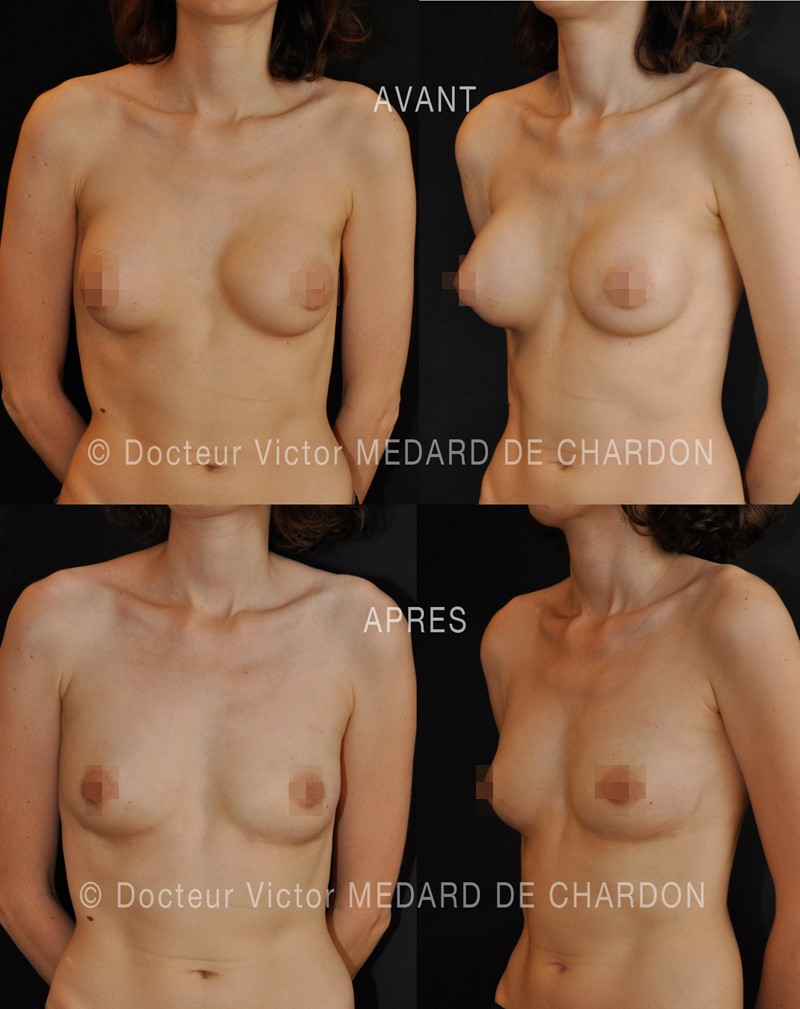
Unsuitable breast implants
Decision to remove the breast implants and transfer fat to the breasts (lipofilling). Result at 1 year
See before and after photos of breast implants, including removals and replacements
How much does breast implant removal cost in Cannes?
€3,000 to €10,000
Depending on the procedure: removal with capsulectomy, with or without a breast lift or fat transfer. The exact price is shown on the detailed written quote given after the consultation (€100, free for a patient already followed at the practice). Cover by Assurance Maladie (French national health insurance) is possible only if the original implant operation was itself covered (for example a reconstruction after cancer), in the case of BIA-ALCL, or for PIP implants; a rupture or capsular contracture after a cosmetic augmentation does not qualify for cover. Dr Médard de Chardon practises in Sector 2 (fees above the national health insurance rate), not OPTAM-registered: additional fees apply. Book on Doctolib or call +33 (0)4 93 68 86 68.
Frequently asked questions about breast implant removal
Explantation, explant surgery, implant removal: is it the same operation?
Yes. These terms all refer to removing breast implants without replacing them. “Explantation” is the medical term; “explant surgery” and “implant removal” are the terms in everyday use.
Do implants have to be replaced after they are removed?
No. Removal can be permanent, and the breasts then return to the volume of the gland. A breast lift or fat transfer can be combined to improve their shape or volume.
Will my breasts sag after implant removal?
It depends on the volume of the implants, how long they have been in place and the quality of the skin. The skin partly retracts over 3 to 6 months; if the breast still sags, a breast lift raises it, at the same time or later.
Should the capsule be removed with the implant?
Not always. Total capsulectomy is indicated for capsular contracture, a thickened capsule or rupture; en bloc capsulectomy if BIA-ALCL is suspected or confirmed. A thin, healthy capsule can be left in place.
How much time off work is needed?
Time off work is 7 to 15 days. Driving resumes after 7 days, upper-body exercise after 6 weeks.
Should macrotextured implants that cause no symptoms be removed?
The ANSM does not recommend preventive removal of macrotextured implants without symptoms; regular examination is enough. Swelling, pain or a lump calls for a prompt consultation. PIP implants are the exception: their preventive removal is recommended.
Is breast implant removal reimbursed?
Only in three cases: if the original implant operation was itself covered, in the case of BIA-ALCL, or for PIP implants. A rupture or capsular contracture after a cosmetic augmentation, removal by personal choice and any associated cosmetic procedures are not reimbursed.
How much does breast implant removal cost in Cannes?
€3,000 to €10,000 depending on the procedure: removal with capsulectomy, with or without a breast lift or fat transfer. The exact price is shown on the detailed written quote given at the consultation (€100).
References
- ANSM. Decision of 2 April 2019: withdrawal from the market of macrotextured breast implants and polyurethane-coated implants; preventive explantation not recommended.
- Médard de Chardon V. MD thesis on breast augmentation with implants. Nice Faculty of Medicine, 2008.