

Poland syndrome at a glance
- Duration1 to 4 hours depending on the technique
- AnaesthesiaGeneral
- Hospital stayDay surgery to 3 days
- Time off work1 to 3 weeks
- Final result6 to 12 months
- Covered by Assurance MaladiePossible
- PriceOn a written quote
Poland syndrome is a rare congenital malformation affecting one side of the body: the pectoralis major muscle is absent or incomplete, the breast is small or absent in women, and sometimes the hand is smaller, with short, joined fingers. Surgery restores the symmetry of the chest and breasts: an implant and fat transfer in moderate forms, a latissimus dorsi flap or fat transfer over several sessions in severe forms, and fat transfer to the chest in men. Each procedure takes 1 to 4 hours under general anaesthesia at the Clinique Oxford in Cannes; the result is final within 6 to 12 months. Once the medical adviser (médecin-conseil) has given approval, French national health insurance (Assurance Maladie) covers the procedure.
Price: on a written quote after a consultation (€100); if the procedure is covered, only the additional fees remain payable.
What is Poland syndrome?
Described in 1841 by Alfred Poland, then a medical student in London, Poland syndrome is a malformation present from birth that affects one side of the chest only. It combines three anomalies, to very varying degrees:
- The chest (always affected): absence of the lower part of the pectoralis major muscle, sometimes of the whole muscle; more rarely the pectoralis minor, latissimus dorsi or serratus anterior are affected, and in severe forms the ribs.
- The breast: small (hypoplasia) or absent (aplasia), with an areola that is often smaller, higher, and sometimes absent.
- The upper limb, on the same side: a smaller hand, short and joined fingers (brachysyndactyly), more rarely anomalies of the forearm.
The affected areas
The patient’s right side (on the left of the image). Hatched: the missing muscle; dotted line: the outline of the normal breast.
- 1Pectoralis major muscle absent: hollow below the collarbone
- 2No relief of the armpit
- 3Small breast, higher and smaller areola
- 4Sometimes, a smaller hand on the same side, with short, joined fingers
- FInjected fat (fat transfer): hollow below the collarbone and fold of the armpit
- IBreast implant; grey dotted line: the breast before
Who is affected?
Poland syndrome is rare. It affects about three men for every woman, the right side twice as often as the left, and almost always one side only. In women, it often becomes apparent at puberty, when the asymmetry of the breasts appears; in men, mild forms can go unnoticed for a long time.
What causes it?
The exact cause is not known. The most widely accepted explanation is a temporary interruption of blood flow in the subclavian artery during embryonic life, which hinders the development of the chest, breast and arm on the same side. Most cases are isolated, with no family history; nothing can be done to prevent it during pregnancy.
How is it diagnosed?
The diagnosis is clinical: a hollow below the collarbone, no relief of the armpit, asymmetry of the breasts, and possibly an anomaly of the hand. Before surgery, a CT scan of the chest shows how the muscles and ribs are affected; an MRI or ultrasound examines the mammary gland; an X-ray of the hand is taken if it is affected.
What forms does Poland syndrome take?
| Form | Breast (in women) | Chest | Hand |
|---|---|---|---|
| Minor | Small | Lower part of the pectoralis major absent | Normal |
| Moderate | Very small, areola poorly positioned | Pectoralis major absent, sometimes pectoralis minor | Sometimes affected |
| Severe | Absent | Several muscles absent, ribs sometimes affected | Often affected |
Which surgery for which situation?
The aim is to restore symmetry: breast volume, the relief of the chest and the fold of the armpit. The choice depends on sex, the form, which muscles and ribs are affected, age and the patient’s wishes.
| Situation | Usual solution | Number of procedures |
|---|---|---|
| Woman, moderate form (gland present) | Implant + fat transfer around it (composite augmentation) | 1, sometimes an additional fat transfer session |
| Woman, severe form (breast absent) | Latissimus dorsi flap ± implant, or skin expansion then implant, or fat transfer over several sessions | Several, then the areola |
| Man, moderate form | No surgery, or fat transfer to the chest | 2 to 4 sessions, 6 months apart |
| Man, severe form | Fat transfer to the chest over several sessions | 3 to 5 sessions, 6 months apart |
In women, moderate form: composite augmentation
When part of the gland is present, a silicone gel implant, round or ergonomic, restores the volume of the breast; fat harvested by liposuction (abdomen, hips, thighs) is injected around it to fill the hollow below the collarbone and redefine the fold of the armpit. About 60% of the injected fat is retained: a second session is sometimes useful.
Everything about breast augmentation Everything about breast fat transfer
In women, severe form: reconstructing the breast
When the breast and the muscle are missing, breast reconstruction techniques are needed, alone or in combination:
- latissimus dorsi flap: this back muscle is turned forwards to recreate the relief of the chest and cover an implant;
- skin expansion: an inflatable implant (tissue expander) is gradually filled over a few months to create space for a permanent implant;
- fat transfer over several sessions: reconstruction entirely with your own tissue;
- in some cases, reconstruction with abdominal tissue (DIEP flap), discussed case by case.
The areola and nipple, if missing, are reconstructed at a later stage (skin graft, tattooing).
Everything about breast reconstruction
In men: restoring the relief of the pectoral muscle
If the discomfort is mild, no surgery is needed. Otherwise, fat transfer to the chest, in several sessions 6 months apart, gradually recreates the volume of the missing muscle and the relief of the armpit. A custom-made pectoral implant can be discussed in some cases.
Before and after photos
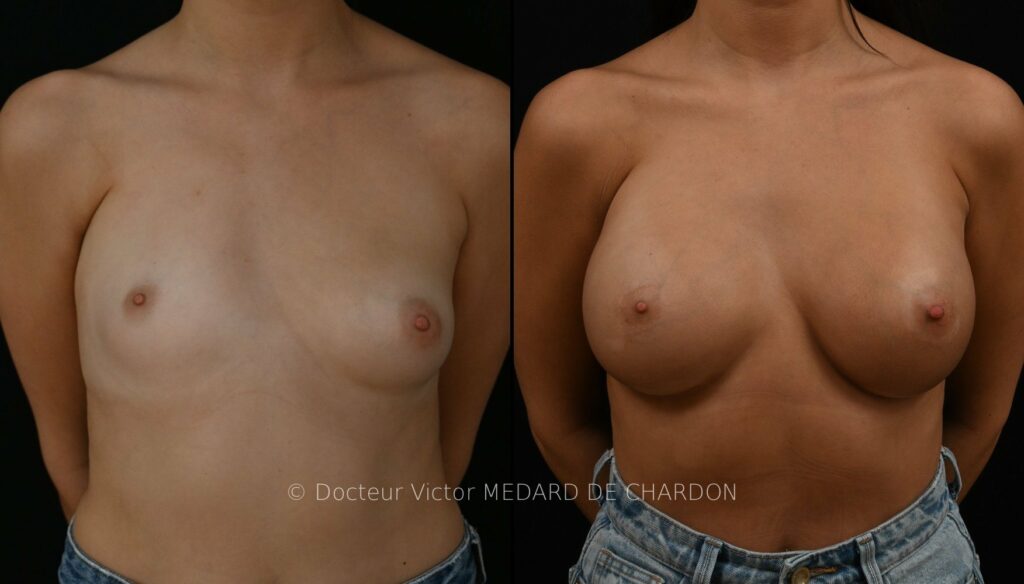
Right-sided Poland syndrome
Reconstructive surgery by breast augmentation and fat transfer (lipofilling) in two stages
Right-sided Poland syndrome in a woman: reconstructive surgery by breast augmentation and fat transfer, in two stages; front view.
Dr Médard de Chardon’s experience in breast surgery
- Qualified plastic surgeon in plastic, reconstructive and aesthetic surgery, former Chef de Clinique (university hospital senior registrar), Nice Faculty of Medicine; practising in Cannes since 2011.
- More than 1,500 mastopexies and breast reductions and more than 3,000 breast implants placed; MD thesis on breast augmentation.
- Member of SOFCEP (French Society of Aesthetic Plastic Surgery), SOFCPRE (French Society of Plastic, Reconstructive and Aesthetic Surgery) and ISAPS (International Society of Aesthetic Plastic Surgery).
At what age, and for whom?
In women, surgery is considered after breast development is complete, around the age of 18. In men, it can be done once growth has finished (around 16–17), after a thorough assessment. The impact is often significant, particularly for a teenage girl who discovers the asymmetry at puberty: discomfort in a swimsuit or underwear, loss of self-confidence.
How does treatment with Dr Médard de Chardon work?
- ConsultationAt the practice, 101 rue d’Antibes in Cannes (€100): examination and classification of the form, medical photographs, tests prescribed (CT scan, MRI), explanation of the possible techniques, their results, their limits and their risks; detailed written quote.
- Request for prior approvalSent to your Assurance Maladie office with the photographs; the medical adviser decides on cover.
- Second consultationTest results, choice of technique.
- SurgeryAt the Clinique Oxford in Cannes, under general anaesthesia: implant and fat transfer 2 to 3 hours; fat transfer alone 1 to 3 hours depending on the volume; latissimus dorsi flap 3 to 4 hours. Hospital stay from a few hours to 3 days.
- Follow-upBy Dr Médard de Chardon’s team between sessions and until the final result.
What is the recovery like?
- Pain: moderate, relieved by standard painkillers.
- Swelling and bruising: 2 to 4 weeks.
- Support bra: 6 weeks.
- Time off work: 1 to 3 weeks depending on your job and the procedure.
- Sport: stopped for 6 to 8 weeks.
- Result: final at 6–12 months, once the swelling has gone and the tissues have stabilised.
Where will you be?
14 days after the procedure
What result can you expect?
A clear improvement in the symmetry of the breasts and chest, visible in underwear and swimwear, and often real psychological relief. Symmetry is never perfect; several operations are often needed in severe forms.
What are the risks?
- risks of any surgery: haematoma, infection, delayed healing;
- fat transfer: resorption of part of the fat, small oil cysts;
- implants: capsular contracture, rupture, palpable folds; an implant lasts 12 to 15 years on average and is monitored by imaging;
- latissimus dorsi flap: compromised flap, fluid collection (seroma) and a scar on the back, discomfort on exertion at the donor site;
- residual asymmetry, sometimes corrected by a touch-up.
Choosing a qualified, experienced and reputable surgeon reduces these risks, and can even eliminate some of them.
What does it cost, and is it reimbursed?
On a written quote
Poland syndrome is a congenital malformation: once the medical adviser has approved a request for prior approval, the procedure, anaesthesia and hospital stay are covered at Assurance Maladie rates. The additional fees, on a written quote after the consultation (€100), may be partly reimbursed by your top-up health insurance (mutuelle). Dr Médard de Chardon helps you with these formalities.
Book an appointment: +33 (0)4 93 68 86 68 or Doctolib.
Frequently asked questions about Poland syndrome
At what age can Poland syndrome be operated on?
In women, after breast development is complete, around the age of 18. In men, once growth has finished, around 16–17, after a thorough assessment.
Is Poland syndrome hereditary?
Very rarely: the vast majority of cases are isolated, with no family history. A few familial cases have been described, but the risk of passing it on to children remains very low.
Is surgery for Poland syndrome reimbursed?
Yes: it is a congenital malformation, covered by Assurance Maladie once the medical adviser has approved a request for prior approval. The additional fees, on a written quote, may be partly reimbursed by your mutuelle.
How many operations are needed for Poland syndrome?
One is often enough for moderate forms in women (implant and fat transfer). Severe forms, and fat transfer to the chest in men, require several sessions, usually 6 months apart.
Why are several fat transfer sessions needed for Poland syndrome?
About 60% of the injected fat is retained; too much cannot be injected at once without the risk that it will not take. The volume is therefore built up in stages, until a stable result is reached.
Are implants placed for Poland syndrome for life?
No: a silicone gel implant lasts 12 to 15 years on average. It is monitored by imaging and is only changed if it ruptures or if the result is no longer satisfactory.
Can a man have surgery for Poland syndrome?
Yes. Fat transfer to the chest gradually recreates the relief of the missing pectoral muscle; a custom-made pectoral implant can be discussed in some cases.
Can Poland syndrome be detected during pregnancy?
Only exceptionally: the anomalies are difficult to see on ultrasound. The diagnosis is made at birth or later, often at puberty in girls.
What does surgery for Poland syndrome cost?
Once Assurance Maladie has given approval, only the additional fees remain payable, on a written quote after the consultation (€100).