
Cutis verticis gyrata at a glance
- Duration1 hour
- AnaesthesiaGeneral
- Hospital stay1 day or one-night stay
- Scalp swelling7 to 15 days
- Hair washingFrom day 2
- Folds smoothed outMore than 75%
- Price€3,500 to €7,000
Cutis verticis gyrata (CVG), also known as pachydermia verticis gyrata of the scalp, is a rare, progressive condition: the scalp skin, thickened and too loose, forms folds resembling the surface of the brain. After an assessment (brain MRI and blood tests), moderate to severe forms are treated surgically: the most heavily folded areas are excised and the scalp is re-tensioned, using a T-shaped pattern described by Dr Médard de Chardon. The procedure takes 1 hour at the Clinique Oxford in Cannes, under general anaesthesia, with a 1-day or one-night hospital stay; it smooths out more than 75% of the folds.
Price: €3,500 to €7,000, on a written quote after consultation (€100); covered by French national health insurance (Assurance Maladie).
What treatments are there for cutis verticis gyrata?
| Scalp lift | Isotretinoin | Needle puncture or needle fasciotomy | |
|---|---|---|---|
| Type | Surgery | Medication | Needle procedure |
| Principle | Excision of the most heavily folded areas and re-tensioning of the scalp | Systemic (oral) medical treatment | Division of the septa under the skin with a needle |
| Effect on the folds | The only treatment that has proven effective: more than 75% of the folds smoothed out | Has not proven effective | Has not proven effective |
How does cutis verticis gyrata present?
With folds of skin and abnormal laxity of the scalp. These folds, of varying size, are most often located on the vertex (crown), sometimes extending to the nape of the neck and the forehead. When they are large, maceration and infections can occur.
Under the microscope, the scalp typically shows hypertrophied fatty tissue beneath the skin, thickened fibrous septa, an abnormally thick dermis, sometimes mucin deposits, and hypertrophied sebaceous glands.
The condition was described in 1837 by Alibert (“cutis sulcata”); the name cutis verticis gyrata was given to it by Unna in 1907.
What causes it?
Primary CVG
Of genetic origin, it can be essential or non-essential. The primary essential form, the most common, is the only abnormality present: it mainly affects men and begins in late adolescence. The non-essential form combines CVG with other neurological or ophthalmic abnormalities (intellectual disability, epilepsy, congenital cataract, microcephaly, etc.).
Secondary CVG
It can be secondary to chronic metabolic, inflammatory, respiratory, cardiac, endocrine or hepatobiliary diseases, to cancer (paraneoplastic form), to treatment with minoxidil, to pachydermoperiostosis, or even to chronic irritation of the scalp. It mainly affects men (5 men for every woman).
What assessment is needed before the operation?
Diagnosis requires a clinical assessment and tests to rule out a secondary or primary non-essential form: a brain MRI and a full set of blood tests.
How is cutis verticis gyrata operated on?
Only scalp-lift surgery has proven effective. It is indicated as soon as the patient requests it, for cosmetic, psychological or functional discomfort, but only moderate to severe forms should be operated on. It does not prevent the progression of the disease.
The excision pattern takes four factors into account: the position of the scars must allow future excisions; it must absorb the excess skin along several axes, over the whole scalp (frontal, parieto-temporal and occipital), at the first operation as at subsequent ones; and the flaps created must have a good blood supply.
Dr Médard de Chardon’s technique, described in an article (Annales de chirurgie plastique esthétique, 2009), uses a T-shaped pattern that meets these requirements and smooths out more than 75% of the folds. It can also, if needed, improve a short forehead. In men, since the longitudinal limb lies on the vertex, early-stage or familial baldness is looked for so that the scars can be placed as well as possible.
Before: longitudinal folds of the scalp, running from front to back, most often on the vertex. In blue-green, the two excised ellipses, one transverse and the other longitudinal (T-shaped pattern).
- 1Longitudinal folds (front to back), most often on the vertex
- 2Transverse ellipse of the T-shaped excision
- 3Longitudinal ellipse, on the vertex
- 4T-shaped scar, hidden in the hair; scalp re-tensioned
Dr Médard de Chardon’s experience
- Qualified plastic surgeon in plastic, reconstructive and aesthetic surgery, former Chef de Clinique (university hospital senior registrar), Nice Faculty of Medicine; in practice in Cannes since 2011; member of SOFCEP (French Society of Aesthetic Plastic Surgery), SOFCPRE (French Society of Plastic, Reconstructive and Aesthetic Surgery) and ISAPS (International Society of Aesthetic Plastic Surgery).
- Since 2010, more than thirty patients operated on, from France, elsewhere in Europe and the Middle East.
- Co-author of the article describing the technique: Dumas P, Médard de Chardon V, et al. “Primary essential cutis verticis gyrata”, Annales de chirurgie plastique esthétique, 2009, 55(3):243-8.
Before and after photos
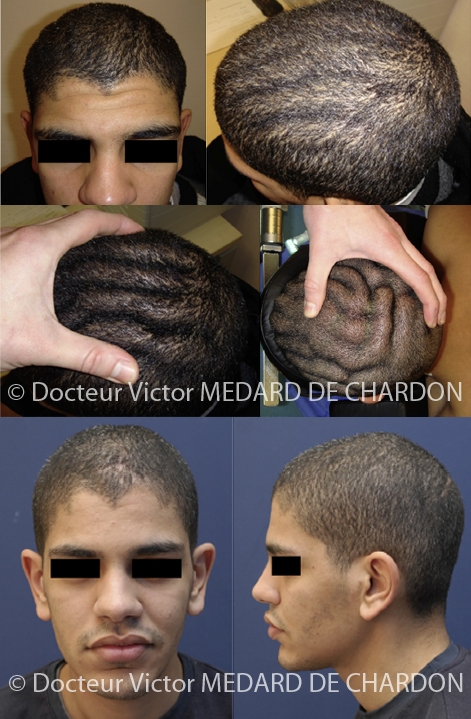
Cutis Verticis Gyrata
Reconstructive surgery by re-tensioning a scalp affected by Cutis Verticis Gyrata. Result at 2 months.
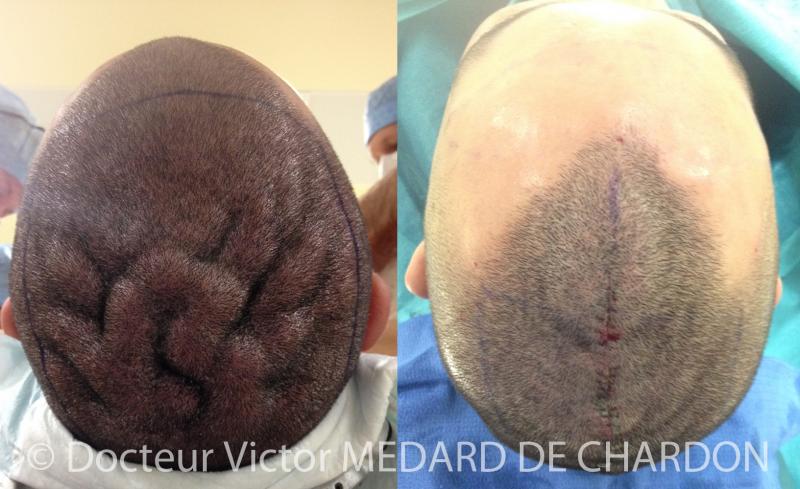
Cutis Verticis Gyrata
Immediate result of scalp lift surgery for Cutis Verticis Gyrata
See the cutis verticis gyrata before and after photos
How does the procedure work?
- ConsultationAt the practice, 101 rue d’Antibes in Cannes (€100): examination of the scalp, checking for early-stage or familial baldness in order to place the scars, written quote.
- AssessmentBrain MRI and a full set of blood tests, to rule out a secondary or primary non-essential form.
- Pre-anaesthetic consultationWith an anaesthetist.
- ProcedureAt the Clinique Oxford in Cannes, under general anaesthesia, in 1 hour, with a 1-day or one-night hospital stay.
- TechniqueExcision of the most heavily folded areas following a T-shaped pattern, adapted to the location and extent of the folds, and re-tensioning of the scalp. No drain and no stitches to remove.
What is the recovery like?
- Little pain.
- Swelling of the forehead and eyelids: 3 to 5 days.
- Swelling of the scalp: 7 to 15 days.
- Hair washing allowed from day 2.
- No drain; no stitches to remove.
- Time off work: 15 to 21 days.
Where will you be?
14 days after the procedure
What are the risks?
Like any surgery, surgery for cutis verticis gyrata carries risks, which are explained in detail at the consultation:
- continued progression of the disease: new folds may appear and justify a further excision;
- a visible scar, especially with baldness or short hair, in particular the vertex limb in men;
- haematoma or infection;
- altered sensation in the scalp.
Choosing a qualified, experienced and reputable surgeon reduces these risks, and can even eliminate some of them.
What does the procedure cost?
€3,500 to €7,000
The price is set on a written quote after the consultation (€100). It ranges from €3,500 to €7,000. As this is a medical condition, the procedure may be covered by French national health insurance (Assurance Maladie).
Book an appointment: +33 (0)4 93 68 86 68 or Doctolib.
Frequently asked questions about cutis verticis gyrata
What is cutis verticis gyrata?
A rare, progressive condition of the scalp skin, sometimes of the face: the thickened, overly loose skin forms folds resembling the surface of the brain, most often on the vertex (crown).
What causes cutis verticis gyrata?
The most common form is primary and essential: CVG is the only abnormality, in a man, from late adolescence onwards. There are also forms secondary to a chronic disease or a treatment (minoxidil), and forms associated with neurological or ophthalmic abnormalities.
What tests are needed before surgery for cutis verticis gyrata?
A brain MRI and a full set of blood tests, to rule out a secondary form or a form associated with other abnormalities.
Is there a non-surgical treatment for cutis verticis gyrata?
Isotretinoin and needle puncture or needle fasciotomy have been tried, without success. Only scalp-lift surgery has proven effective.
Who can have surgery for cutis verticis gyrata?
Moderate to severe forms, as soon as the patient requests it, for cosmetic, psychological or functional discomfort (maceration, infection).
Is the result of cutis verticis gyrata surgery permanent?
Surgery smooths out more than 75% of the folds, but does not halt the progression of the disease. The scars are placed so as to allow future excisions.
What is the recovery like after cutis verticis gyrata surgery?
There is little pain; hair washing is allowed from day 2; the scalp swelling lasts 7 to 15 days; there are no stitches to remove.
What does cutis verticis gyrata surgery cost?
The price is set on a written quote after the consultation (€100) and ranges from €3,500 to €7,000.