
Abdominoplasty at a glance
- Duration2 to 3 h
- AnaesthesiaGeneral
- Hospital stay1 to 2 nights
- Time off work15 to 21 days
- Stable resultAt 3 months
- Price€5,000 to €10,000
Abdominoplasty, or tummy tuck, is cosmetic surgery of the abdomen. It removes damaged skin (stretch marks, an overhanging apron of skin, scars), tightens the healthy skin and, if needed, repairs the muscles that have separated after pregnancy (rectus diastasis). Liposuction of the flanks is often combined with it. The operation takes 2 to 3 hours under general anaesthesia at Clinique Oxford, with one or two nights in hospital. Time off work is 15 to 21 days, the result is stable at 3 months and the scars fade over 12 months.
Price: on a written quote after consultation (pre-operative consultation: €100); operation €5,000 to €10,000.
Which abdominoplasty for which abdomen?
The technique depends on the area of skin to be tightened: the whole abdomen, only below the navel, or the abdomen together with the hips and buttocks after major weight loss. In every case, liposuction is carried out first to slim the fatty areas.
| Upper high-tension abdominoplasty | Mini abdominoplasty | Body lift | |
|---|---|---|---|
| Area tightened | The whole abdomen, above and below the navel | Skin below the navel | Abdomen, outer thighs and buttocks |
| Scars | Low horizontal scar, hidden by swimwear, and around the navel | Low horizontal scar within the swimwear line, none around the navel | Circumferential, within the underwear line, and around the navel |
| Muscles (diastasis) | Repaired if needed | Repaired if needed | Repaired if needed |
| Combined liposuction | Flanks, iliac fossae (lower sides of the abdomen), upper abdomen | The whole abdomen | Flanks, saddlebags (outer thighs) |
| Duration | 2 to 3 hours | 1 to 2 hours | 4 to 6 hours |
| Hospital stay | 1 to 2 nights | Day surgery or 1 night | 1 to 3 nights |
| Recovery | 15 to 21 days | 7 to 15 days | 15 to 21 days |
| Suitable for | Loose abdomen after pregnancies or weight loss | Laxity limited to the lower abdomen | After major weight loss, sagging buttocks |
Abdominoplasty in diagrams
Upper high-tension: the whole abdomen
Liposuction of the flanks and upper abdomen, muscles brought back together, skin removed from the navel to the pubis, then retightened downwards. Low scar within the swimwear line and around the navel.
- 1Liposuction
- 2Skin removed
- 3Rectus abdominis muscles brought together (diastasis)
- 4Retightening downwards
- 5Scars
Bringing separated muscles back together
Before: after pregnancy, the rectus abdominis muscles remain separated; the abdomen bulges between them.
- 1Skin
- 2Fat under the skin
- 3Rectus abdominis muscles
- 4Separation (diastasis), then closure with stitches
- 5Intestines, bulging through the gap
A flat abdomen, hidden scars
Before: loose abdomen, roll of fat and stretch marks below the navel.
Illustrative diagram: the result is stable at 3 months; the scars fade over 12 months.
High-tension, mini abdominoplasty or body lift
Upper high-tension abdominoplasty: the whole abdomen
This is the reference technique when all the skin of the abdomen needs to be tightened. After liposuction of the flanks and upper abdomen, the separated rectus abdominis muscles are brought back together if needed. All the skin below the navel, where stretch marks are most often concentrated, is removed; the skin of the upper abdomen is then drawn gradually down towards the pubis with internal stitches. These stitches close the whole space that has been lifted, which makes haematoma, seroma and necrosis very rare. The tightening is stronger and longer-lasting than with a conventional technique.
Mini abdominoplasty: the lower abdomen
This tightens only the skin below the navel. The scar is limited to a horizontal line within the swimwear line, with no scar around the navel. Liposuction of the whole abdomen can be carried out during the same operation, and recovery is shorter.
Body lift: the abdomen, hips and buttocks
After major weight loss, with or without obesity surgery, the laxity often extends beyond the abdomen. A body lift combines a high-tension abdominoplasty, a lift of the outer thighs and a buttock lift; the scar is circumferential and hidden within the underwear line. It takes 4 to 6 hours, with 1 to 3 nights in hospital, and requires your weight to have been stable for at least 6 months.
Why Dr Médard de Chardon does not perform reverse abdominoplasty
Reverse abdominoplasty tightens the skin of the upper abdomen, between the breasts and the navel, with a scar placed in the fold beneath the breasts. Dr Médard de Chardon does not perform it because complications are too frequent: unsightly scars and sagging of the folds beneath the breasts. The appropriate solution for laxity of the upper abdomen is discussed at consultation.
Abdominoplasty or liposuction?
Liposuction removes fat but does not tighten the skin: it is suitable for an abdomen with elastic skin and intact muscles. As soon as the skin is stretched or marked with stretch marks, or the muscles have separated, abdominoplasty is necessary; it then includes liposuction of the fatty areas. The liposuction is carried out on the flanks, the back and the upper abdomen, never on the skin that has been lifted: liposuction of that area during a high-tension abdominoplasty would be dangerous. When there is a large amount of excess fat, it is sometimes safer to perform the liposuction first and the abdominoplasty 3 to 6 months later.
Why is abdominoplasty a demanding operation?
- The tension must be strong for a lasting result, without compromising the blood supply to the skin.
- The scar must stay low, hidden by swimwear, and symmetrical.
- The navel must keep a natural shape and position.
- The separated muscles must be repaired along their entire length.
- The combined liposuction must not touch the skin that has been lifted.
Dr Médard de Chardon’s experience in abdominoplasty
Dr Médard de Chardon has performed more than 1,000 abdominoplasties. He performs the high-tension technique, the mini abdominoplasty and the body lift after major weight loss, at Clinique Oxford in Cannes. See the before and after photos of abdominoplasty.
Who is abdominoplasty for?
Abdominoplasty is for women and men whose abdomen remains loose after one or more pregnancies or after significant weight loss: stretched skin or stretch marks, an overhanging apron of skin, unsightly scars, separated muscles (diastasis) or a small hernia. It is considered once you have no further plans for pregnancy, at least 6 months after giving birth and the end of breastfeeding, and at a stable weight. When the laxity extends to the thighs and buttocks, particularly after weight loss, it forms part of a body lift.
How is an abdominoplasty carried out?
- Pre-operative consultationAt the practice, 101 rue d’Antibes, Cannes: examination of the skin and muscles of the abdomen, check for a hernia, choice of technique, information on the risks and a detailed written quote.
- Cooling-off periodThe law requires at least 15 days between receiving the quote and the operation.
- Anaesthetic consultationWith an anaesthetist (anaesthesia and intensive care physician); stop smoking completely at least one month before and one month after the operation.
- OperationAt Clinique Oxford in Cannes, under general anaesthesia, lasting 2 to 3 hours, with one or two nights in hospital.
- Follow-upPost-operative consultations with Dr Médard de Chardon and his team.
Recovery and return to activities
- Dressing: 15 days; no stitches to remove.
- Abdominal binder: 1 month; compression stockings for 15 days.
- Swelling: mild, for 1 month.
- Work: return after 15 to 21 days.
- Sport: resume in week 4, with strengthening of the rectus abdominis muscles.
- Result: visible immediately, stable and final at 3 months.
- Scars: final appearance at 12 months.
Where will you be?
14 days after the procedure
Risks and complications
Like any surgery, an abdominoplasty carries risks, which are rare when it is performed by a qualified plastic surgeon in an accredited facility. With the high-tension technique, haematoma, seroma (a collection of fluid) and skin necrosis have become very rare. The other risks are delayed healing, which smoking makes more likely, a widened scar, temporary changes in sensation in the lower abdomen and phlebitis (deep vein thrombosis), which is prevented with preventive anticoagulation. They are explained in detail at the consultation.
Choosing a qualified, experienced and reputable surgeon reduces these risks, and can even eliminate some of them.
Maintaining the result
The result lasts as long as your weight remains stable. A new pregnancy or significant weight gain can stretch the skin and muscles again; this is why the operation is generally considered once you have no further plans for pregnancy and your weight has stabilised.
Before and after photos

Loose abdominal skin with excess fat
High-tension abdominoplasty in a man

High-tension abdominoplasty with transposition of the navel
Result at 6 months of an abdominoplasty (cosmetic tummy surgery) combined with moderate circumferential abdominal liposuction
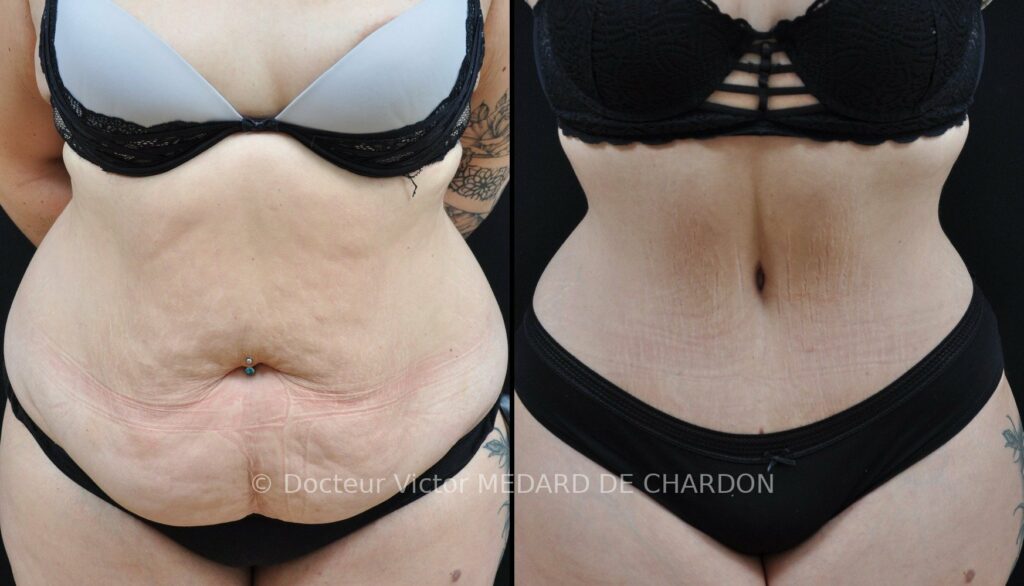
Lipoabdominoplasty
Lipoabdominoplasty with muscle repair and 5-litre circumferential liposuction
See all before and after photos of abdominoplasty
How much does an abdominoplasty cost, and is it reimbursed?
€5,000 to €10,000
The price depends on the technique and any combined procedures. It is set out in a written quote after the pre-operative consultation (€100) and ranges from €5,000 to €10,000. Cosmetic abdominoplasty is not reimbursed. French national health insurance (Assurance Maladie) may, however, cover part of the operation when the apron of skin covers at least part of the pubis, most often after major weight loss, subject to prior approval. Additional fees (above the Assurance Maladie rate) remain payable by the patient or their top-up insurance (mutuelle). Book on Doctolib or call +33 (0)4 93 68 86 68.
Frequently asked questions about abdominoplasty
What is the difference between abdominoplasty and a tummy tuck?
There is none: abdominoplasty, tummy tuck and tummy lift all refer to the same operation, which removes excess skin from the abdomen and tightens the remaining skin.
Does abdominoplasty make you lose weight?
No. It removes excess skin and slims the abdomen with liposuction, but it is not a way to lose weight. It is ideally done once you have reached your ideal weight and it is stable, as large changes in weight can affect the result.
Does abdominoplasty remove stretch marks?
It removes the stretch marks below the navel, since all that skin is removed during a high-tension abdominoplasty. Stretch marks higher up are drawn down and tightened, but not removed.
Does abdominoplasty repair the muscles after pregnancy?
Yes. When the rectus abdominis muscles have separated (diastasis), they are brought together with stitches during the operation, which firms the abdomen. A small hernia can be treated at the same time.
How should I prepare for an abdominoplasty?
A blood test is carried out, supplemented if necessary by a cardiologist’s opinion. Smoking is stopped at least one month before and one month after the operation; aspirin, anti-inflammatory drugs and herbal supplements are avoided, as they increase bleeding. A shower with an antiseptic soap is taken the evening before and the morning of the operation.
Where are the scars from an abdominoplasty?
After a high-tension abdominoplasty, the scar is horizontal, at the very bottom of the abdomen, hidden by underwear or swimwear, with a small scar around the navel. The mini abdominoplasty leaves no scar around the navel. The scars fade over 12 months.
Is abdominoplasty painful?
Usually only a little. In addition to the general anaesthetic, the anaesthetist numbs the abdominal wall for several hours with an ultrasound-guided injection (TAP block), and painkillers are prescribed for the first few days.
When can I go back to work after an abdominoplasty?
After 15 to 21 days. Sport resumes in week 4, and an abdominal binder is worn for 1 month.
What precautions should I take after an abdominoplasty?
No heavy lifting for 3 weeks, and no sleeping on your front for 1 month; sleeping on your back or side is fine. The abdominal binder is worn for 1 month, the compression stockings for 15 days, and sport resumes in week 4.
Is the result of an abdominoplasty permanent?
The result is visible immediately and stable at 3 months. It lasts as long as your weight remains stable and there is no new pregnancy.
Is a touch-up sometimes needed after an abdominoplasty?
Rarely. A small touch-up may be offered from 3 months onwards to correct an imperfection, for example a small excess of skin or fat at the end of the scar.
Can I have a child after an abdominoplasty?
Yes, but pregnancy stretches the skin and muscles again and can undo part of the result. This is why it is advisable to wait until you have no further plans for pregnancy before the operation.
Abdominoplasty or liposuction: which should I choose?
Liposuction is enough if the skin is elastic and the muscles are intact. As soon as the skin is stretched or marked with stretch marks, or the muscles have separated, an abdominoplasty is necessary; it then includes liposuction of the flanks.
How much does an abdominoplasty cost in Cannes, and is it reimbursed?
The price depends on the technique and any combined procedures: from €5,000 to €10,000, on a written quote after the pre-operative consultation (€100). Cosmetic abdominoplasty is not reimbursed; partial cover is possible when the apron of skin covers at least part of the pubis, subject to prior approval from Assurance Maladie.