

Rippling at a glance
- Frequency0.7 to 15% (marked rippling)
- Main causeThin covering tissues
- Most troublesome areaCleavage
- ThresholdLess than 20 mm of tissue: behind the muscle
- Volume to avoidOver 350 cc in a slim patient
- PriceOn quotation
Rippling means folds in the implant that are visible under the skin, especially in the cleavage; the implant may also be visible or palpable. Rippling appears when the tissues covering the implant are thin: a very slim patient, a very small breast, an implant that is too large or placed in front of the muscle. It is prevented by the choice of implant position and volume. When it is bothersome, fat transfer (lipofilling), an implant change or a change of pocket can reduce it.
Price: treatment on a written quote after consultation (€100).
What is rippling after breast augmentation?
Rippling is folds visible on the surface of the skin, which follow the folds of the implant shell. It may appear only in certain areas of the breast, depending on the technique used and the patient’s anatomy. Published figures are hard to compare, because the diagnosis is subjective and both patients and implants differ: rippling judged excessive affects 0.7 to 15% of patients, depending on the study.
Why does rippling form?
Two phenomena, often combined, cause the implant to fold:
- folds related to the implant’s contents: a silicone gel of low cohesiveness (or, in the past, an underfilled saline implant; these implants are no longer sold);
- traction folds: the implant pulls on the capsule surrounding it, through its weight or because its surface adheres to the capsule.
These folds only become visible if the tissues covering the implant are thin.
Slim patient, implant in front of the muscle: only the skin and a thin layer of breast gland cover it; its edge and folds show in the cleavage (3). (default state).
- 1Implant
- 2Pectoralis major muscle
- 3Implant edge and visible rippling
- 4Injected fat (lipofilling)
What are the causes?
The causes combine:
| Cause | Examples |
|---|---|
| Insufficient covering tissue | Very slim patient, thin skin and fat; very small breast; narrow breast base, or implant wider than the breast (volume too large) |
| Implant position | In front of the muscle; behind the muscle if its inner attachments are released too much |
| Implant | Large volume (weight, thinning of the tissues over time); low-cohesive gel; textured surface that adheres to the capsule |
| Moderate capsular contracture | The tightening capsule folds the implant (see capsular contracture) |
Late rippling, several years after the operation, is explained by gradual thinning of the tissues: a large-volume implant, pregnancy, breastfeeding, weight loss or age.
Is rippling serious?
The problem is mainly cosmetic. In the cleavage, rippling is particularly unsightly and most often requires treatment. In exceptional cases, very marked folds can wear the implant down until it ruptures, or thin the tissues to the point of exposing the implant.
How can rippling be prevented?
Four precautions during breast augmentation:
- Place the implant behind the muscle when the tissues covering the upper breast measure less than 20 mm, and do not release the lower inner fibres of the muscle when they measure less than 5 mm at the level of the fold.
- Do not over-release the inner attachments of the pectoralis major muscle.
- Avoid an excessive volume, above 350 cc in a slim patient with thin skin and fat. When a patient wants a large volume, full information helps her choose a more reasonable volume.
- Choose a well-filled implant: the fill and the cohesiveness of the gel vary between manufacturers.
Choosing a qualified, experienced and reputable surgeon reduces these risks, and can even eliminate some of them.
How is rippling treated?
Several solutions, alone or combined:
| Solution | When? |
|---|---|
| No treatment, in agreement with the patient | Minimal rippling, outside the cleavage |
| Regaining weight | Rippling that appeared after weight loss: the fat under the skin thickens |
| Breast fat transfer (lipofilling) | Injecting fat into the breast to thicken the tissues and conceal the rippling |
| Implant change | Implants with more cohesive gel or better filled; smooth or micro-textured implants in place of textured implants |
| Change of pocket | Implant in front of the muscle with rippling in the cleavage: moving it behind the muscle or to a dual plane position |
| Acellular dermal matrix (ADM) | A sheet placed between the implant and the breast to thicken the tissues |
Polyurethane-coated implants, formerly offered against traction folds, have been banned in France since April 2019 (see capsular contracture).
The operations take place at Clinique Oxford in Cannes, after a consultation (€100), a written quote and the statutory 15-day cooling-off period.
Dr Médard de Chardon’s experience
- MD thesis on breast augmentation with implants (Nice Faculty of Medicine, 2008): this page is drawn from it.
- More than 3,000 breast implants placed; practising in Cannes since 2011.
- Qualified plastic surgeon in plastic, reconstructive and aesthetic surgery, former Chef de Clinique (university hospital senior registrar), Nice Faculty of Medicine; member of SOFCEP (French Society of Aesthetic Plastic Surgery), SOFCPRE (French Society of Plastic, Reconstructive and Aesthetic Surgery) and ISAPS (International Society of Aesthetic Plastic Surgery).
Before and after photos
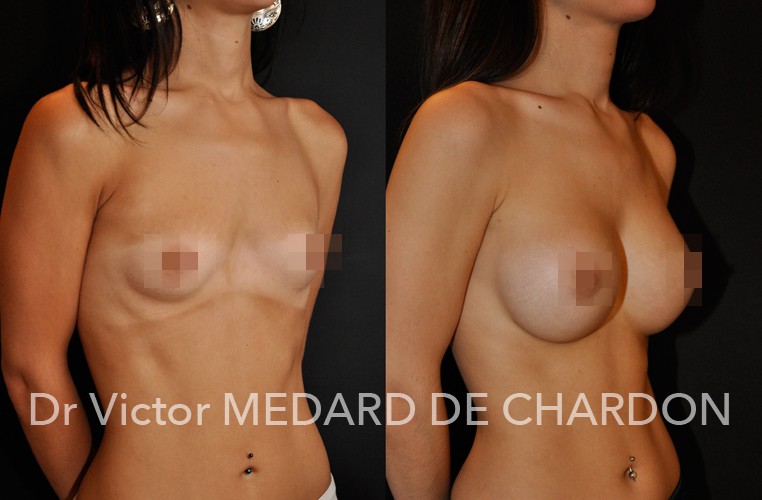
Composite breast augmentation (implants + fat transfer)
Breast augmentation with implants and fat transfer (composite technique) to better conceal the edges of the implant and correct a minor pre-operative volume asymmetry.
See all breast augmentation before and after photos
Frequently asked questions about rippling
Why can my breast implant be seen or felt?
Because the tissues covering it are thin: a very slim patient, a very small breast, an implant that is too large or placed in front of the muscle. The folds of the shell then become visible or palpable.
Can breast implant rippling appear years later?
Yes, when the tissues thin: a large-volume implant, pregnancy, breastfeeding, weight loss or age.
How can breast implant rippling be avoided?
By placing the implant behind the muscle or in a dual plane position when the tissues are thin, and by choosing a reasonable volume, not exceeding 350 cc in a slim patient.
Can fat transfer conceal breast implant rippling?
Yes, injecting fat thickens the tissues covering the implant. It can be done at the time the implants are placed (composite augmentation) or later.
Do breast implants need to be changed if there is rippling?
Not always. A change to implants with more cohesive gel, or a change of pocket to behind the muscle, is offered when the rippling is marked, particularly in the cleavage.
Is breast implant rippling dangerous?
Usually not: the problem is cosmetic. In exceptional cases, very marked folds can damage the implant or thin the tissues to the point of exposing it.
References
This information is drawn from Dr Victor Médard de Chardon’s MD thesis on breast augmentation (Nice Faculty of Medicine, 2008).
- Handel N, Cordray T, Gutierrez J, et al. A long-term study of outcomes, complications, and patient satisfaction with breast implants. Plast Reconstr Surg 2006; 117: 757-767.
- Codner MA, Cohen AT, Hester TR. Complications in breast augmentation: prevention and correction. Clin Plast Surg 2001; 28: 587-595.
- Baeke JL. Breast deformity caused by anatomical or teardrop implant rotation. Plast Reconstr Surg 2002; 109: 2555-2564.
- Araco A, Gravante G, Araco F, et al. A retrospective analysis of 3,000 primary aesthetic breast augmentations: postoperative complications and associated factors. Aesthetic Plast Surg 2007; 31: 532-539.
- Tebbetts JB. What is adequate fill? Implications in breast implant surgery. Plast Reconstr Surg 1996; 97: 1451-1454.
- Tebbetts JB. Breast augmentation with full-height anatomic saline implants: the pros and cons. Clin Plast Surg 2001; 28: 567-577.
- Danino A, Rocher F, Blanchet-Bardon C, et al. [A scanning electron microscopy study of the surface of porous-textured breast implants and their capsules. Description of the “velcro” effect of porous-textured breast prostheses]. Ann Chir Plast Esthet 2001; 46: 23-30.
- Dionyssopoulos A. [The non-perfect results of breast implants]. Ann Chir Plast Esthet 2005; 50: 534-543.