

Choosing implant volume at a glance
- Most common volume200 to 300 cc
- CriteriaChest and breast measurements
- Implant sizersTried on during the consultation
- SimulationIn 3 dimensions
- Final volume2 months
- Price€5,000 to €10,000
The volume of breast implants is chosen during the consultation by bringing two approaches together: the measurements of the chest and breasts, which set what the tissues can take, and the patient’s wishes, refined with implant sizers, photos of similar cases and a 3-dimensional simulation. In France, most implants used are between 200 and 300 cc. Too small a volume leaves the breasts set wide apart; too large a volume gives an unnatural result that ages faster.
Price: breast augmentation from €5,000 to €10,000, implants included, on a written quote after consultation (€100).
What implant volumes are used in France?
In France, 87% of surgeons use implants of 200 to 300 cc. This volume is added to the volume of the existing breast: a 250 cc implant does not give the same result on a very small breast as on a breast that already has some volume. The volume of implants used has been gradually increasing over the years.
What criteria does the surgeon use to choose the volume?
The volume follows first from measurements taken during the consultation. An implant is defined by its base (its diameter) and its projection: it is these two dimensions, more than the figure in cc, that must match the breast.
| Measurement | What it determines |
|---|---|
| Breast base, existing and ideal | The diameter of the implant, which must not exceed the ideal base |
| Distance between the breasts | How close together the breasts sit in the cleavage |
| Lateral fullness | The curve on the outer side of the breast, without spilling under the arm |
| Desired height | The fullness of the upper breast (cleavage) |
| Projection | Re-draping of a deflated (emptied) breast |
- 1Breast base: sets the diameter of the implant
- 2Distance between the breasts: how close they sit in the cleavage
- 3Lateral fullness: the curve on the outer side of the breast
- 4Height: the fullness of the upper breast
- 5Projection: re-draping of a deflated breast
Other criteria matter too:
- The shape and elasticity of the breast. The skin of a youthful, firm, conical breast is often not very elastic: it copes poorly with a large volume.
- The height of the breast on the chest. The higher the breast sits, the smaller the volume needed for a satisfying result.
- The shape of the chest. A rounded upper back (kyphosis) or a flat or hollow chest (pectus excavatum) visually “absorbs” volume and sometimes calls for a larger implant.
- Asymmetry. Asymmetry of the chest, often related to scoliosis, or of the breasts, is compensated for with two implants of different volumes or with additional breast fat transfer (lipofilling). See also: breast asymmetry.
How does the patient define what she wants?
The surgeon assesses the patient’s wishes using:
- implant sizers tried on during the consultation;
- photos of similar cases operated on by Dr Médard de Chardon;
- a 3-dimensional simulation of the breast augmentation;
- photos brought by the patient that illustrate the result she is looking for.
The volume chosen is the one that reconciles these wishes with the measurements. When the volume requested is unsuited to the patient’s build, Dr Médard de Chardon declines to operate.
What are the risks of too small a volume?
Too small a volume can leave imperfections: breasts set wide apart (a wide gap between the breasts), or a lack of curve in the cleavage or in the lower outer part of the breast.
What are the risks of too large a volume?
Too large a volume gives an unnatural result. This distortion comes from three factors: a volume too large for the patient’s measurements and her chest, too wide a diameter, and an over-rounded upper breast (segment II).
An implant that is too large also exposes you to complications:
- thinning of the breast gland (attenuation), with rippling and folds that can be felt to the touch;
- early sagging of the breast (ptosis), with the lower breast stretching out excessively, especially when the implant is in front of the muscle;
- symmastia: the pockets of the two implants join in front of the breastbone, which looks very unsightly;
- breakdown of the scar, with a risk of the implant becoming exposed.
Choosing a qualified, experienced and reputable surgeon reduces these risks, and can even eliminate some of them.
Right volume: the implant fills the breast without stretching it; the upper breast slopes down gently. (default state).
- 1Flat upper breast
- 2Over-rounded upper breast (segment II)
- 3Stretched tissues, lower breast stretching out
Volume, shape and profile
Volume is not chosen in isolation: for the same volume, a low-profile implant is wider and projects less than a high-profile implant. Shape matters too: see round implants and anatomical (teardrop) implants.
Dr Médard de Chardon’s experience
- MD thesis on breast augmentation with implants, defended at the Nice Faculty of Medicine in 2008: the criteria above are drawn from it.
- More than 3,000 breast implants placed; practising in Cannes since 2011.
- Qualified plastic surgeon in plastic, reconstructive and aesthetic surgery, former Chef de Clinique (university hospital senior registrar), Nice Faculty of Medicine; member of SOFCEP (French Society of Aesthetic Plastic Surgery), SOFCPRE (French Society of Plastic, Reconstructive and Aesthetic Surgery) and ISAPS (International Society of Aesthetic Plastic Surgery).
How does breast augmentation take place?
The volume, shape and position of the implant and the scar are discussed at the first consultation (€100) and finalised at the second; a statutory 15-day cooling-off period separates the handing over of the written quote from the operation. The operation takes about 1 hour, as day surgery (home the same day) or with a one-night stay at Clinique Oxford in Cannes; the volume is final after about 2 months. The procedure, recovery and risks are described in detail on the breast augmentation page.
Before and after photos
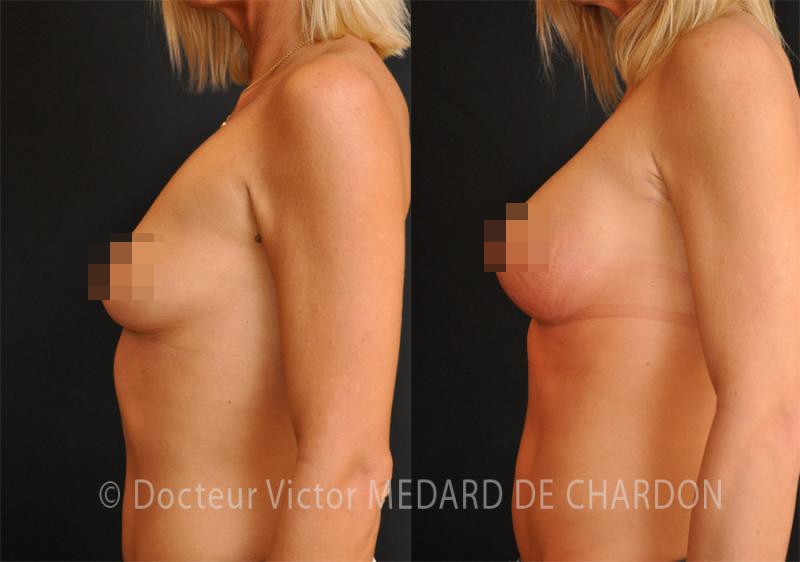
Breast augmentation with 250 cc moderate-profile round implants, dual plane I, by the endoscopic transaxillary (armpit) approach
Breast augmentation with breast implants
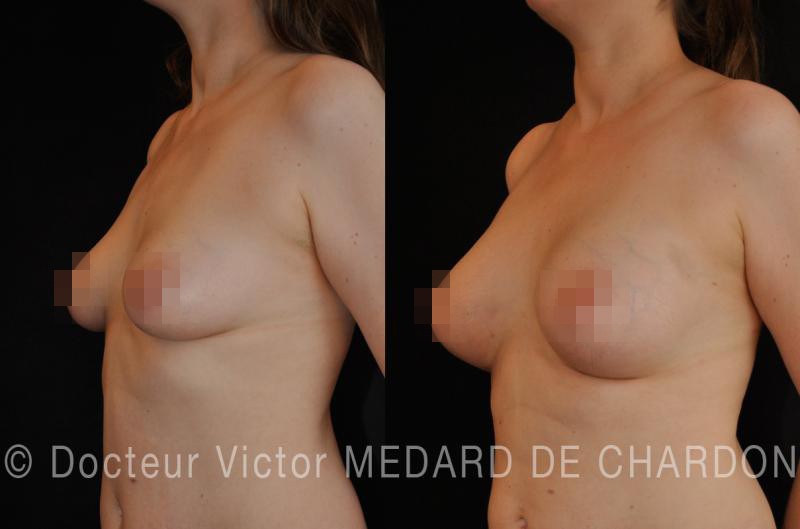
Round breast implants, inframammary incision, 300 cc, dual plane
Tall woman with breast hypotrophy, requesting breast augmentation with implants
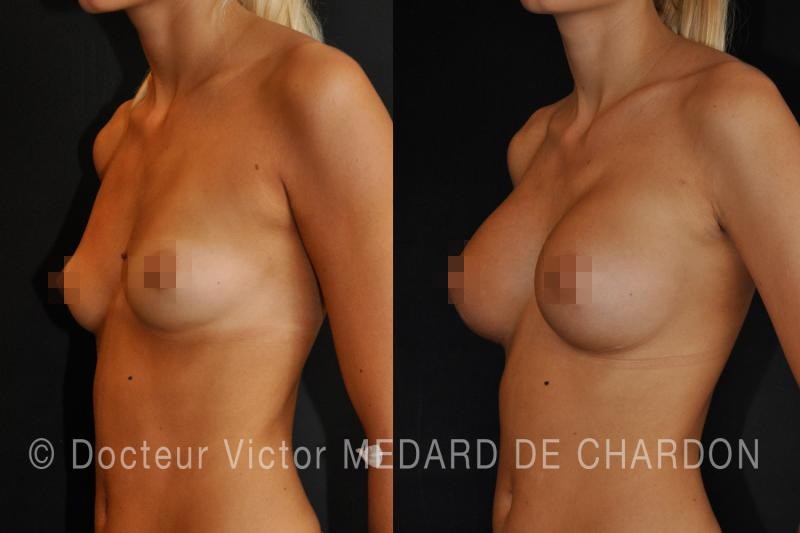
Breast implants for breast hypoplasia in a tall woman
Breast augmentation through an inframammary incision, dual plane, 410 cc round breast implants.
See all breast augmentation before and after photos
Frequently asked questions about implant volume
How many cc of breast implant does it take to go up one cup size?
For a woman of average height and weight, with a chest of normal shape, a 250 cc implant adds about one cup size, and a 300 cc implant about two cup sizes. This is only an estimate: the result varies with each patient’s anatomy (volume of the existing breast, width of the chest, implant profile), which is why measurements and sizers matter.
What is the most common breast implant volume?
In France, most implants used are between 200 and 300 cc. This volume is added to that of the existing breast.
Can I choose the volume of my breast implants myself?
The patient’s wishes are essential, but the volume must remain compatible with her measurements. Sizers, photos of similar cases and the 3-dimensional simulation help bring the two together; a volume unsuited to the patient’s build is declined.
Why avoid too large a breast implant volume?
Too large a volume gives an unnatural result and stretches the tissues: thinning of the breast gland, rippling, early sagging of the breast, and even symmastia or breakdown of the scar.
Can two breast implants of different volumes be used?
Yes, to correct asymmetry of the breasts or of the chest. Fat transfer (lipofilling) can also complete the result on the smaller side.
When is breast volume final after breast augmentation?
The volume is final after about 2 months, once the swelling (oedema) has settled; the shape continues to refine for up to 3 months.
References
This information is drawn from Dr Victor Médard de Chardon’s MD thesis on breast augmentation with implants (Nice Faculty of Medicine, 2008).