

Anatomical breast implants at a glance
- ShapeTeardrop
- UseChanging the shape of the breast
- Main riskRotation
- Since 2019Macrotextured implants banned
- TodayNo longer recommended
- Price€5,000 to €10,000
The anatomical implant is teardrop-shaped: fuller at the bottom, with a gentle slope towards the top of the breast. For a long time it was used to change the shape of the breast: very small breasts, sagging breasts (ptosis), a low nipple. Since April 2019, macrotextured implants, which gripped the surrounding tissue, have been banned in France; the anatomical implants still available, micro-textured, nano-textured or smooth, rotate much more often, which distorts the breast. Dr Médard de Chardon therefore no longer recommends them and prefers round or ergonomic implants, in cohesive silicone gel, with an average lifespan of 12 to 15 years.
Price: breast augmentation €5,000 to €10,000, implants included, on a written quote after a consultation (€100).
Anatomical, round or ergonomic implant: what is the difference?
| Anatomical implant | Round implant | Ergonomic implant (Motiva) | |
|---|---|---|---|
| Shape | Teardrop, fuller at the bottom | Round, symmetrical | Round, soft gel that takes on a teardrop shape when standing |
| Risk of rotation | Yes, much higher since 2019 (end of macrotextured implants) | None | None |
| Strength | Changes the shape of the breast | Simplicity; identical result on a well-proportioned breast | Natural look when standing, with no risk of rotation |
| Indications | Very small breasts, ptosis, low nipple (2008 thesis) | Well-proportioned breast, centred nipple, revision surgery | Patients seeking a natural result |
| Recommended today | No | Yes | Yes |
Anatomical: teardrop-shaped, fuller at the bottom; useful for changing the shape of the breast, but it rotates much more often since the end of macrotextured implants (2019): Dr Médard de Chardon no longer recommends it.
How is an anatomical implant designed?
All anatomical implants have two features in common: the upper part of the breast, between the top of the chest and the nipple (segment II), slopes down gently; and the most projecting point of the implant sits lower than on a round implant. This is the natural shape of most breasts: 71.5% of the breasts in the series studied in Dr Médard de Chardon’s thesis.
The first breast implant, designed by Cronin in 1963, was already anatomical in shape. See the history of breast implants.
There are two variants:
| Taller than wide (classic shape) | Wider than tall (reduced height) | |
|---|---|---|
| Effect | Fills the upper breast with a gentle slope | Widens the breast while filling the upper part only slightly |
| Best indications | Long chest (12%), breasts set low on the chest (10.5%) | Wide gap between the breasts (38%), wide chest (18%), breasts set high (8%), wish for a less filled cleavage |
| To avoid | — | Long chest, breasts set low or sagging, wish for a rounded cleavage |
The implant that is wider than tall brings the breasts closer together without resorting to an excessive volume. Being well covered by the breast tissue in its upper part, it also shows rippling (folds in the shell) in the upper breast less often.
Which breasts was an anatomical implant suited to?
When the breast already has a pleasing shape, the result is satisfactory with any implant shape. According to Dr Médard de Chardon’s research (2008 thesis, at the time of macrotextured implants), the anatomical implant found its best indications when the aim was to change the shape of the breast:
- very small breasts in a slim patient, or a large augmentation that must remain as natural as possible: the shape of the breast then depends mainly on that of the implant, as in breast reconstruction. For a small augmentation, however, the anatomical implant offers no advantage;
- sagging breasts (ptosis): 40% of the breasts in the series. The upper breast is empty and the nipple low; the anatomical implant places its most projecting point opposite the nipple and fills the upper breast with a gentle slope;
- a nipple set low on the breast, because the distance between the nipple and the fold under the breast is short (short segment III): 13.25% of the series. A round implant would mean either lowering the fold only slightly, giving the impression of a sagging breast, or lowering it a great deal, with a risk of double bubble;
- patients who do not want a rounded cleavage even though their build tends towards one.
An irregular shape of the chest wall is not a poor indication: despite a theoretical risk of rotation, a well-fitted pocket keeps the implant in place.
Advantages and drawbacks
Advantages
- The different proportions (height and width) suit more breasts, which improves coverage of the implant by the tissues.
- The implant fills the upper part of a deflated breast with a gentle slope and makes it possible, to a certain extent, to change the shape of the breast.
- The fold under the breast is lowered less than with a round implant, which limits the risk of double bubble, of uneven fold heights and of the implants gradually descending.
Drawback
The main drawback is the risk of rotation: the implant can turn in its pocket and, because it is not symmetrical, the shape of the breast changes. This risk is much higher with the micro-textured, nano-textured or smooth implants available today.
Why does Dr Médard de Chardon no longer recommend anatomical implants?
To grip the tissues and not rotate, anatomical implants were for a long time macrotextured. Since April 2019, the ANSM (French National Agency for the Safety of Medicines and Health Products) has banned macrotextured and polyurethane-coated implants in France, because of a rare risk of lymphoma (BIA-ALCL). The anatomical implants still available, micro-textured, nano-textured or smooth, rotate much more often: Dr Médard de Chardon therefore no longer recommends them. He prefers the round implant, which can rotate without changing the shape of the breast. See: rotation of anatomical implants.
How does the surgeon place an anatomical implant?
- The implant is chosen on its dimensions (height, width, projection) rather than on its volume.
- It can be deliberately angled 20 to 30° inwards or outwards to correct an asymmetry of the breast or chest, or to better fill the inner or outer side of the upper breast.
- For an implant that is taller than wide, the pocket is narrow at the sides, which stabilises the implant (cam effect), and deliberately wide towards the top so that the skin and breast tissue drape well.
- For an implant that is wider than tall, the pocket is cut to the dimensions of the implant.
In place: the tip of the teardrop pointing upwards, the full part at the bottom, opposite the nipple.
Dr Médard de Chardon’s experience
- MD thesis on breast augmentation with implants, defended at the Nice Faculty of Medicine in 2008: the indications above are drawn from it.
- More than 3,000 breast implants placed; practising in Cannes since 2011.
- Qualified plastic surgeon in plastic, reconstructive and aesthetic surgery, former Chef de Clinique (university hospital senior registrar), Nice Faculty of Medicine; member of SOFCEP (French Society of Aesthetic Plastic Surgery), SOFCPRE (French Society of Plastic, Reconstructive and Aesthetic Surgery) and ISAPS (International Society of Aesthetic Plastic Surgery).
How does breast augmentation work?
The choice of implant (round or ergonomic), its dimensions, its position and the scar is made in consultation, after trial sizers and a 3D simulation. The operation lasts about 1 hour, as day surgery or with a one-night stay at Clinique Oxford in Cannes; time off work is 7 to 10 days. The process, recovery and risks are set out on the breast augmentation page. See also: how to choose the volume of your implants.
Before and after photos
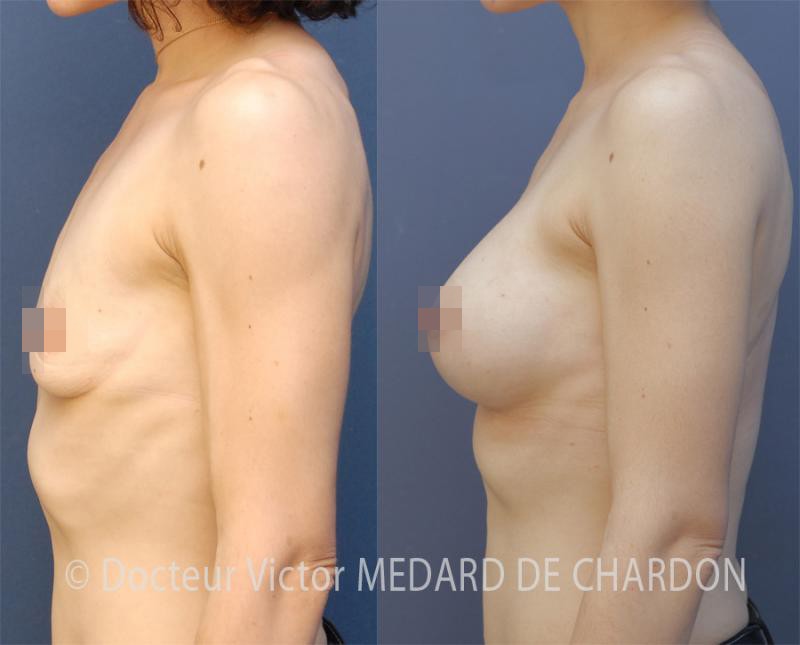
Breast augmentation with 370 cc high-profile anatomical breast implants, dual plane II, areolar incision
Refilling breasts emptied by weight loss and pregnancy, with anatomical breast implants that restore projection and fill segment II of the breasts.
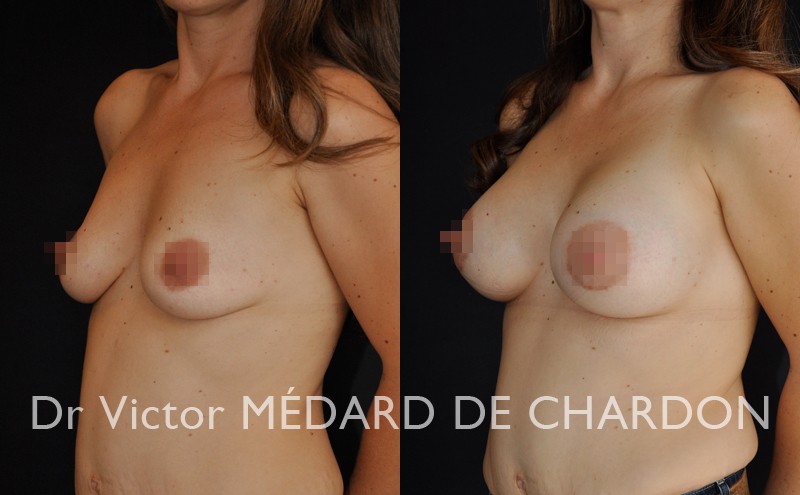
Breast augmentation through the areola, dual plane, 350 cc anatomical implants
Anatomical breast implants in a dual-plane pocket for breast ptosis
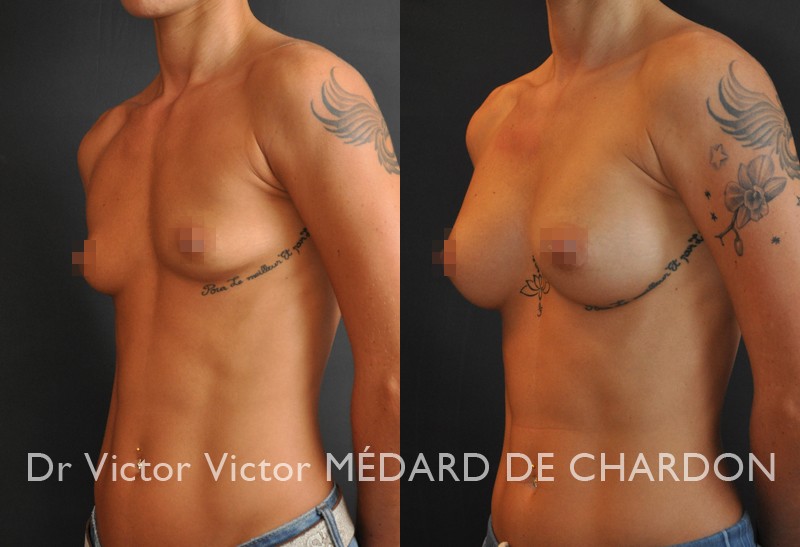
Breast hypoplasia (small breasts) in an athletic woman, a fitness coach
235 cc anatomical breast implants inserted through an areolar incision into a dual-plane pocket, with no additional fat injection.
See all before and after breast augmentation photos
Frequently asked questions about anatomical implants
Anatomical or round breast implant: which should you choose?
Dr Médard de Chardon no longer recommends anatomical implants: those available since 2019, micro-textured, nano-textured or smooth, rotate much more often than the former macrotextured implants. He prefers the round implant, which does not distort the breast if it rotates. On a breast that is already well proportioned, both give the same result in any case.
Can an anatomical breast implant rotate?
Yes, this is its main drawback. Because it is not symmetrical, a rotation changes the shape of the breast. The surgeon limits this risk by creating a pocket fitted to the dimensions of the implant, but the risk is much higher with the micro-textured, nano-textured or smooth implants available since 2019.
Is an anatomical breast implant useful for a small augmentation?
No. For a small augmentation on a pleasingly shaped breast, round and anatomical implants give the same result; the anatomical implant then adds nothing and carries the risk of rotation.
What is the difference between a breast implant that is taller than wide and one that is wider than tall?
The implant that is taller than wide fills the upper breast with a gentle slope; it suits a long chest and breasts set low. The implant that is wider than tall widens the breast while filling the upper part only slightly; it suits a wide chest, a large gap between the breasts and breasts set high.
Does an anatomical breast implant give a more natural result?
Its teardrop shape, fuller at the bottom, matches that of most breasts (71.5% of the thesis series). On a breast that is already well proportioned, however, a round implant gives a comparable result.
How long does an anatomical breast implant last?
12 to 15 years on average. It is not replaced as a matter of routine: if imaging shows no rupture and the result is still satisfactory, regular monitoring is enough.
References
This information is drawn from Dr Victor Médard de Chardon’s MD thesis on breast augmentation with implants (Nice Faculty of Medicine, 2008).
- Cronin TD, Gerow FJ. Augmentation mammaplasty: a new “natural feel” prosthesis. Transactions of the 3rd International Congress of Plastic and Reconstructive Surgery, Amsterdam, 1963.
- Spear SL. Breast augmentation with reduced-height anatomic implants: the pros and cons. Clin Plast Surg 2001; 28: 561-565.
- Hidalgo DA. Breast augmentation: choosing the optimal incision, implant, and pocket plane. Plast Reconstr Surg 2000; 105: 2202-2216.
- Gingrass MK. Breast augmentation: choosing the optimal incision, implant, and pocket plane. Plast Reconstr Surg 2000; 105: 2217-2218.
- Heden P, Jernbeck J, Hober M. Breast augmentation with anatomical cohesive gel implants: the world’s largest current experience. Clin Plast Surg 2001; 28: 531-552.
- Tebbetts JB. Breast augmentation with full-height anatomic saline implants: the pros and cons. Clin Plast Surg 2001; 28: 567-577.
- Hammond DC. Breast augmentation using anatomic implants. Operative Techniques in Plastic and Reconstructive Surgery 2000; 7: 125-130.
- Tebbetts JB. Use of anatomic breast implants: ten essentials. Aesthetic Surgery Journal 1998; 18: 377-384.