

Double bubble at a glance
- Other nameDouble bubble (double fold)
- MechanismImplant sitting below the original fold
- Breasts at riskTuberous, sagging, short lower breast
- PreventionLower the fold as little as possible
- TreatmentRevision surgery
- PriceOn quotation
A double bubble (in French, « double sillon », a double fold) is a possible complication of breast augmentation: two creases appear under the breast instead of one. The upper crease is the original inframammary fold (the crease under the breast); the implant, most often sitting too low, forms a second curve beneath it. It occurs mainly when the fold has to be lowered to place the implant, on tuberous or sagging breasts, or breasts whose lower part is short. It is prevented by the choice of implant and technique; once established, it requires revision surgery to rebuild the fold at the right height.
Price: revision surgery on a written quote after consultation (€100).
What is a double bubble?
It is a true double contour under the breast. The higher crease is the original inframammary fold, which remains marked; below it, the implant draws a second curve. The implant is most often too low, but it can also be at the right height, with the original fold then remaining too high. The result is unsightly and revision surgery is needed.
Double bubble: the implant (1) has dropped below the original fold (2), which is still marked; it forms a second curve underneath (3). (default state).
- 1Implant
- 2Inframammary fold (original fold)
- 3Second curve formed by the implant
- 4Stitches at the bottom of the pocket (capsulorrhaphy)
Why does the inframammary fold play a key role?
The inframammary fold marks the lower limit of the breast. It is not a ligament, but an area where the skin is connected to the deeper layers by collagen and elastin fibres; the fat there is very thin, or even absent. It keeps a certain mobility, more on the outer side than on the inner side. When the surgeon has to lower it to place the implant, these attachments may persist and mark the old crease: this is the origin of the double bubble.
Further reading: anatomy and histology of the fold
Anatomy. The inframammary fold separates the breast gland from the chest wall and forms the lower limit of the breast, where the lowest Cooper’s ligaments classically insert. It is concave upwards; its lowest point lies on a vertical line passing through the nipple. Its inner limb, slightly shorter than the outer limb, ends at the edge of the breastbone (sternum), level with the 4th costal cartilage. Its lowest point classically corresponds to the anterior arc of the 6th rib, sometimes the 7th, and projects level with the lowest fibres of the pectoralis major muscle. Sitting higher or lower on the chest, it can give a false impression of ptosis (sagging) on a low-set breast. Its radius of curvature varies with the shape of the breast: the square breasts of heavier patients have a very open fold, pushed upwards by the thickness of the abdominal fat.
Histology. The fold corresponds to the close union of the dermis, the fascia superficialis and the prepectoral fascia; the fat under the skin there is very thin, or even absent. Strictly speaking there is no ligament (“inframammary fold ligament” or “prepectoral ligament”), but a connection by collagen and elastin fibres (fibrous septa).
Mobility. Fixed and constant, the fold keeps a certain mobility on the chest, depending on the extent of its fibrous connections; it is, however, firmly attached to the skin. It is more mobile on the outer side than on the inner side, where fat becomes scarce and the fibrous connections between the sternum and the dermis increase. This explains why the breast and areola move downwards and outwards in ptosis: downwards under the effect of gravity, outwards because the inner part of the fold is fixed.
This structure also explains double-fold deformities (Massiha type II double contour) and the risk of implants descending if the fold is lowered excessively during breast augmentation.
What are the causes, and which breasts are at risk?
The cause lies in the anatomy of the fold. The risk factors are:
- a fold that has to be lowered to place the implant, particularly on a sagging breast (ptosis);
- tuberous breasts;
- a short lower part of the breast (short segment III);
- dissection that is too deep, below the plane of the superficial fasciae, when lowering the fold.
How can a double bubble be prevented?
- Avoid lowering the fold on breasts at risk, and favour anatomical (teardrop) implants, which limit how far it needs to be lowered.
- When the fold has to be lowered on a breast at risk, carry out the dissection in a fairly superficial plane, weakening the attachments of the original fold.
- On very glandular breasts, particularly tuberous breasts, radial incisions (scoring) of the gland are useful.
- If needed, fat transfer (lipofilling) at the level of the original fold completes the procedure.
Choosing a qualified, experienced and reputable surgeon reduces these risks, and can even eliminate some of them.
How is a double bubble treated?
Treatment is based on precise indications and techniques of plastic, aesthetic and reconstructive surgery. It is revision surgery, which calls for experience of this complication.
| Situation | Techniques |
|---|---|
| Original fold at the right height, implant too low | Rebuilding the fold at the correct height: repair of the pocket by suturing the lower capsule (capsulorrhaphy) or a capsular flap; acellular dermal matrix (ADM) |
| Original fold too high | Change of pocket (in front of the muscle, or a new pocket behind the muscle); rebuilding the fold and dissection in the correct plane; additional fat transfer (lipofilling); acellular dermal matrix (ADM) |
When the implants also need to be replaced, see breast implant replacement.
The operations take place at Clinique Oxford in Cannes, after a consultation (€100), a written quote and the statutory 15-day cooling-off period.
Dr Médard de Chardon’s experience
- Publication: “Double breast contour in primary aesthetic breast augmentation: incidence, prevention and treatment”, Annals of Plastic Surgery, 2010 (V. Médard de Chardon, T. Balaguer, B. Chignon-Sicard, E. Lebreton).
- MD thesis on breast augmentation with implants (Nice Faculty of Medicine, 2008).
- More than 3,000 breast implants placed; qualified plastic surgeon in plastic, reconstructive and aesthetic surgery, former Chef de Clinique (university hospital senior registrar), Nice Faculty of Medicine; member of SOFCEP (French Society of Aesthetic Plastic Surgery), SOFCPRE (French Society of Plastic, Reconstructive and Aesthetic Surgery) and ISAPS (International Society of Aesthetic Plastic Surgery).
Before and after photos
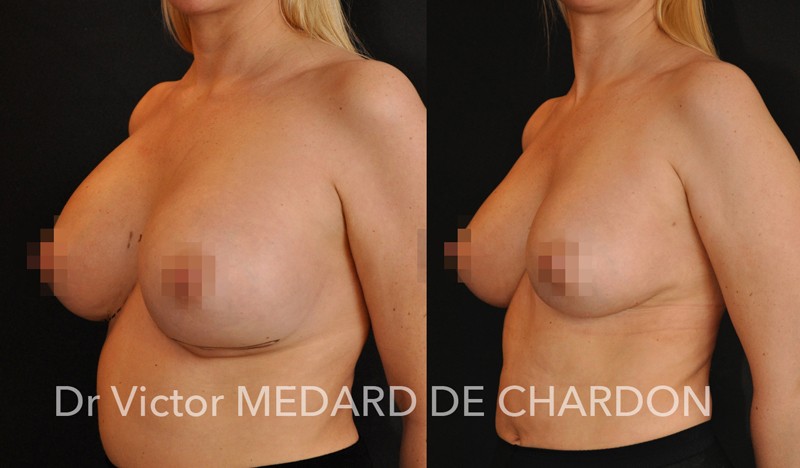
Replacement of breast implants
Double bubble, implants of excessive volume. Implants replaced with a smaller volume and the inframammary fold repaired by internal capsulorrhaphy.
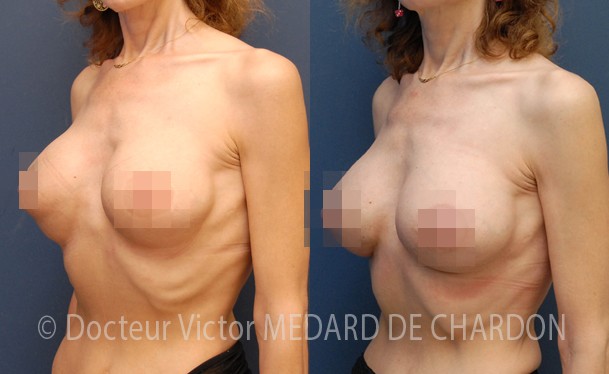
Double bubble after breast augmentation with implants
Reconstruction of the inframammary fold by capsulorrhaphy. Result at 3 months
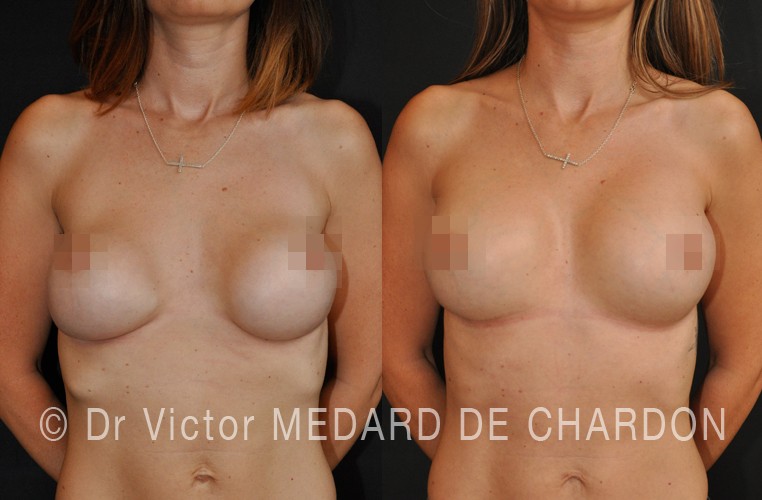
Correction of low-positioned and wide-set implants after breast augmentation
Replacement of breast implants, inframammary mastopexy, 350 cc anatomical implants
See all breast augmentation before and after photos
Frequently asked questions about double bubble
How can I tell if I have a double bubble after breast augmentation?
Two creases appear under the breast instead of one: the original fold, which remains marked, and below it the curve of the implant, which has often dropped too low.
Why does a double bubble appear after breast augmentation?
Most often because the fold had to be lowered to place the implant and the attachments of the original fold persist. Tuberous breasts, sagging breasts and breasts with a short lower part are the most exposed.
Can a double bubble under the breast go away on its own?
No, an established double bubble does not disappear spontaneously; correcting it requires revision surgery.
How is a double bubble under the breast corrected?
By rebuilding the fold at the right height: suturing the lower part of the pocket (capsulorrhaphy), possibly with a change of pocket, fat transfer (lipofilling) or acellular dermal matrix, depending on the situation.
Can a double bubble be prevented during breast augmentation?
Yes, by avoiding lowering the fold on breasts at risk, by favouring anatomical implants in these cases, and by using an appropriate technique when lowering is necessary.
References
- Médard de Chardon V, Balaguer T, Chignon-Sicard B, Lebreton E. Double breast contour in primary aesthetic breast augmentation: incidence, prevention and treatment. Annals of Plastic Surgery, 2010.
- Médard de Chardon V. MD thesis: breast augmentation with implants. Nice Faculty of Medicine, 2008.
- Bricout N. [Chest morphology and breast augmentation]. Ann Chir Plast Esthet 2005; 50: 441-450.
- Bricout N. Chirurgie du sein. Springer-Verlag, 1992.
- Muntan CD, Sundine MJ, Rink RD, et al. Inframammary fold: a histologic reappraisal. Plast Reconstr Surg 2000; 105: 549-556.
- Bayati S, Seckel BR. Inframammary crease ligament. Plast Reconstr Surg 1995; 95: 501-508.
- Maillard GF, Garey LJ. An improved technique for immediate retropectoral reconstruction after subcutaneous mastectomy. Plast Reconstr Surg 1987; 80: 396-408.
- Stuzin JM, Baker TJ, Gordon HL. The relationship of the superficial and deep facial fascias: relevance to rhytidectomy and aging. Plast Reconstr Surg 1992; 89: 441-449.
- Lockwood TE. Superficial fascial system (SFS) of the trunk and extremities: a new concept. Plast Reconstr Surg 1991; 87: 1009-1018.
- Boutros S, Kattash M, Wienfeld A, et al. The intradermal anatomy of the inframammary fold. Plast Reconstr Surg 1998; 102: 1030-1033.
- Brown TP, Ringrose C, Hyland RE, et al. A method of assessing female breast morphometry and its clinical application. Br J Plast Surg 1999; 52: 355-359.