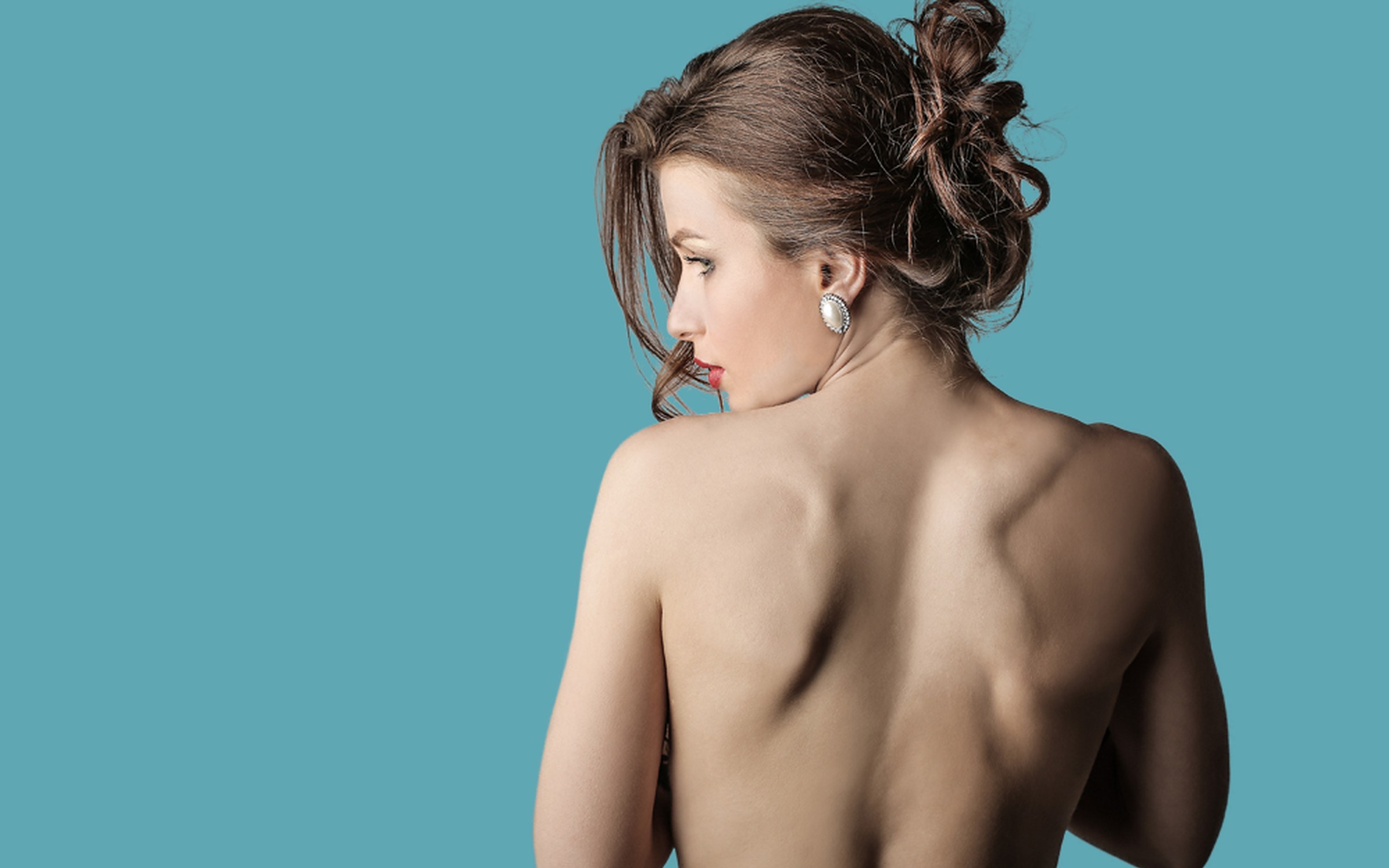

Scoliosis, rounded back and breast augmentation at a glance
- Scoliosis9% of patients
- Chest wall asymmetries due to scoliosis52.9%
- Kyphosis13%
- DetectionAt the consultation
- CorrectionDifferent implants or lipofilling
- SourceDr Médard de Chardon’s MD thesis
Scoliosis (sideways curvature of the spine) or kyphosis (rounded back) deforms the chest wall, and therefore the base on which the breasts sit. Scoliosis rotates the chest wall: one side is more hollow, and the breast on that side looks smaller, even when the glands have the same volume. A rounded back flattens the chest in profile and makes the breasts look smaller and more sagging. These deformities, often subtle, are looked for at the consultation before a breast augmentation: two identical implants can accentuate an asymmetry, whereas implants of different volumes or lipofilling reduce it.
Based on Dr Médard de Chardon’s MD thesis on breast augmentation (Nice Faculty of Medicine).
Scoliosis
Is it common?
In the series of patients studied for Dr Médard de Chardon’s thesis, scoliosis was present in 9% of patients, and it accounted for 52.9% of chest wall asymmetries. It is thought to be the leading cause of breast asymmetry, in shape as well as volume (Dionyssopoulos); a French study found scoliosis in 34% of women with breast volume asymmetry (Denoel et al.).
What does it change in the chest wall and breasts?
The deformity can be seen in profile and from the front:
- in profile: the upper chest, below the collarbones, is more prominent, and a hollow appears below the breast, above the rib margin, which sticks out;
- from the front: the chest wall is rotated; one side is more hollow, and the areola points more outwards.
This deformity is often masked by the volume of the breasts; it is more visible when the breasts are very small. It produces:
- a “false” asymmetry: the glands have the same volume, but one breast looks smaller because the chest wall is more hollow on that side;
- or a mixed asymmetry, of both the chest wall and the breast.
On the concave side of the scoliosis are the shorter side of the chest wall and the smaller breast; on the convex side, the larger side of the chest wall and the larger breast, which is also the more sagging one (Fredericks). Placing two implants of the same volume can therefore visually accentuate the asymmetry.
Scoliosis: the chest wall rotates. On the concave side (1), it is more hollow: the breast sits further back and looks smaller, even if the gland has the same volume. On the convex side (2), the chest wall is more prominent.
How is it detected?
At the first consultation, the surgeon looks for:
- from the front: shoulders or collarbones at different heights, an overly prominent upper chest, a hollow below one breast;
- from behind: asymmetrical shoulder blades and, with the patient bending forward, poorly aligned vertebrae on palpation or a hump on one side of the back.
Rounded back (kyphosis)
Kyphosis, or a rounded-back posture, was present in 13% of patients in the series. It often produces a flat or even hollow chest in profile, shoulders held forward and a hollow below the collarbones. The breasts look smaller, more sagging and closer together than they really are.
The deformed chest wall supports the breast less well, which encourages it to sag (Dionyssopoulos). A rounded back also visually “absorbs” volume: it sometimes calls for a slightly larger implant for the same result.
What difference does this make to breast augmentation?
At the first consultation, Dr Médard de Chardon measures the breasts and the chest wall, looks for scoliosis or kyphosis, and shows the patient the asymmetries on the photographs. Depending on what he observes:
- two implants of different volumes, the larger on the more hollow side, compensate for an asymmetry of the chest wall or breasts;
- lipofilling can fill a hollow in the chest wall or add to the smaller breast;
- the choice of volume takes into account a rounded back, which makes the breasts look smaller.
The patient is informed that an asymmetry caused by the chest wall can be reduced, but rarely eliminated completely: the implant acts like a magnifying glass on what was there before. All about asymmetry and breast augmentation · All about breast augmentation
Frequently asked questions
Can you have a breast augmentation if you have scoliosis?
Yes. Scoliosis is not a contraindication, but it must be identified before the procedure in order to adapt the choice of implants and inform the patient of the asymmetry that may persist.
Why does one breast look smaller when you have scoliosis?
Because the chest wall is rotated: it is more hollow on one side, and the breast on that side looks smaller, even when both glands have the same volume.
Should two different implants be used?
Often, yes: a larger implant on the more hollow side compensates for the asymmetry. Two identical implants, on the other hand, can accentuate it.
Does a rounded back change the result?
Yes: it makes the breasts look smaller and more sagging, and may call for a slightly larger implant for the same result.
References
- MD thesis of Dr Victor Médard de Chardon on breast augmentation, Nice Faculty of Medicine.
- Dionyssopoulos A. Les résultats non parfaits des prothèses mammaires [Imperfect results of breast implants]. Ann Chir Plast Esthet 50: 534-543, 2005.
- Denoel C., Garson S., Sinna R., et al. Les scolioses idiopathiques : une cause sous-estimée d’asymétries mammaires [Idiopathic scoliosis: an underestimated cause of breast asymmetry]. 52nd National Congress of the SOFCPRE, Paris, 2007.
- Fredericks S. Skeletal and postural relations in augmentation mammaplasty. Ann Plast Surg: 44-47, 1978.