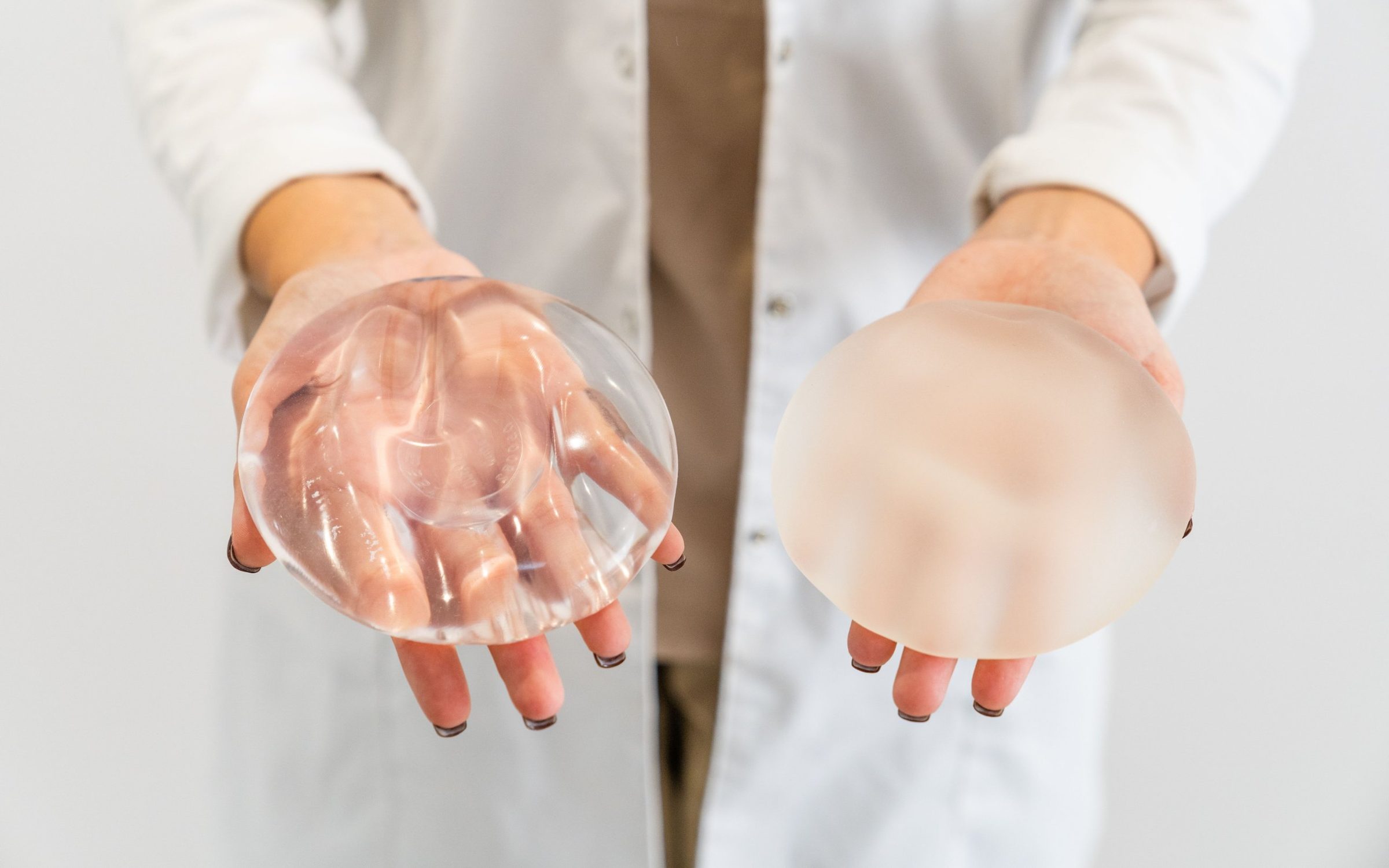

Implant surfaces at a glance
- SmoothRoughness below 10 µm
- NanotexturedSmooth under the standard, very fine relief
- MicrotexturedRoughness of 10 to 50 µm
- MacrotexturedBanned in France since 2019
- At the practiceSmooth, micro- or nanotextured
- The choiceDepends on shape, pocket and history
The surface of a breast implant is the texture of its silicone shell, more or less rough, where it meets the tissues. It affects the membrane that forms around every implant (the capsule), how much the implant moves in its pocket and, for the roughest surfaces, the risk of a rare lymphoma [1][5]. In France, only smooth, nanotextured and microtextured surfaces have been allowed since April 2019 [4].
The surface chosen does not change the price: breast augmentation with implants costs €5,000 to €10,000 at the practice, on a quote given after the consultation (€100).
1. What is an implant’s surface?
All implants used today are filled with cohesive silicone gel inside a silicone shell. It is the relief of this shell that distinguishes the surfaces. It is measured as average roughness, in micrometres (µm, thousandths of a millimetre). The international standard for breast implants defines three classes, smooth, microtextured and macrotextured [3]:
| Surface | Average roughness | In France |
|---|---|---|
| Smooth | Less than 10 µm | Allowed |
| Nanotextured | A few µm (classed as smooth) | Allowed |
| Microtextured | 10 to 50 µm | Allowed |
| Macrotextured | More than 50 µm | Banned since April 2019 |
| Polyurethane | Foam covering the shell | Banned since April 2019 |
“Nanotextured” is not a class in the standard: the term describes surfaces with a very fine relief that remain smooth under the standard. Researchers have proposed a more detailed classification into macro-, meso-, micro- and nanotextured surfaces, because cells react differently from one surface to another [2].
2. Why were implants textured?
- To limit capsular contracture. A membrane, the capsule, forms around every implant; when it tightens, the breast hardens and changes shape: this is capsular contracture. In breast augmentation studies, especially older ones, textured implants led to less contracture than smooth ones [6].
- To keep the implant in place. A rough surface adheres to the tissues. This was essential for anatomical implants, teardrop-shaped, which distort the breast if they turn (see implant rotation).
In breast reconstruction, a recent analysis of the studies no longer finds a difference in contracture between smooth and textured implants [7]: implant position, technique and recovery matter as much as the surface.
3. Lymphoma and the end of macrotextured surfaces
Breast implant-associated anaplastic large cell lymphoma (BIA-ALCL) is a very rare cancer, usually showing as late swelling of the breast. It is linked to the surface: the rougher and larger the surface area, the higher the risk [5]. By a decision of 2 April 2019, effective on 5 April, the French medicines agency (ANSM) withdrew macrotextured and polyurethane-coated implants from the French market [4]. It does not recommend removing these implants as a precaution, and advises choosing smooth implants where possible [4].
The subject is covered in detail in the article breast implants and lymphoma.
4. Each surface, its strengths and limits
Smooth surface
With no relief, it does not adhere to the tissues: the implant stays mobile in its pocket. This is not a problem with a round implant, which can turn without changing the shape of the breast. It is the surface associated with the lowest lymphoma risk [4][5].
Nanotextured surface
Smooth under the standard, it carries a very fine relief designed to reduce the tissue reaction around the implant [1]. These surfaces are recent: long-term results are still being assessed.
Microtextured surface
Its fine relief lets the tissues adhere slightly, which steadies the implant without gripping it like a macrotexture. These surfaces have a long track record. Dr Médard de Chardon presented at the SOFCPRE congress (2008) a series of cosmetic breast augmentations with microtextured implants, with no severe early capsular contracture (grades III and IV).
Macrotextured and polyurethane surfaces
They gripped the tissues firmly, which limited rotation and, for polyurethane, contracture. They have been banned in France since April 2019; women who have them do not need to have them removed without a reason [4].
5. How the surface is chosen
The surface is one of the criteria for choosing implants, together with shape, profile, volume and position (see choosing breast implants). It is decided at the consultation, depending on:
- the shape of the implant: a round implant does not need to adhere to the tissues;
- its position, in front of or behind the muscle, and the thickness of the tissues covering it;
- your history: capsular contracture or an implant that moved after a previous operation;
- the setting: cosmetic augmentation, implant replacement or reconstruction.
Dr Médard de Chardon uses smooth, microtextured or nanotextured CE-marked implants. The name, reference and batch number are on the implant card given to you after the operation.
6. Already have textured implants?
- find your implant card or operation report: they give the brand and model, and therefore the surface;
- removing textured implants that cause no problem is not recommended [4];
- have your breasts examined every year, with imaging if your doctor thinks it useful;
- see a doctor without delay if a breast swells, or if you notice a lump, pain or skin changes, especially several years after the operation.
When implants are replaced, the new surface is chosen on the same criteria.
Dr Victor Médard de Chardon sees patients from Cannes, Antibes, Nice, Monaco and the whole Alpes-Maritimes at 101 rue d’Antibes. Operations take place at the Clinique Oxford in Cannes.
Find out more: breast augmentation · choosing implants · implants and lymphoma · capsular contracture · implant replacement
Frequently asked questions
Smooth or textured breast implants: which should I choose?
No surface is best for everyone. A round implant can be smooth; a microtextured surface steadies the implant more. The choice is made at the consultation, depending on shape, position and your history.
What is a nanotextured breast implant?
An implant whose shell carries a very fine relief, a few micrometres deep. The international standard classes it as smooth. These surfaces are recent and their long-term results are still being assessed.
Are textured implants banned in France?
No. Since April 2019, only macrotextured and polyurethane-coated implants have been banned. Smooth, nanotextured and microtextured implants are still allowed.
Should macrotextured implants be removed?
No, not as a precaution. The ANSM recommends a yearly breast examination and a visit to a doctor if there is swelling, a lump or pain.
How can I find out what surface my implants have?
The brand and model are on your implant card and in the operation report. The surgeon who operated on you can also tell you.
Does the surface change the price of the operation?
No. The price of breast augmentation, €5,000 to €10,000, depends on the operation, not on the implant surface.
References
- Munhoz AM, Clemens MW, Nahabedian MY. Breast implant surfaces and their impact on current practices: where we are now and where are we going? Plast Reconstr Surg Glob Open. 2019;7(10):e2466. doi:10.1097/GOX.0000000000002466
- Barr S, Hill EW, Bayat A. Functional biocompatibility testing of silicone breast implants and a novel classification system based on surface roughness. J Mech Behav Biomed Mater. 2017;75:75-81. doi:10.1016/j.jmbbm.2017.06.030
- ISO 14607:2018. Implants chirurgicaux non actifs — Implants mammaires — Exigences particulières. iso.org
- ANSM. Retrait du marché des implants mammaires macrotexturés et des implants mammaires à surface recouverte de polyuréthane (décision du 2 avril 2019). ansm.sante.fr
- Loch-Wilkinson A, Beath KJ, Knight RJW, et al. Breast implant-associated anaplastic large cell lymphoma in Australia and New Zealand: high-surface-area textured implants are associated with increased risk. Plast Reconstr Surg. 2017;140(4):645-654. doi:10.1097/PRS.0000000000003654
- Liu X, Zhou L, Pan F, et al. Comparison of the postoperative incidence rate of capsular contracture among different breast implants: a cumulative meta-analysis. PLoS One. 2015;10(2):e0116071. doi:10.1371/journal.pone.0116071
- Christodoulou N, Secanho M, Kokosis G, et al. Capsular contracture in breast reconstruction: a systematic review and meta-analysis. J Plast Reconstr Aesthet Surg. 2024;98:131-143. doi:10.1016/j.bjps.2024.08.057