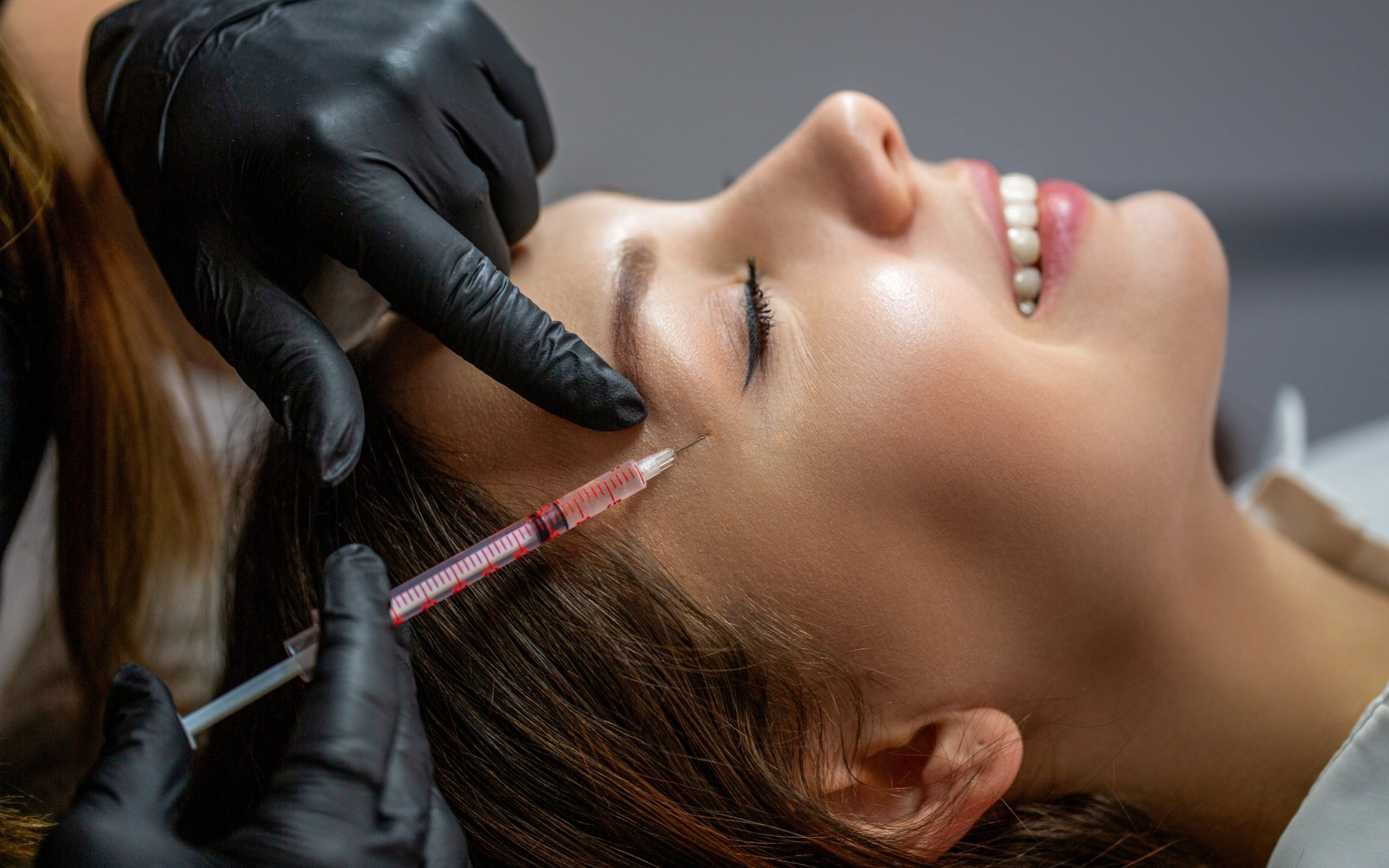

Botox at a glance
- UnitSpecific to each brand
- Frown lines20 units (Vistabel, Bocouture)
- First effectsFrom day 3
- How long it lasts2 to 6 months
- Minimum interval3 months
- PricePer area, from €250
Botox is dosed in units, not in millilitres or syringes. The dose depends on the area, the strength of the muscle and the result you want; it affects how long the effect lasts, from 2 to 6 months. To maintain it, a session is advised every 4 months in the first year, then every 6 months.
One area €250; upper third of the face €420; free touch-up if there is an imperfection.
1. What is a unit of Botox?
A unit measures the biological activity of botulinum toxin, not a volume. Each manufacturer has its own way of measuring it, so units are not interchangeable from one brand to another [1, 3]. Twenty units of Vistabel are not the same as twenty Speywood units of Azzalure.
The number of units alone therefore cannot be used to compare two sessions with different products. What matters is the right dose for the muscle being treated, with the chosen product.
2. How many units per area?
The official product information gives reference doses for the three areas of the upper face [1, 2, 3]:
| Area | Vistabel or Bocouture | Azzalure (Speywood units) |
|---|---|---|
| Frown lines | 20 units, at 5 points | 50 units, at 5 points |
| Crow’s feet | 24 units (12 on each side) | 60 units (30 on each side) |
| Forehead | 20 units (Vistabel); 10 to 20 units (Bocouture) | — |
| All three areas together | 64 units (Vistabel) | — |
At the practice, Dr Médard de Chardon uses Azzalure: its doses are expressed in Speywood units, hence higher numbers than for other brands, which do not compare one for one. These figures are guides, not quotas. For preventive treatment or a very natural result, lower doses are often enough: this is the so-called “baby Botox” technique. Conversely, a strong muscle needs more. In men, a study showed that for frown lines, 40 units were more effective and lasted longer than 20 units [4].
For other areas (neck, masseters, sides of the nose, corners of the mouth, chin), the dose is set at the consultation according to the muscle.
3. How long does the effect last?
The first effects appear from day 3; the result is at its best between day 10 and day 15. The effect then lasts 2 to 6 months. In the studies used to authorise the products, it was shown to last up to 4 months for frown lines [1, 3].
How long it lasts depends on:
- the dose: a higher dose generally lasts longer [4];
- the strength of the muscle: a strong muscle, more common in men, “uses up” the toxin faster;
- the area: for underarm sweating, the effect lasts about 6 months;
- regular sessions: regular sessions extend the duration of action.
4. How often should you have sessions?
At the practice, the recommended schedule is:
- Day 0: first session, 10 to 15 minutes.
- Ideally from day 21: check-up and touch-up if needed.
- Months 4 and 8: the next sessions of the first year.
- From the second year: one session every 6 months.
For prevention, two sessions a year are often enough. A non-surgical facelift is maintained with two Botox sessions and one hyaluronic acid session a year. For excessive sweating, one session about every 6 months.
The product information for these toxins requires at least 3 months between two treatments [1, 2, 3]. Bringing sessions closer together does not lengthen the result and increases the risk of resistance.
5. Can you become resistant to Botox?
It is rare. After repeated injections, the body can make antibodies that neutralise the toxin: the treatment then loses its effect. A meta-analysis of 43 studies, mostly in neurology with far higher doses than in aesthetics, found these antibodies in 1.8% of patients [5].
The risk factors described are sessions less than 3 months apart, high or cumulative doses, and “boosters” given within 3 weeks of an injection [6]. Keeping to the 3-month interval and the right dose limits this risk. This is also why, at the practice, any touch-up is ideally done from day 21.
6. How much does a session cost?
At the practice, the price is set per area, not per unit: you know the price before the session, whatever dose is needed.
| Area | Price |
|---|---|
| One area (for example, frown lines) | €250 |
| Upper third of the face (forehead, frown lines, crow’s feet) | €420 |
| Neck | €420 |
| Upper third and neck | €600 |
| Masseters | €300 |
| Excessive sweating (underarms, hands or feet) | €400 to €600 |
The touch-up is free if there is an imperfection; if the result is insufficient, it costs €0 to €275 (most often €100). Cosmetic injections are not covered by French national health insurance. All prices: prices page.
Dr Victor Médard de Chardon, a plastic surgeon and former anatomy prosector at the Nice faculty of medicine, has carried out more than 7,000 Botox injections.
He sees patients from Cannes, Antibes, Nice, Monaco and the whole French Riviera at his practice at 101 rue d’Antibes in Cannes; Nice Côte d’Azur airport is about thirty minutes away.
Further reading: Botox injections · preventive Botox: from what age? · Botox for excessive sweating · non-surgical facelift · Botox or hyaluronic acid: what are the differences?
Frequently asked questions
How many units of Botox for frown lines?
20 units of Vistabel or Bocouture, or 50 Speywood units of Azzalure, according to the product information. The dose is adjusted at the consultation to the strength of the muscle.
How many units for the whole upper face?
According to the Vistabel product information, 64 units for the forehead, frown lines and crow’s feet treated together. At the practice, this treatment costs €420, whatever the number of units.
How long does Botox last?
From 2 to 6 months. The first effects appear on day 3 and the result is at its best between day 10 and day 15.
Can Botox be repeated before 3 months?
No: the product information requires at least 3 months between two treatments. Closer sessions increase the risk of resistance without lengthening the result.
Does Botox last longer over time?
Regular sessions often extend the duration of action. This is why the schedule moves from every 4 months to every 6 months after the first year.
Do men need more Botox?
Often yes, because their muscles are stronger. A study in men showed that a higher dose for frown lines was more effective and lasted longer.
References
- Vistabel, résumé des caractéristiques du produit, rubrique 4.2. Base de données publique des médicaments. base-donnees-publique.medicaments.gouv.fr
- Bocouture, résumé des caractéristiques du produit, rubrique 4.2. Base de données publique des médicaments. base-donnees-publique.medicaments.gouv.fr
- Azzalure, résumé des caractéristiques du produit, rubrique 4.2. Base de données publique des médicaments. base-donnees-publique.medicaments.gouv.fr
- Carruthers A, Carruthers J. Prospective, double-blind, randomized, parallel-group, dose-ranging study of botulinum toxin type A in men with glabellar rhytids. Dermatol Surg. 2005;31(10):1297-303. doi:10.1111/j.1524-4725.2005.31206
- Rahman E, Alhitmi HK, Mosahebi A. Immunogenicity to botulinum toxin type A: a systematic review with meta-analysis across therapeutic indications. Aesthet Surg J. 2022;42(1):106-20. doi:10.1093/asj/sjab058
- Kroumpouzos G, Silikovich F. Exploring nonresponse to botulinum toxin in aesthetics: narrative review of key trigger factors and effective management strategies. JMIR Dermatol. 2025;8:e69960. doi:10.2196/69960