

Leg liposuction at a glance
- Duration1 to 3 hours
- AnaesthesiaGeneral or spinal anaesthesia
- Hospital stayDay surgery (home the same day)
- Time off work7 to 15 days
- Final result3 months
- Price€3,000 to €7,500
Leg liposuction slims the calves and ankles by permanently removing localised fat, using circumferential vibration-assisted liposuction (Microaire). It is intended for people whose excess volume is due to fat, not to a venous, lymphatic or muscular cause, which the examination confirms. The operation takes 1 to 3 hours at Clinique Oxford in Cannes, under general or spinal anaesthesia, as day surgery. Compression stockings for at least one month and an 8-day course of anticoagulant treatment. Final result at 3 months.
Price: €3,000 to €7,500, on a written quote after consultation (€100).
Fat, swelling or muscle: which solution for which leg?
| Your legs | Appropriate solution |
|---|---|
| Thick calves or ankles due to excess fat, elastic skin | Circumferential liposuction of the calves and ankles |
| Legs that swell by the end of the day, varicose veins, venous or lymphatic insufficiency | Assessment by a phlebologist (vein specialist) before any decision; liposuction does not treat swelling (oedema) |
| Thick, painful, symmetrical legs that spare the feet | Suggests lipoedema: specific management |
| Calves that are bulky because of muscle | Liposuction does not reduce muscle |
| Loose skin on the inner thighs | Thigh lift |
| Calves that are too thin | Calf implants, fat transfer (lipofilling) or Hyacorp |
Excess fat under the skin (2): this is the indication for liposuction, performed circumferentially, all the way round the leg.
- 1Skin
- 2Fat under the skin
- 3Calf muscles
- 4Bones (tibia, fibula)
- 5Superficial vein
- 6Oedema (fluid in the tissues)
Why do the calves and ankles need a particular technique?
The ankle and calf are narrow areas with pronounced contours, where blood vessels, nerves and lymphatic vessels run close to the surface. The fat is removed circumferentially, all the way round the leg, to avoid a visible step between treated and untreated areas. A sound knowledge of the anatomy of the calf is needed to respect the natural shape of the leg.
Dr Médard de Chardon uses vibration-assisted liposuction (Microaire): the cannula loosens the fat without forcing the tissues, which helps to preserve the blood vessels, nerves and lymphatics. Find out more about vibration-assisted liposuction.
Emulsification and suction: the two stages of liposuction
Leg liposuction is carried out in two stages, through incisions of 2 to 3 mm:
- Emulsifying the fatThe vibration of the microcannula (Microaire) emulsifies the fat without forcing the tissues; a laser can also be used to liquefy it before suction.
- SuctionThe emulsified fat is suctioned out with microcannulas, circumferentially around the calves and ankles.
How is the operation carried out?
- ConsultationAt the practice, 101 rue d’Antibes, Cannes (€100): clinical examination of the legs to look for venous or lymphatic insufficiency; if needed, a venous assessment by a phlebologist. Statutory 15-day cooling-off period.
- Anaesthetic consultationWith an anaesthetist (anaesthesia and intensive care physician).
- OperationAt Clinique Oxford in Cannes, under general or spinal anaesthesia, as day surgery. Incisions of 2 to 3 mm.
- Follow-up visitsDay 10, month 1, month 3.
- 1Inner knees
- 2Calves
- 3Ankles
What is the recovery like?
- Walking from the same day.
- Bruising for 7 to 21 days.
- Compression stockings: for at least one month.
- Preventive anticoagulant treatment: one daily injection of low-molecular-weight heparin for 8 days, to reduce the risk of phlebitis (deep vein thrombosis).
- Lymphatic drainage massage: if needed.
- Work: 7 to 15 days; sport: 21 days.
- Swelling: the result is visible immediately but masked by the swelling (oedema), which settles within 3 months.
- Final result at month 3, with normal muscle contours visible. The scars measure 2 to 3 mm and reach their final appearance at month 12.
What are the risks?
Like any surgery, leg liposuction carries risks, which are explained in detail at the consultation: surface irregularities or asymmetry, temporary changes in sensation and, more rarely, phlebitis, which is prevented by walking from the same day, compression stockings and the 8-day anticoagulant treatment.
Choosing a qualified, experienced and reputable surgeon reduces these risks, and can even eliminate some of them.
Dr Médard de Chardon’s experience
- Qualified plastic surgeon in plastic, reconstructive and aesthetic surgery, former Chef de Clinique (university hospital senior registrar), Nice Faculty of Medicine; in practice in Cannes since 2011; member of SOFCEP (French Society of Aesthetic Plastic Surgery), SOFCPRE (French Society of Plastic, Reconstructive and Aesthetic Surgery) and ISAPS (International Society of Aesthetic Plastic Surgery).
- More than 1,800 liposuction procedures performed.
- Vibration-assisted liposuction (Microaire), circumferential on the calves and ankles.
- Systematic venous assessment before the operation.
Before and after photos
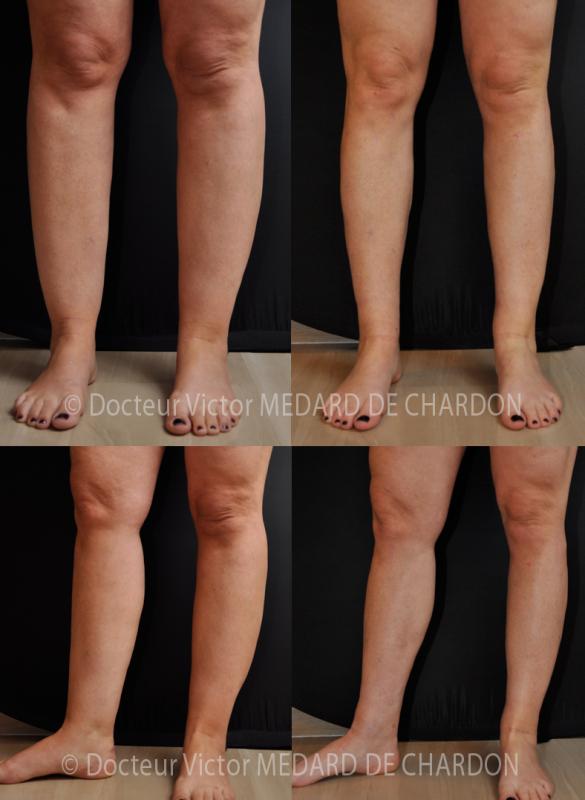
Leg liposuction: ankles, calves and inner knees
Liposuction of large calves
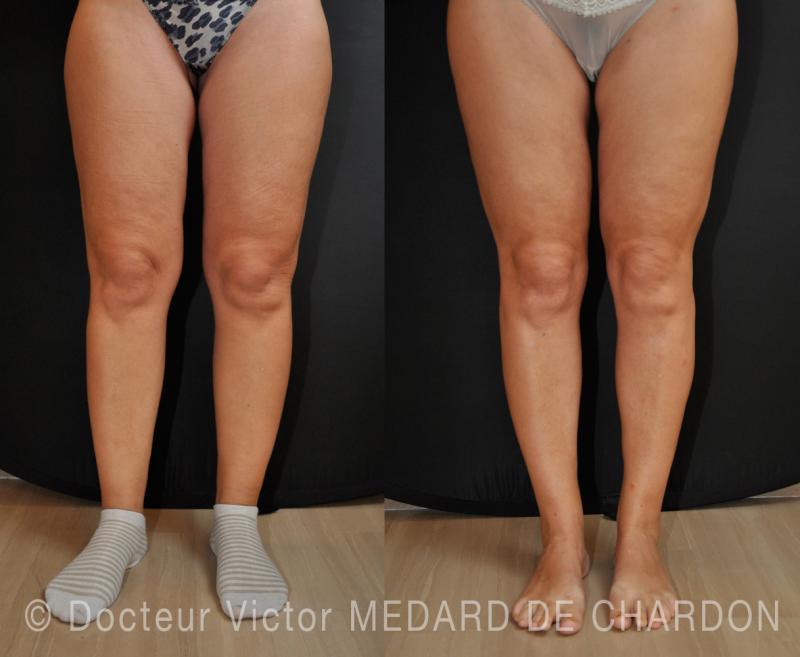
Slimming the legs
Liposuction of the legs and knees
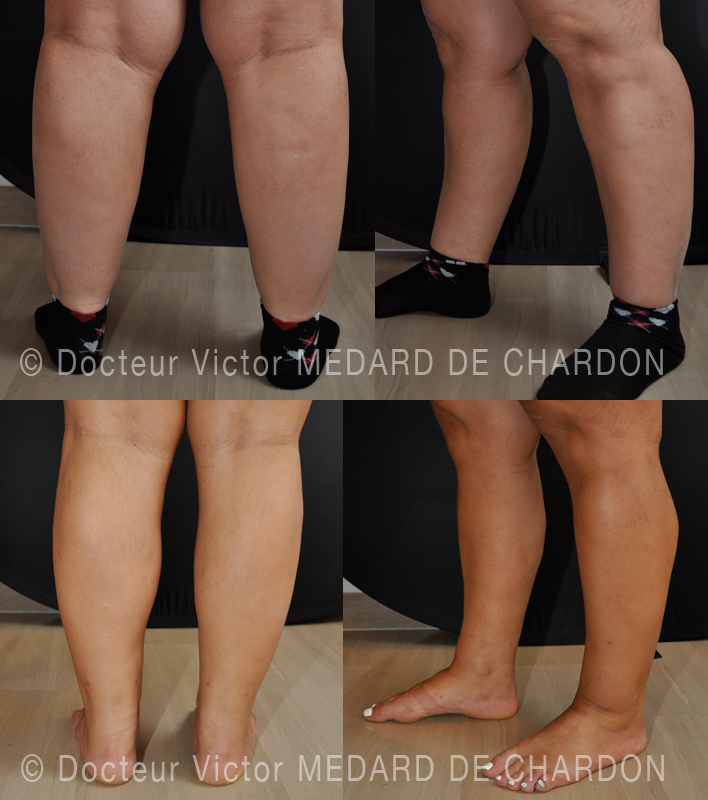
Leg liposuction
Liposuction from the knees down to the ankles
See all before and after photos of liposuction
Book an appointment: Doctolib or +33 (0)4 93 68 86 68. See also: Liposuction · Abdominal liposuction · Cryolipolysis.
Frequently asked questions about leg liposuction
Can liposuction slim a muscular calf?
No. Liposuction removes the fat beneath the skin, not muscle. If the volume of the calf is mainly muscular, the examination shows this and liposuction is not offered.
Why have a venous examination before leg liposuction?
Thick or swollen legs can be due to venous or lymphatic insufficiency, which liposuction does not treat. The clinical examination, supplemented if necessary by a phlebologist, rules out these causes before the operation is decided on.
How long do compression stockings have to be worn after leg liposuction?
For at least one month. They limit swelling, help the skin to retract and contribute to preventing phlebitis.
Why is anticoagulant treatment needed after leg liposuction?
Surgery on the legs increases the risk of phlebitis. One daily injection of low-molecular-weight heparin for 8 days reduces this risk.
When can the result of calf and ankle liposuction be seen?
The result is visible straight away but masked by the swelling. It can be judged at month 3, once the oedema has settled.
Are the scars from leg liposuction visible?
The incisions measure 2 to 3 mm. The scars fade gradually and reach their final appearance at month 12.
How much does calf and ankle liposuction cost?
From €3,000 to €7,500, on a written quote after the consultation (€100). Cosmetic liposuction is not reimbursed by French national health insurance (Assurance Maladie) or by top-up insurance (mutuelle).