
Abdominal liposuction at a glance
- Duration30 min to 2 h
- AnaesthesiaLocal + sedation or general
- Hospital stayDay surgery or 1 night
- Time off work7 days
- Final result3 to 6 months
- Price€3,000 to €6,000
The abdomen is the area most often treated by liposuction, in women and men alike. The procedure permanently removes the fat under the skin of the abdomen and flanks, through 3 incisions of 2 to 3 mm for the abdomen and 2 for the love handles. It is vibration-assisted (Microaire) and takes 30 minutes to 2 hours at the Clinique Oxford in Cannes, under local anaesthesia with sedation or general anaesthesia, as day surgery or with one night’s stay. Time off work is 7 days; the final result can be judged between 3 and 6 months. The first criterion for success is the quality of the skin.
Price: €3,000 to €6,000, on a written quote after the consultation (€100).
Which solution for which abdomen?
| Your abdomen | Suitable solution |
|---|---|
| Fat under the skin, elastic skin | Abdominal liposuction |
| Small fat deposit, good-quality skin | Cryolipolysis, without surgery |
| Thin, stretch-marked or slack skin | Abdominoplasty (tummy tuck) |
| Muscles separated after pregnancy (diastasis) | Abdominoplasty with muscle repair |
| Bulge above a caesarean section scar | Liposuction; sometimes scar revision or a mini-abdominoplasty |
| Round, firm abdomen, fat around the intestines | Neither liposuction nor cryolipolysis: weight loss (diet, physical activity, or even bariatric surgery) |
| Fibrous fat after major weight loss | Vibration-assisted liposuction essential; cryolipolysis is not suitable |
Fat under the skin (2), elastic skin: this is the indication for liposuction; the microcannula suctions the fat between the skin and the muscles.
- 1Skin
- 2Fat under the skin
- 3Rectus abdominis muscles
- 4Intestines
- 5Fat around the intestines
- 6Separated muscles (diastasis)
What determines the result?
- Skin quality: this is the main factor. The skin must be elastic enough to retract; otherwise, ripples may appear and an abdominoplasty is preferable.
- Where the fat is: only superficial fat, between the skin and the muscles, can be suctioned. Deep fat, around the digestive tract, cannot be suctioned safely; it is common in some men with a round, distended abdomen.
- Pregnancies: they can leave a stretched abdominal wall (rectus diastasis) that liposuction alone does not correct.
- Weight history: after obesity, the fat is more fibrous and harder to suction.
- Sex: women’s fat is softer and less fibrous than men’s.
- Age matters little: some of the most satisfied patients are over 50, provided the skin quality is sufficient.
- Realistic expectations and an even technique: the result is never entirely predictable.
How does the procedure work?
- ConsultationAt the practice, 101 rue d’Antibes, Cannes (€100): examination of the skin, fat and abdominal wall; on an abdomen that has already been operated on, a check for a hernia or incisional hernia (by palpation and, if needed, ultrasound or CT scan). Statutory 15-day cooling-off period.
- Anaesthetic consultationWith an anaesthetist (anaesthesia and intensive care specialist).
- ProcedureAt the Clinique Oxford in Cannes, in 30 minutes to 2 hours. Dr Médard de Chardon most often performs circumferential liposuction of the abdomen and flanks, vibration-assisted (Microaire), with microcannulas: the technique is more precise and recovery less painful. It takes place in three steps: emulsifying the fat, suction, then optimising skin retraction (see below).
- Scars3 incisions for the abdomen, 2 for the love handles, 2 to 3 mm long, closed with a dissolvable stitch under the skin; they usually become undetectable.
- Reusable fatThe suctioned fat can be prepared and reinjected into the breasts or buttocks.
- Follow-upCheck-up consultations at day 10, 1 month and 3 months.
- 1Abdomen
- 2Flanks (love handles), treated at the same time: circumferential liposuction
- 3Incisions of 2 to 3 mm
Emulsion, suction, retraction: the three steps of liposuction
Abdominal liposuction takes place in three steps, through the same 2 to 3 mm incisions:
- Emulsifying the fatThe vibration of the microcannula (Microaire) emulsifies the fat without forcing the tissues; a laser can also liquefy it before suction.
- SuctionThe emulsified fat is suctioned with microcannulas, most often circumferentially over the abdomen and flanks.
- Optimising skin retractionWhen the skin is at risk of retracting poorly, controlled heat is delivered under the skin by laser, radiofrequency or Renuvion (helium plasma). It contracts the collagen fibres and helps the skin to tighten. Very slack skin still requires an abdominoplasty.
Emulsion: the vibration of the microcannula (Microaire), and a laser if needed, make the fat more fluid (1) without forcing the tissues.
- 1Emulsified fat
- 2Vibration of the microcannula
- 3Suction
- 4Microcannula
- 5Heat under the skin
- 6Retracted skin
What is the recovery like?
- Pain: comparable to muscle stiffness or bruises, more noticeable when bending, getting up or turning over in bed; simple painkillers are enough.
- Bruising and swelling: bruising for 7 to 21 days; the abdomen swells in the first few days (slowed bowel transit, oedema), which masks the result; the swelling (oedema) goes down gradually over 3 months.
- Compression: abdominal compression garment for 2 to 4 weeks; compression stockings only if you already wore them for venous-lymphatic insufficiency.
- Walking from the same day, at home and then outdoors; shower from the next day.
- Bath, swimming pool, sea: once the incisions have healed, after 15 days.
- Work: 7 days; sport: 7 to 15 days.
- Final result between 3 and 6 months.
What are the risks?
Like any surgery, abdominal liposuction carries risks, which are rare when it is performed by a qualified plastic surgeon in an approved facility:
- surface irregularities (ripples) or asymmetry, especially on average-quality skin;
- temporary changes in skin sensation;
- phlebitis (deep vein thrombosis), rarer, prevented by walking from the same day;
- perforation of the abdominal wall in the case of an undiagnosed hernia near the navel: this is why a hernia is looked for before the procedure and repaired beforehand by a digestive (general) surgeon.
The risks increase when liposuction is combined with other procedures (longer operating time) and after a previous liposuction (more fibrous fat). Compressive abdominal dressings, which promote phlebitis, are no longer used.
Choosing a qualified, experienced and reputable surgeon reduces these risks, and can even eliminate some of them.
Liposuction and abdominoplasty: can they be combined?
Yes. On an abdomen with loose skin or muscles and a lot of fat, liposuction can be carried out at the same time as the abdominoplasty (lipoabdominoplasty). Sometimes it is preferable to perform the liposuction first, then the abdominoplasty 3 to 6 months later: the liposuction can then be more thorough, with fewer risks than combined surgery.
Dr Médard de Chardon’s experience
- Qualified plastic surgeon in plastic, reconstructive and aesthetic surgery, former Chef de Clinique (university hospital senior registrar), Nice Faculty of Medicine; in practice in Cannes since 2011; member of SOFCEP (French Society of Aesthetic Plastic Surgery), SOFCPRE (French Society of Plastic, Reconstructive and Aesthetic Surgery) and ISAPS (International Society of Aesthetic Plastic Surgery).
- Vibration-assisted liposuction (Microaire), laser emulsification of fat and optimisation of skin retraction by laser, radiofrequency or Renuvion. Liposuction of the abdomen and flanks is most often circumferential.
- More than 1,800 liposuctions performed.
Before and after photos
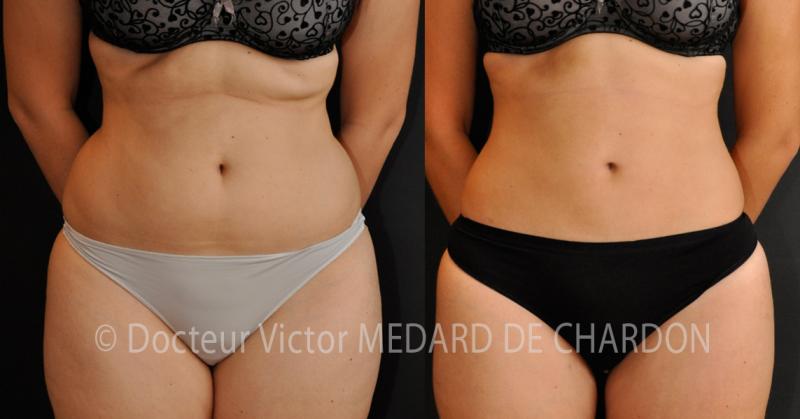
Prominent abdomen and flanks in an 18-year-old woman
Circumferential abdominal liposuction
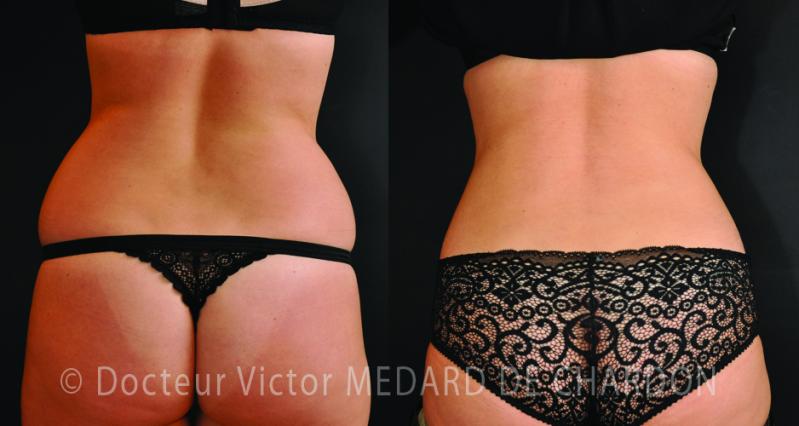
Love handles in a woman
Liposuction of the love handles
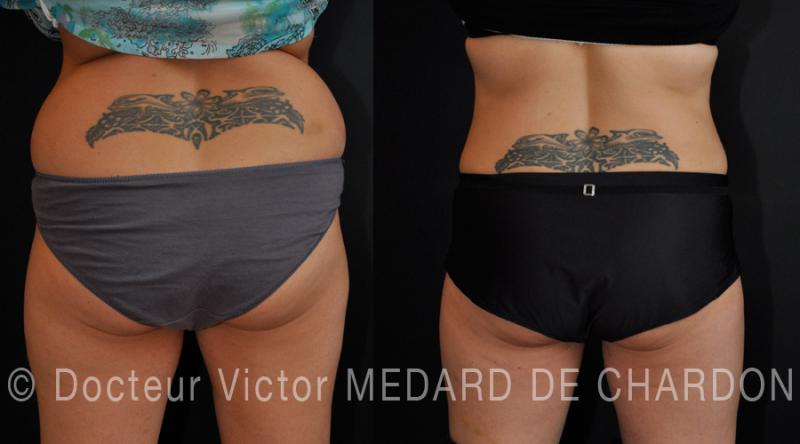
Liposuction of the love handles
Liposuction of the flanks with the Lipomatic™
See all the liposuction before and after photos
See also the Liposuction page (all areas). Book an appointment: +33 (0)4 93 68 86 68 or Doctolib.
Frequently asked questions about abdominal liposuction
Can all the fat in the abdomen be removed by liposuction?
No. Only the fat under the skin can be suctioned. The fat surrounding the intestines, inside the abdomen, only decreases with weight loss.
Liposuction or abdominoplasty: which should I choose?
It all depends on the skin and muscles. With elastic skin, liposuction is enough. With thin, stretch-marked or slack skin, or with muscles separated after pregnancy, an abdominoplasty is needed.
How many scars does abdominal liposuction leave?
Three incisions of 2 to 3 mm for the abdomen, two for the love handles. Closed with a dissolvable stitch under the skin, they usually become undetectable.
Why does the abdomen swell after liposuction?
Bowel transit is slowed by the anaesthetic, painkillers and rest, and the treated area is swollen (oedematous). This swelling masks the result and goes down gradually over 3 months.
When can I go swimming after abdominal liposuction?
Once the incisions have healed, after 15 days. Showering is possible from the next day.
Can I have abdominal liposuction after a caesarean section?
Yes. It corrects well the bulge that often persists above the scar. A hernia or incisional hernia is looked for before the procedure.
How much does abdominal liposuction cost in Cannes?
The price is set on a written quote after the consultation (€100). It ranges from €3,000 to €6,000. Cosmetic liposuction is not reimbursed by French national health insurance (Assurance Maladie) or by mutuelles (top-up health insurance).