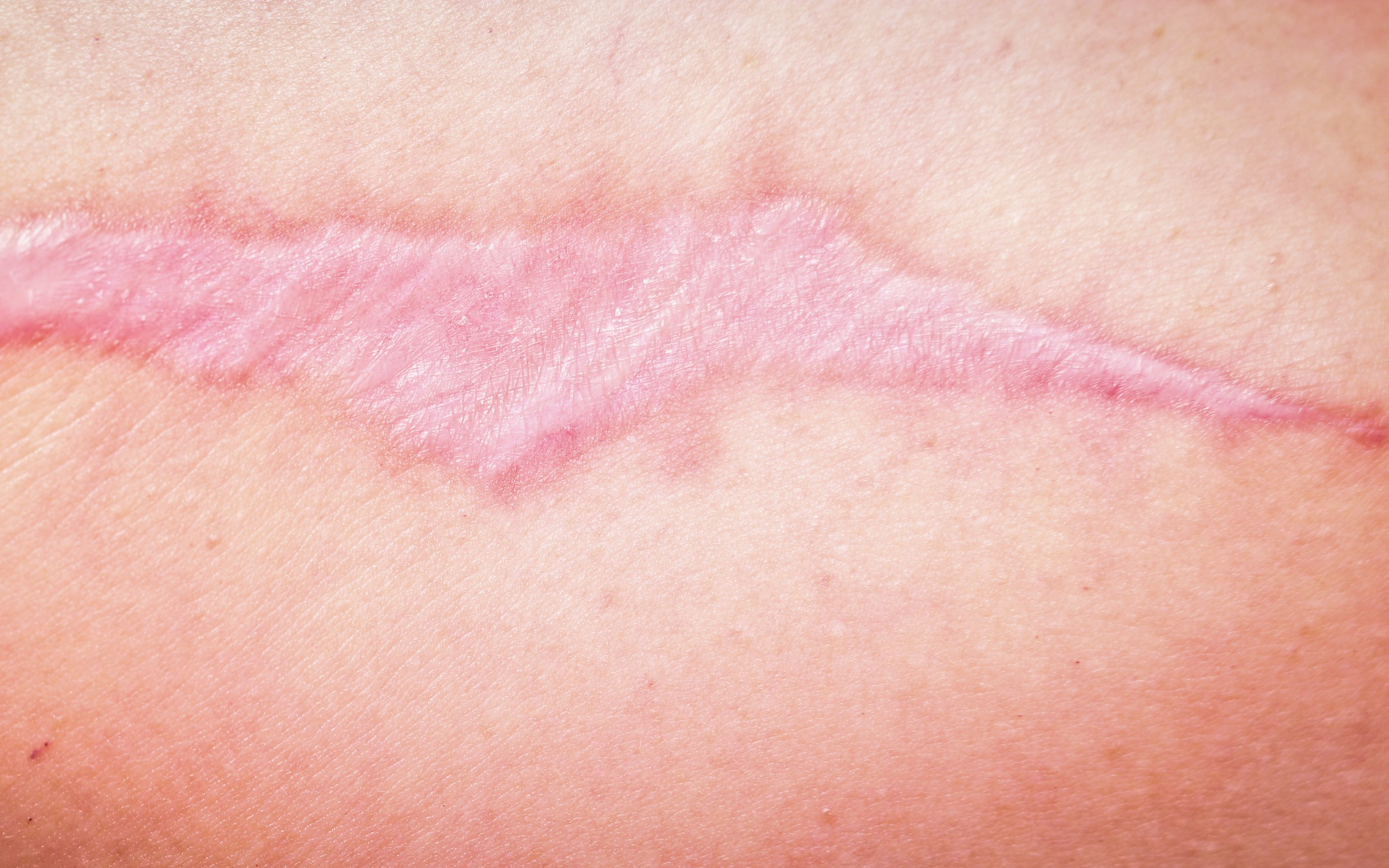

Abnormal scarring at a glance
- HypertrophicStays within the incision
- KeloidSpreads beyond the incision
- TetheredSunken, attached to deeper layers
- WideFlat, widened by tension
- Scar revisionNot before 1 year (except keloids)
- FactorsTension, infection, smoking, sun, individual tendency
A scar is described as abnormal (pathological) when its development departs from normal maturation. A hypertrophic scar remains thick and red but does not extend beyond the incision, and often improves within 12 to 18 months. A keloid spreads beyond the incision, does not regress and often recurs after simple surgical revision. A tethered scar (or depressed scar) is sunken and attached to the deeper layers. A wide scar is flat and supple, but has been widened by tension. A pigmented scar is darker than the surrounding skin, most often after sun exposure. Each has its own treatments: silicone, massage, corticosteroid injections, cryotherapy, vascular laser, fat, dermal matrix, depigmenting creams, chemical peel or surgical revision.
New article, a companion to “Normal scarring”.
1. Normal or abnormal scar?
During the first few months, every scar becomes red, firm and sometimes raised, peaking at around 2 months, then becomes finer over about 12 months: this is normal maturation (see normal scarring). A scar is abnormal when this reaction does not regress or spreads beyond the incision, or when the scar widens or becomes sunken.
Choosing a qualified, experienced and reputable surgeon reduces these risks, and may even eliminate some of them.
Normal scar, at 1 year: thin, flat and supple.
2. Hypertrophic scars
How do you recognise one?
It is thick, red and raised, often itchy and sometimes painful. It appears in the weeks following the operation and stays within the boundaries of the incision.
What makes it more likely
Tension on the scar and mobile areas (shoulders, front of the chest, joints), delayed healing, infection or haematoma, smoking, young age.
How does it develop?
It most often improves on its own within 12 to 18 months, and faster with treatment.
Treatments
- silicone gel or sheets, for several hours a day over several months;
- massage;
- corticosteroid injections into the scar, which flatten it and relieve the itching, carried out at the practice;
- vascular laser, carried out at the practice, for redness;
- surgical revision, rarely needed, and not before one year.
3. Keloid scars
A keloid is treated early, without waiting a year.
How do you recognise one?
It forms a firm, red or dark ridge that spreads beyond the boundaries of the incision onto healthy skin. It may appear months after the operation, continue to grow, itch and hurt. It does not regress spontaneously.
Who is affected?
It is a personal tendency, often running in families, more common on dark skin and between the ages of 10 and 30. It mainly affects certain areas: the earlobe (after a piercing), the front of the chest, the shoulders and the upper back. Mention any previous keloid, in yourself or your family, at your consultation.
Treatments
- corticosteroid injections into the keloid, repeated every 4 to 6 weeks, carried out at the practice;
- silicone gel or sheets;
- for the earlobe, a pressure earring;
- cryotherapy, which destroys the keloid by freezing;
- surgical removal, always combined with an additional treatment (corticosteroid injections, sometimes radiotherapy of the scar in the following days), because keloids often come back after removal alone.
A keloid can be improved and stabilised, but the risk of recurrence remains.
4. Tethered or depressed scars
How do you recognise one?
The scar is sunken, set back from the surrounding skin, and attached to the deeper layers (muscle, bone): it dimples or pulls when you move. It can be bothersome and more visible than a flat scar.
What makes it more likely
A haematoma or infection, slow healing, a thin layer of fat under the scar, liposuction performed too close to the surface, or an area where the skin lies close to the bone.
Treatments
- massage, which softens the scar and partly releases the tethering;
- release of the tethering under the skin and injection of fat under the scar (lipofilling), which lifts and softens it;
- grafting of an acellular dermal matrix (ADM) under the scar;
- surgical revision, which rebuilds the layers beneath the scar.
5. Wide scars
How do you recognise one?
The scar is flat, supple and white, but wider than the original incision. It widens gradually over the first few months under the effect of tension.
What makes it more likely
Tension on the scar: back, shoulders, front of the chest, abdomen, scars running perpendicular to the skin’s tension lines; returning to sport or physical effort too soon; significant weight gain or loss; growth in children.
Treatments
A wide scar does not become finer on its own. It can be revised surgically after one year: the scar is removed and the skin is stitched in several layers to reduce tension. If the tension persists, the scar may widen again.
6. Pigmented (hyperpigmented) scars
How do you recognise one?
The scar is darker than the surrounding skin, brown or grey, sometimes surrounded by a pigmented halo. It is generally flat and supple: only its colour is the problem.
What makes it more likely
- exposure to the sun (or to sunbeds) during maturation: a scar that is still red, and therefore inflamed, then produces pigment that lasts;
- olive or dark skin, more prone to pigmentation after inflammation (post-inflammatory hyperpigmentation);
- prolonged inflammation of the scar: infection, slow healing, repeated rubbing;
- certain medicines, or photosensitising products applied to the skin.
How does it develop?
Protected from the sun, it often fades slowly over several months; established pigmentation may, however, persist.
Treatments
- strict sun protection (total sunblock and clothing), essential throughout treatment: without it, no treatment works;
- depigmenting creams, on prescription, applied for several months;
- a depigmenting chemical peel, carried out at the practice.
A pigmented scar is prevented above all by sun protection throughout the first year.
7. Can abnormal scarring be prevented?
The risk cannot be eliminated, but it can be reduced:
- mention any previous keloid or hypertrophic scar at your consultation;
- stop smoking before and after the operation;
- avoid efforts and movements that pull on the scar during the first few weeks;
- protect the scar from the sun throughout the first year;
- massage the scar and apply silicone if your surgeon advises it;
- seek advice early if the scar grows, spreads or itches a lot: a hypertrophic scar or keloid responds better to treatment the earlier it is caught.
See also: Normal scarring · Why stop smoking before cosmetic surgery?
Frequently asked questions
How can I tell whether my scar is hypertrophic or a keloid?
A hypertrophic scar stays within the boundaries of the incision and often improves over time. A keloid spreads onto healthy skin and does not regress. Only an examination by the surgeon can tell for certain.
Is a red, thick scar at 2 months abnormal?
Not necessarily: this is what a normal scar looks like at around 2 months. It becomes abnormal if it does not improve, thickens further or spreads beyond the incision.
Can a keloid be removed?
Yes, but a keloid often comes back after removal alone. Removal is therefore always combined with an additional treatment, and the area is monitored for several months.
When can a wide or tethered scar be revised?
Not before one year after the operation, once the scar has finished developing.
I have had a keloid before: can I have surgery?
Yes, in most cases, but mention it from your first consultation: the surgeon takes it into account when choosing the procedure and the placement of the scar, and may suggest preventive treatment.
My scar has turned brown: is it permanent?
Not necessarily. Strictly protected from the sun, a pigmented scar often fades over several months; depigmenting creams or a chemical peel can help. Long-standing pigmentation may, however, persist.
Are abnormal scars common?
Most scars develop normally. Hypertrophic scars are more common in areas under tension; keloids are rare, except in people who are predisposed to them.