Choosing your cosmetic surgeon at a glance
- QualificationPlastic, reconstructive and aesthetic surgery
- CheckOrdre des médecins directory
- PlaceFacility authorised by the ARS
- QuoteDetailed, compulsory
- Cooling-off period15 days minimum
- SurgeonNamed on the quote
In France, cosmetic surgery is regulated by law. The surgeon must be qualified in plastic, reconstructive and aesthetic surgery, or in a specialty limited to one region of the body (the eyes or the face, for example); their qualification can be checked in the directory of the Ordre des médecins (the French medical council). They operate in a facility authorised by the agence régionale de santé (ARS, the regional health authority). They give you a detailed written quote and allow you a cooling-off period of at least 15 days, with no exception possible. Beyond these safeguards, what makes the difference is their experience of the procedure, the quality of the consultation and the confidence they inspire in you.
Article from 2018, updated with the rules of the French Public Health Code.
1. Qualification: the essential criterion
Only a surgeon qualified in plastic, reconstructive and aesthetic surgery may perform cosmetic surgery on the whole of the face and body. This qualification, granted by the Ordre des médecins, requires several years of specific training, validated by a diplôme d’études spécialisées (DES, the French specialist diploma), or by a DESC (French specialist qualification) for surgeons trained before the 2017 reform.
Other specialists may perform certain procedures, each within their own anatomical area only (article D. 6322-43 of the French Public Health Code): maxillofacial surgeons, stomatologists and ENT surgeons for the face and neck, ophthalmologists for cosmetic eyelid and eye-area surgery, obstetrician-gynaecologists for cosmetic surgery of the vulva, and urologists for their region. They have not always received the specific training in cosmetic surgery that plastic surgeons receive.
Qualification is necessary but not sufficient: additional university diplomas, continuing education and membership of professional (learned) societies (SOFCPRE, SOFCEP in France; ISAPS or ASPS abroad) show that the surgeon maintains and updates their knowledge.
2. How do you check a surgeon?
- Ordre des médecins directory: it shows the specialty and qualification of every registered doctor.
- Annuaire santé (annuaire.sante.fr): it gives the RPPS number (French national health professional identifier) and specialty of every health professional.
- The surgeon’s curriculum vitae: training, hospital and university posts, professional societies.
Be wary of vague titles (“aesthetic doctor”, “cosmetic surgery specialist”): they do not correspond to any surgical qualification.
Every surgeon must also be covered by professional liability insurance (article L. 1142-2 of the French Public Health Code).
3. Experience of the procedure
“You only do well what you do often.” There is no minimum number, but it is legitimate to ask the surgeon how many times they perform the procedure you are interested in, and to see before and after photos of patients with a profile similar to yours: they show the surgeon’s style and aesthetic sensibility.
4. The facility and the anaesthetist
In France, cosmetic surgery may only be performed in a facility authorised by the regional health authority (article L. 6322-1 of the French Public Health Code). You can ask about the facility’s certification by the Haute Autorité de santé (HAS, the French National Authority for Health) and its quality indicators (infections, adverse events). Anaesthesia is provided by an anaesthetist (anaesthesia and intensive care physician), whom you meet in consultation before the operation; you can ask whether they use regional anaesthesia techniques that improve comfort after the operation (PECS block for the breasts, TAP block for the abdomen).
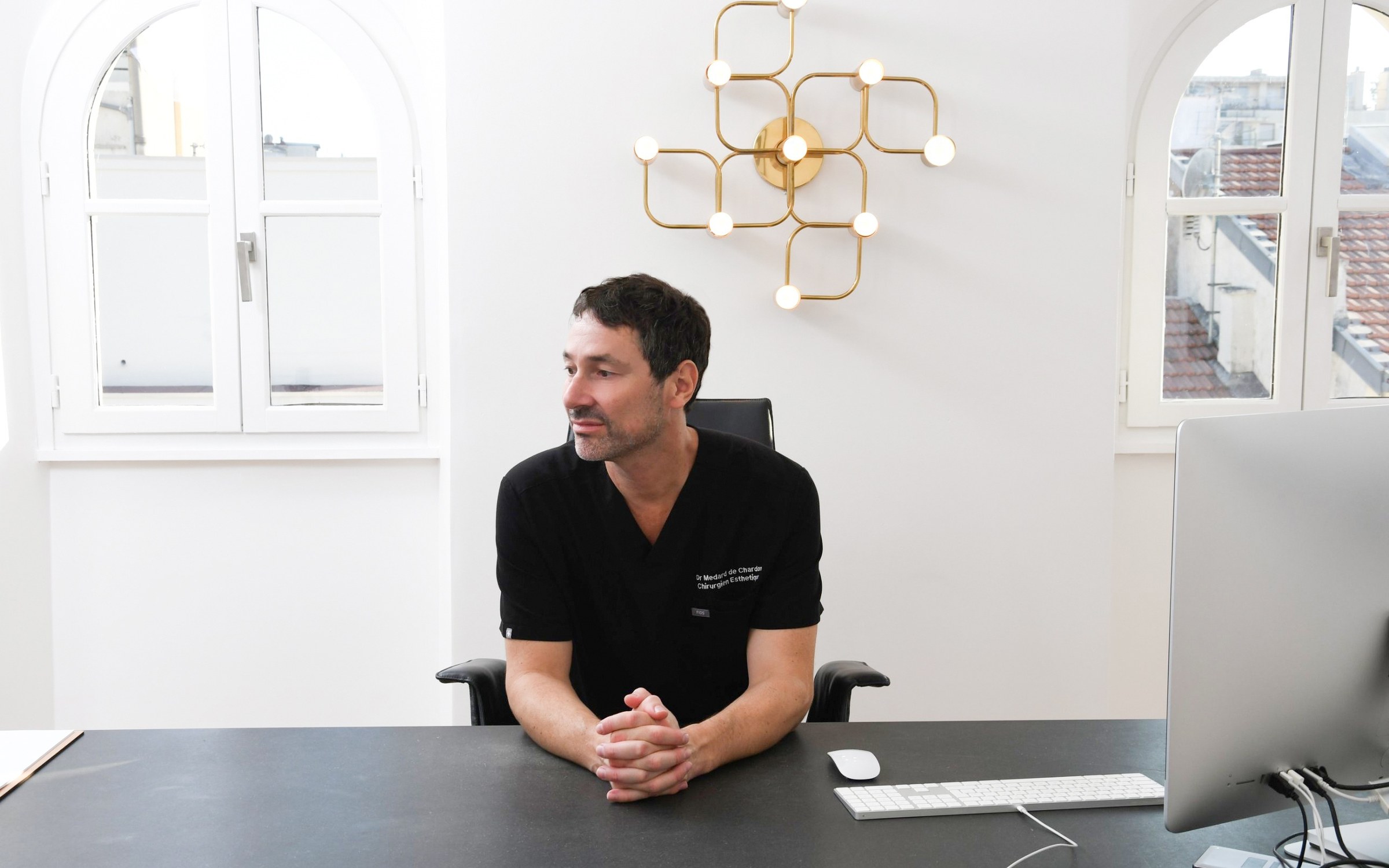
Dr Médard de Chardon operates at the Clinique Oxford in Cannes.
5. The consultation, the quote and the cooling-off period
A good consultation takes the time your request requires. The surgeon examines you, takes photographs, explains the technique, the alternatives, the benefits, the risks and the recovery, and gives you information sheets (those of the SOFCPRE, for example). The law requires the surgeon to inform you about the conditions of the operation, its risks and possible complications, and to give you a detailed written quote (article L. 6322-2 of the French Public Health Code), which states the name of the doctor or doctors who will operate.
A minimum period of 15 days must separate the handing over of the quote from the operation, with no exception possible, even at your request (article D. 6322-30). A surgeon who pressures you to commit is not the right person to deal with.
6. Price: compare like with like
Ask for the total price: surgeon’s and anaesthetist’s fees, clinic fees (operating theatre, room), implants or implanted materials, compression garment, follow-up consultations. A price far lower than the others should prompt you to check what is included; a high price does not, on its own, guarantee the quality of the result.
7. Warning signs
- no qualification that can be checked in the Ordre des médecins directory;
- an operation offered outside an authorised facility;
- no detailed quote, or an operation offered before the end of the 15-day period;
- a very short consultation, risks played down, a “guaranteed” result;
- promotions, time-limited offers, pressure to decide quickly;
- a surgeon you do not meet before the day of the operation.
8. Online reviews, forums and word of mouth
Word of mouth from someone you trust (your doctor, a friend or relative who has had surgery) remains valuable. Forums and online reviews should be read with caution: you do not always know who writes them, and the medical information found there is often incomplete or inaccurate.
Is there such a thing as the best cosmetic surgeon?
No. There is no “best surgeon” in absolute terms: the right surgeon is one who is qualified, experienced in the procedure that concerns you, and with whom you feel confident.
Dr Médard de Chardon’s qualifications
- Qualified plastic surgeon in plastic, reconstructive and aesthetic surgery, registered with the Ordre des médecins.
- Former Chef de Clinique (university hospital senior registrar), Nice Faculty of Medicine; MD thesis on breast augmentation (2008).
- Member of the SOFCEP (French Society of Aesthetic Plastic Surgery), the SOFCPRE and the ISAPS (International Society of Aesthetic Plastic Surgery).
- Practising in Cannes since 2011; operations at the Clinique Oxford in Cannes.
See Dr Médard de Chardon’s curriculum vitae.
Frequently asked questions
How can I tell whether a surgeon is qualified in cosmetic surgery?
Consult the Ordre des médecins directory or the Annuaire santé: they show the specialty and qualification of each doctor. Look for the qualification “chirurgie plastique, reconstructrice et esthétique” (plastic, reconstructive and aesthetic surgery).
Can an aesthetic doctor perform cosmetic surgery?
No. Aesthetic medicine (injections, lasers) is not a surgical qualification. Cosmetic surgery is reserved for qualified surgeons, in an authorised facility.
Is the 15-day period compulsory?
Yes. It is required by law between the handing over of the quote and the operation, with no exception possible, even if you ask for one.
How many consultations before deciding?
At least one consultation with the surgeon, often two, plus the anaesthetic consultation. Do not hesitate to ask all your questions and to consult several surgeons.
Sources
- French Public Health Code: articles L. 6322-1 (authorisation of cosmetic surgery facilities), L. 6322-2 (information and detailed quote), D. 6322-30 (15-day period), D. 6322-43 (doctors’ qualifications), L. 1142-2 (professional liability insurance).
- Conseil national de l’Ordre des médecins (French National Medical Council): directory of registered doctors.
- Annuaire santé (annuaire.sante.fr).