

Mondor’s disease at a glance
- AppearanceCord under the skin
- OnsetA few weeks after the operation
- FrequencyAbout 10% via the armpit
- CauseContraction of the fascia superficialis
- TreatmentAnti-inflammatories, massage
- RecoverySix weeks, with no lasting effects
Mondor’s disease is a “cord” under the skin, firm and sometimes painful, that appears a few weeks after breast surgery, on either side of the scar. It is common after breast augmentation via the armpit (about 10%), and rarer via the inframammary fold (the crease under the breast). It is not phlebitis, but a contraction of a thin membrane located under the skin (the fascia superficialis). It disappears in about six weeks, with no lasting effects, with anti-inflammatories and massage.
Price: no extra cost, included in the follow-up of the breast augmentation.
What is Mondor’s disease?
It is a cord, or band, stretched under the skin between different structures, on either side of the scar. It can occur after any breast surgery. It was long attributed to inflammation of a superficial vein (thrombophlebitis); it is in fact a contraction, after the operation, of the fascia superficialis, a thin membrane located under the skin.
After breast augmentation via the armpit, the cord runs from the arm (the fascia of the coracobrachialis muscle) to the chest (the superficial layer of the fascia of the pectoralis major muscle).
After an armpit approach: the cord (2) runs from the scar in the armpit (1) towards the arm and towards the chest. (default state).
- 1Scar
- 2Cord under the skin (Mondor’s disease)
How is it recognised?
The diagnosis is made on examination: a firm cord, sometimes painful, sometimes with a small dimple in the skin. It usually appears several weeks after the operation.
First described after breast augmentation via the armpit, where its frequency is reported to be about 10%, it can also occur after an inframammary approach, in the form of vertical cords under the skin.
Why does it occur?
It is linked to contraction of the superficial fascia. Dissection that is too superficial, just under the skin, is thought to make it worse by creating a band that adheres to the skin and contracts.
Can it be prevented?
To limit Mondor’s disease after breast augmentation via the armpit, four technical precautions matter:
- a horizontal, not vertical, incision;
- a clean incision, without undermining under the skin;
- an approach without monopolar electrocautery;
- no suturing of the fasciae when closing.
Even when these principles are followed, Mondor’s disease remains possible. Choosing a qualified, experienced and reputable surgeon reduces these risks, and can even eliminate some of them.
See also: the approaches (armpit, areola, inframammary fold) on the breast augmentation page.
How is it treated?
Treatment is medical: anti-inflammatories as tablets and/or gel, and massage. The symptoms disappear in about six weeks, with no lasting effects. Endermology (LPG) treatment, described in the literature, is reported to make the cord disappear in ten days.
Dr Médard de Chardon’s experience
- MD thesis on breast augmentation with implants (Nice Faculty of Medicine, 2008): this page is drawn from it.
- Breast augmentation via the armpit under endoscopic guidance, via the areola or via the inframammary fold.
- Qualified plastic surgeon in plastic, reconstructive and aesthetic surgery, former Chef de Clinique (university hospital senior registrar), Nice Faculty of Medicine; member of SOFCEP (French Society of Aesthetic Plastic Surgery), SOFCPRE (French Society of Plastic, Reconstructive and Aesthetic Surgery) and ISAPS (International Society of Aesthetic Plastic Surgery).
Photo: Mondor’s disease after the armpit approach
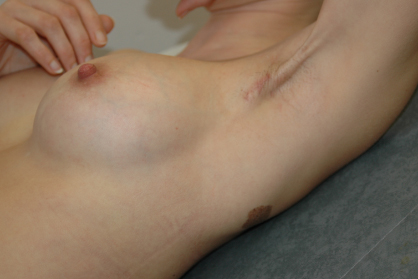
Mondor's disease after breast augmentation through the armpit
A cord under the skin, running from the armpit towards the chest
See breast augmentation before and after photos
Frequently asked questions about Mondor’s disease
Is Mondor’s disease serious?
No. It is a cord under the skin, bothersome and sometimes painful, which disappears in about six weeks, with no lasting effects.
Is Mondor’s disease a form of phlebitis?
No. This was long believed, but it is a contraction of a thin membrane located under the skin, the fascia superficialis.
When does Mondor’s disease appear?
Usually several weeks after the operation.
Is Mondor’s disease more common after breast augmentation via the armpit?
Yes: it is reported to affect about 10% of breast augmentations via the armpit. It can also occur after an inframammary approach, in the form of vertical cords.
How is Mondor’s disease treated?
With anti-inflammatories as tablets or gel, and massage. It disappears in about six weeks.
References
- Médard de Chardon V. MD thesis on breast augmentation. Nice Faculty of Medicine, University of Nice Sophia-Antipolis, 2008.
- Cornette de Saint Cyr B, Delmar H, Aharoni C. [Approach to augmentation mammaplasty]. Ann Chir Plast Esthet 2005; 50: 451-462.
- Chekaroua K, Trevidic P, Foyatier JL, et al. [Postoperative complications after breast implantation]. Ann Chir Plast Esthet 2005; 50: 544-553.
- Delmar H, Cornette de Saint Cyr B, Aharoni C. [Endoscopic axillary breast augmentation]. Ann Chir Plast Esthet 2005; 50: 463-475.
- Grolleau JL, Gangloff D, Garrido I, et al. [Mammary prosthesis: considerations about a choreography of the surgical procedure]. Ann Chir Plast Esthet 2005; 50: 524-533.