
Cannula or needle at a glance
- Entry pointOnly one per area
- TipRounded, does not cut
- BruisingLess than with a needle
- DepthBeneath the skin, against the bone
- AreasJawline, tear troughs, temples, cheekbones, cheeks, hands
- Needle preferredFine lines, lip border
Fillers such as hyaluronic acid are injected with a fine needle or a cannula. A cannula is a flexible tube with a rounded (blunt) tip: it does not cut the tissues and treats a whole area from a single entry point, with less bruising, less swelling and, in most areas, less pain. It also reduces the risk of injecting into a blood vessel, without eliminating it. It places the product deep, but cannot inject within the thickness of the skin: the needle is still preferred for fine lines and the lip border. The choice is made area by area.
Article from 2012, updated and brought into line with the injection pages.
1. What is a cannula?
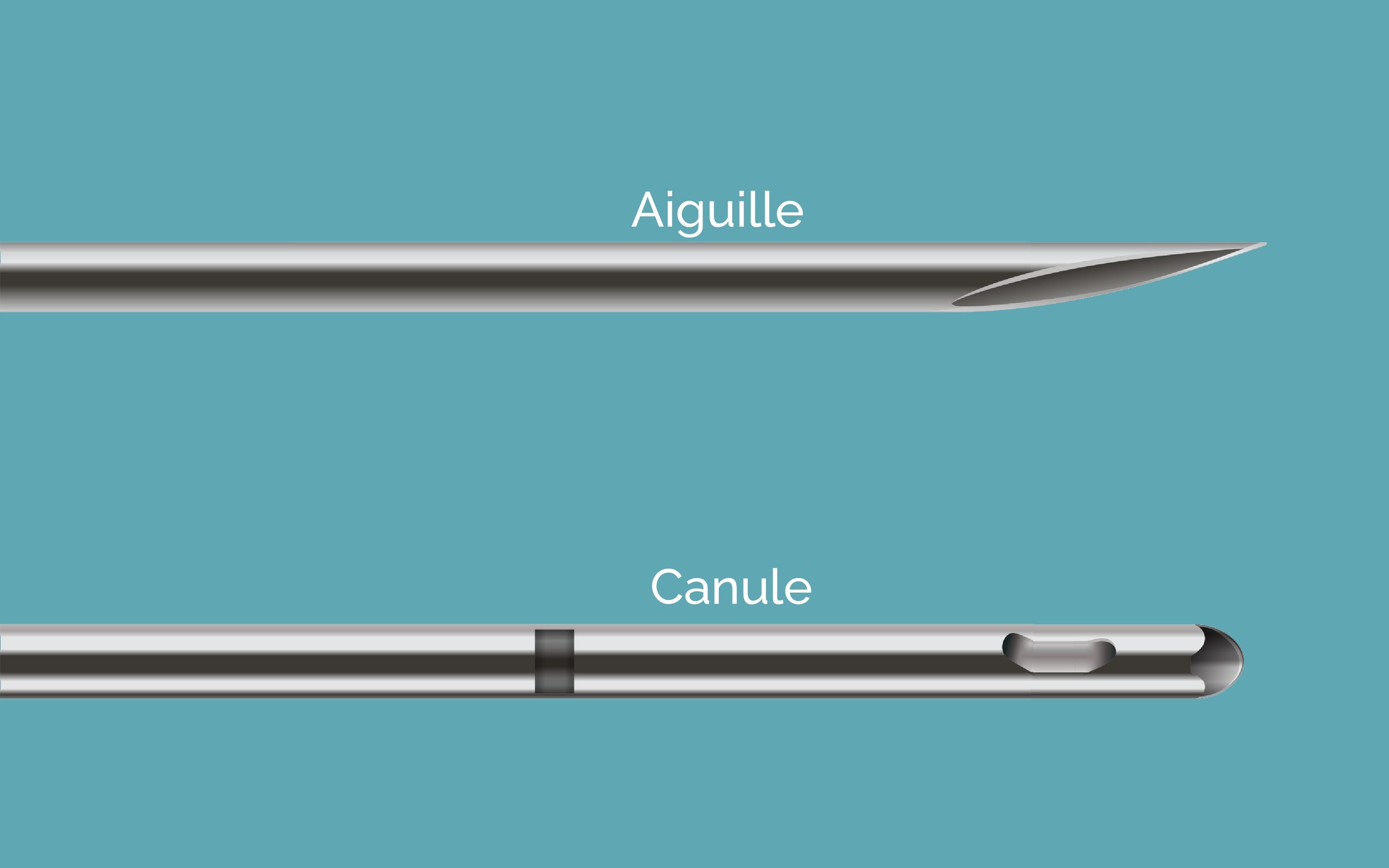
It is a thin, flexible tube with a rounded, closed tip, with an opening on the side near its end. A small needle prick creates an entry point in the skin; the cannula is inserted through it, then slid beneath the skin in a fan pattern to deposit the product over the whole area to be treated. Injection cannulas generally range from 14 to 27 G: the higher the number, the finer the cannula.
- 1Fine, pointed needle: several injection points; injection possible into the epidermis, dermis or fatty tissue
- 2Straight blunt-tipped cannula: a single entry point, the area treated in a fan pattern; injection possible only into the fatty tissue
2. Cannula or needle: the difference
| Fine needle | Blunt-tipped cannula | |
|---|---|---|
| Tip | Pointed, cuts the tissues | Rounded, pushes the tissues apart |
| Injection points | Several per area | Only one per area |
| Depth | Epidermis, dermis or fatty tissue | Below the dermis: fatty tissue, against the bone |
| Bruising, swelling | More frequent | Less frequent |
| Risk of injecting into a blood vessel | Higher | Reduced, but not zero |
| Precision at the surface | High (fine lines, lip border) | Low |
3. The advantages of the cannula
- comfort: a single entry point, and less pain in most areas;
- less bruising, swelling and redness, and therefore shorter social downtime;
- greater safety in high-risk areas, such as around the eyes: its rounded tip pushes blood vessels aside instead of piercing them, which reduces the risk of injecting into a vessel;
- even distribution of the product over a large area.
Choosing a qualified, experienced and reputable surgeon reduces these risks, and in some cases eliminates them.
4. The limitations of the cannula
- it cannot inject within the thickness of the dermis: it is not suitable for fine lines or for defining the lip border;
- it can be more uncomfortable than the needle in certain areas, such as the lips or marionette lines, and some patients prefer the feel of the needle;
- being flexible, it passes poorly through certain deep membranes, such as the one covering the temporal muscle; a more rigid cannula or the needle is then used.
5. Areas where the cannula is often preferred
- the jawline and jaw: with two entry points, the whole length of the jaw can be treated, to redefine the jawline or accentuate the angle;
- tear troughs: a single entry point on the cheekbone, and the gel is placed deep, against the bone, which limits bruising and the risk of injecting into a vessel;
- the temples;
- the cheekbones: a large area treated from a single entry point;
- the cheeks: the product is spread in thin layers, as for a skin booster;
- the backs of the hands.
The needle is still often preferred for the lip border and lip volume, marionette lines, fine lines, the nose and anchor points against the bone.
6. How does a cannula injection session go?
At the practice, in about 15 minutes: disinfection, anaesthetic cream and cold or local anaesthesia, a small prick for the entry point, then injection with the cannula and massage. You can resume your activities immediately. A small bruise at the entry point is possible.
7. What about fat injections?
Fat is also reinjected with a cannula, in thin layers: this is the principle of microlipostructure (micro fat grafting), which uses miniaturised cannulas.
See also: hyaluronic acid injections.
Frequently asked questions
Is a cannula injection less painful?
In most areas, yes: a single entry point and a rounded tip that does not cut the tissues. In some areas, such as the lips, the needle is sometimes better tolerated.
Does the cannula prevent bruising?
It reduces it considerably, without preventing it altogether: a small bruise at the entry point is still possible.
Is the cannula risk-free?
It reduces the risk of injecting into a blood vessel, without eliminating it. If a vessel becomes blocked, the hyaluronic acid is dissolved without delay with hyaluronidase.
Can the lips be injected with a cannula?
It is possible for volume, but the needle is still often preferred for defining the border.
Who chooses between needle and cannula?
The doctor, area by area, according to the injection depth, the patient’s anatomy and the product used; often, both are used during the same session.